Thank you for visiting SNEWPapers!
Sign up free
The Hillsborough Recorder
Hillsboro, Orange County, North Carolina
What is this article about?
On Washington's birthday, the narrator is interrupted while reading Ivanhoe by friends Homer Cosey and Bob Dashall, who drag him for a promenade in bustling Broadway. They observe dandies, fashionable ladies, and a pretentious tavern keeper's daughter posing as a belle. They meet Harry Headstrong, who invites them to a lavish dinner, and discuss the ethics of advertising for a wife amid social extravagance.
Clipping
OCR Quality
Full Text
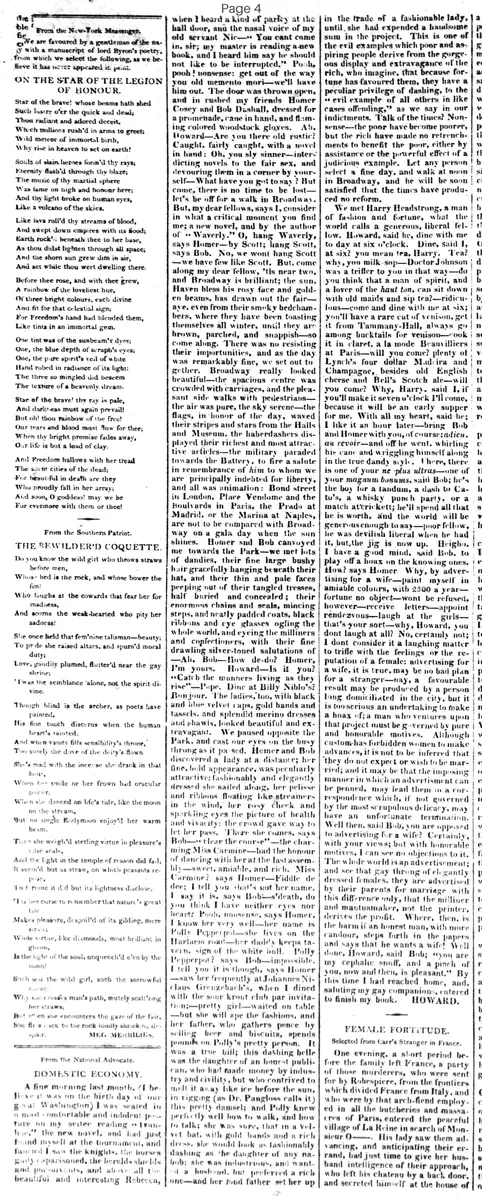
DOMESTIC ECONOMY.
A fine morning last month, (I believe it was on the birth day of our great Washington) I was seated in a most comfortable and indolent posture on my settee reading "Ivan-hoe" the new novel, and had just found myself at the tournament, and fancied I saw the knights, the horses gayly caparisoned, the heralds shields and poursuivants, and above all the beautiful and interesting Rebecca,
when I heard a kind of parer at the hall door, and the nasal voice of my old servant Nic—"You cant come in, sir: my master is reading a new book, and I heard him say he should not like to be interrupted." Pooh, pooh! nonsense: get out of the way you old memento mori—we'll have him out. The door was thrown open, and in rushed my friends Homer Cosey and Bob Dashall, dressed for a promenade, cane in hand, and donning colored Woodstock gloves. Ah, Howard—Are you there old rustic? Caught, fairly caught, with a novel in hand: Oh, you sly sinner—interdicting novels to the fair sex, and devouring them in a corner by yourself—What have you got to say? But come: there is no time to be lost—let's be off for a walk in Broadway.
But, my dear fellows, says I, consider in what a critical moment you find me; a new novel, and by the author of "Waverly." O, hang Waverly, says Homer—by Scott; hang Scott, says Bob. No, we wont hang Scott we have few like Scott. But come along my dear fellow, 'tis near two, and Broadway is brilliant; the sun, Heaven bless his rosy face and golden beams, has drawn out the fair—aye, even from their smoky bedchambers, where they have been toasting themselves all winter, until they are brown, parched, and snappish—so come along. There was no resisting their importunities, and as the day was remarkably fine, we set out together. Broadway really looked beautiful—the spacious centre was crowded with carriages, and the pleasant side walks with pedestrians—the air was pure, the sky serene—the flags, in honor of the day, waved their stripes and stars from the Halls and Museum, the haberdashers displayed their richest and most attractive articles—the military paraded towards the Battery, to fire a salute in remembrance of him to whom we are principally indebted for liberty, and all was animation: Bond street in London, Place Vendome and the Boulevards in Paris, the Prado at Madrid, or the Marina at Naples, are not to be compared with Broadway on a gala day when the sun shines. Homer and Bob convoyed me towards the Park—we met lots of dandies, their fine large bushy hair gracefully hanging beneath their hat, and their thin and pale faces peeping out of their tangled tresses, half buried and concealed; their enormous chains and seals, mincing steps, and neatly padded coats, black ribbons and eye glasses ogling the whole world, and eyeing the milliners and confectioners, with their fine drawling silver-toned salutations of—Ah, Bob—how de-do? Homer, I'm yours. Howard—Is it you? "Catch the manners living as they rise"—Pope. Dine at Billy Niblo's? Bon jour. The ladies, too, with black and blue velvet caps, gold bands and tassels, and splendid merino dresses and shawls, looked beautiful and extravagant. We paused opposite the Park, and cast our eyes on the busy throng as it passed. Homer and Bob discovered a lady at a distance; her fine, bold appearance, was peculiarly attractive: fashionably and elegantly dressed she sailed along, her pelisse and ribbons floating like streamers in the wind, her rosy cheek and sparkling eyes the picture of health and vivacity: the crowd gave way to let her pass. There she comes, says Bob—clear the course—the charming Miss Carmine—had the honour of dancing with her at the last assembly—sweet, amiable, and rich. Miss Carmine? says Homer—Fiddle de dee; I tell you that's not her name. I say it is, says Bob—'sdeath, do you think I have neither eyes nor heart? Pooh, nonsense, says Homer, I know her very well—her name is Polly Pepperpot—she lives on the Harlem road—her daddy keeps tavern, sign of the white mill. Polly Pepperpot? says Bob—impossible. I tell you it is though, says Homer—saw her frequently at Johannes Nidlaus Grenzcbach's, when I dined with the sour krout club par invitation;—pretty girl—waited on table—but she will ape the fashions, and her father, who gathers pence by selling beer and biscuits, spends pounds on Polly's pretty person. It was a true bill; this dashing belle was the daughter of an honest publican, who had made money by industry and civility, but who contrived to melt it away like ice before the sun, in rigging (as Dr. Pangloss calls it) this pretty damsel; and Polly knew perfectly well how to walk, and how to talk; she was sure, that in a velvet hat, with gold bands and a rich dress, she would look as fashionably dashing as the daughter of any nabob: she was industrious, and wanted a husband, but preferred a rich one—and her fond father set her up in the trade of a fashionable lady, until she had expended a handsome sum in the project. This is one of the evil examples which poor and aspiring people derive from the gorgeous display and extravagance of the rich, who imagine, that because fortune has favoured them, they have a peculiar privilege of dashing, to the evil example of all others in like cases offending," as we say in our indictments. Talk of the times? Non-sense—the poor have become poorer, but the rich have made no retrenchments to benefit the poor, either by assistance or the powerful effect of a judicious example. Let any person select a fine day, and walk at noon in Broadway, and he will be soon satisfied that the times have produced no reform.
We met Harry Headstrong, a man of fashion and fortune, what the world calls a generous, liberal fellow. Howard, said he, dine with me to day at six o'clock. Dine, said I, at six? you mean tea, Harry. Tea? why, you milk-sop—Doctor Johnson was a trifler to you in that way—do you think that a man of spirit, and a lover of the haut ton, can sit down with old maids and sip tea?—ridiculous—come and dine with me at six; you'll have a rare cut of venison, get it from Tammany-Hall, always go among bucktails for venison—cook it in claret, a la mode Beauvilliers at Paris—will you come? plenty of Lynch's four dollar Madeira and Champagne, besides old English cheese and Bell's Scotch ale—will you come? Why, Harry, said I, if you'll make it seven o'clock I'll come, because it will be an early supper for me. With all my heart, said he: I like it an hour later—bring Bob and Homer with you, of course: adieu, au revoir—and off he went, whirling his cane and wriggling himself along in the true dandy style. There, there is one of your ne plus ultras—one of your magnum bonums, said Bob; he's the boy for a tandem, a dash to Cato's, a whisky punch party, or a match at cricket; he'll spend all that he is worth, and the world will be generous enough to say—poor fellow, he was devilish liberal when he had it, but the jig is now up. Heigho.
I have a good mind, said Bob, to play off a hoax on the knowing ones. How? says Homer. Why, by advertising for a wife—paint myself in amiable colours, with £2500 a year—fortune no object—wont be refused, however—receive letters—appoint rendezvous—laugh at the girls—that's your sort—why, Howard, you dont laugh at all? No, certainly not; I dont consider it a laughing matter to trifle with the feelings or the reputation of a female: advertising for a wife, it is true, may be no bad plan for a stranger—nay, a favourable result may be produced by a person long domiciliated in the city, but it is too serious an undertaking to make a hoax of; a man who ventures upon that project must be governed by pure and honorable motives. Although custom has forbidden women to make advances, it is not to be inferred that they do not expect or wish to be married; and it may be that the imposing manner in which an advertisement can be penned, may lead them to a correspondence which, if not governed by the most scrupulous delicacy, may have an unfortunate termination.
Well then, said Bob, you are opposed to advertising for a wife? Certainly, with your views; but with honorable motives, I can see no objections to it. The whole world is an advertisement; and see that gay throng of elegantly dressed females, they are advertised by their parents for marriage with this difference only, that the milliner and mantuamaker, not the printer, derives the profit. Where, then, is the harm if an honest man, with more candour, steps forth in the papers and says that he wants a wife! Well done, Howard, said Bob; you are my cephalic snuff, and a pinch of you, now and then, is pleasant. By this time I had reached home, and, saluting my gay companions, entered to finish my book.
HOWARD.
What sub-type of article is it?
What themes does it cover?
What keywords are associated?
What entities or persons were involved?
Where did it happen?
Story Details
Key Persons
Location
Broadway, New York
Event Date
Last Month, On The Birthday Of Washington
Story Details
Narrator Howard is interrupted reading Ivanhoe by friends Homer and Bob, who take him for a walk in Broadway on Washington's birthday. They observe dandies, ladies, and debate the identity of a fashionable woman as Polly Pepperpot, daughter of a tavern keeper aping high society. They meet extravagant Harry Headstrong inviting them to dinner and discuss the ethics of advertising for a wife as a serious matter, not a hoax.