Thank you for visiting SNEWPapers!
Sign up free
Daily National Intelligencer
Washington, District Of Columbia
What is this article about?
On January 6, 1823, the U.S. Senate debated but advanced a bill remitting duties on a painting for Pennsylvania Hospital. The House extensively debated and passed a bill fixing members' daily pay at $8 (down from $9 proposed) and travel allowance at $8 per 20 miles.
Merged-components note: These two components form a single continuous report on congressional proceedings regarding member compensation.
Clippings
1 of 2
OCR Quality
Full Text
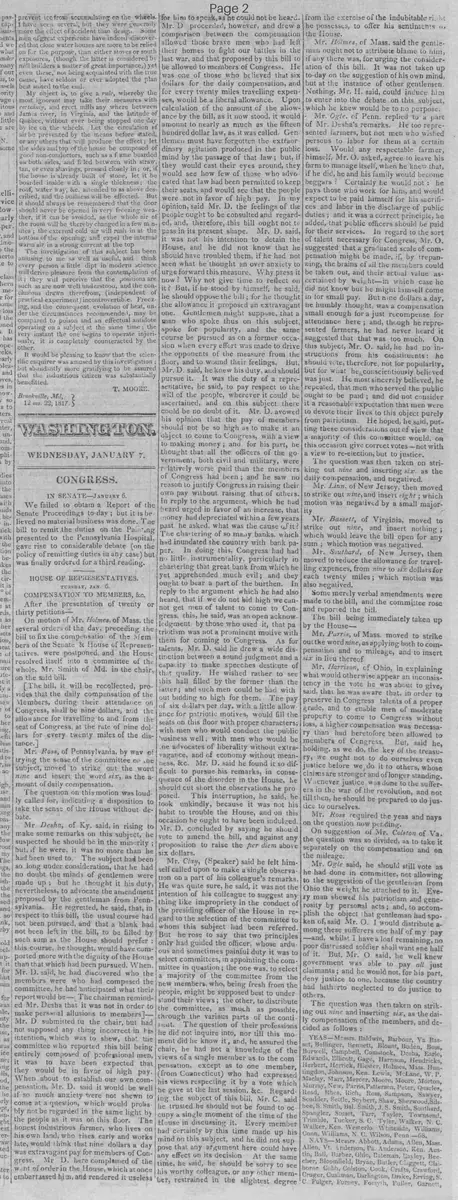
WEDNESDAY, JANUARY 7.
CONGRESS.
IN SENATE—JANUARY 6.
We failed to obtain a Report of the Senate Proceedings to-day; but it is believed no material business was done. The bill to remit the duties on the Painting presented to the Pennsylvania Hospital, gave rise to considerable debate (on the policy of remitting duties in any case) but was finally ordered for a third reading.
HOUSE OF REPRESENTATIVES.
TUESDAY, JAN. 6.
COMPENSATION TO MEMBERS, &c.
After the presentation of twenty or thirty petitions
On motion of Mr. Holmes, of Mass. the several orders of the day, preceding the bill to fix the compensation of the Members of the Senate & House of Representatives, were postponed, and the House resolved itself into a committee of the whole, Mr. Smith of Md. in the chair, on the said bill.
The bill, it will be recollected, provides that the daily compensation of the Members, during their attendance on Congress, shall be nine dollars, and the allowance for travelling to and from the seat of Congress, at the rate of nine dollars for every twenty miles of the distance.
Mr. Ross, of Pennsylvania, by way of trying the sense of the committee on the subject, moved to strike out the word nine and insert the word six, as the amount of daily compensation.
The question on this motion was loudly called for, indicating a disposition to take the sense of the House without debate.
Mr. Desha, of Ky. said, in rising to make some remarks on this subject, he suspected he should be in the minority; but, if he were, it was no more than he had been used to. The subject had been so long under consideration, that he had no doubt the minds of gentlemen were made up; but he thought it his duty, nevertheless, to advocate the amendment proposed by the gentleman from Pennsylvania. He regretted, he said, that, in respect to this bill, the usual course had not been pursued, and that a blank had not been left in the bill, to be filled by such sum as the House should prefer: this course, he thought, would have comported more with the dignity of the House than that which had been pursued. When, Mr. D. said, he had discovered who the members were who had composed the committee, he had anticipated what their report would be— The chairman reminded Mr. Desha that it was not in order to make personal allusions to members— Mr. D. submitted to the chair, but had not supposed any thing incorrect in his intention, which was to shew, that the committee who reported this bill being entirely composed of professional men, it was to have been expected that they would be in favor of high pay.
When about to establish our own compensation, Mr. D. said it would be well if so much anxiety were not shewn to come at a question, which would probably not be regarded in the same light by the people as it was on this floor. The honest industrious farmer, who lives on his own land, who rises early and works late, would think that nine dollars a day was extravagant pay for members of Congress. Mr. D. here complained of the want of order in the House, which at once embarrassed him, and rendered it useless for him to speak, as he could not be heard.
Mr. D proceeded, however, and drew a comparison between the compensation allowed those brave men who had left their homes to fight our battles in the last war, and that proposed by this bill to be allowed to members of Congress. He was one of those who believed that six dollars for the daily compensation, and for every twenty miles travelling expenses, would be a liberal allowance. Upon calculation of the amount of the allowance by the bill, as it now stood, it would amount to nearly as much as the fifteen hundred dollar law, as it was called. Gentlemen must have forgotten the extraordinary agitation produced in the public mind by the passage of that law; but, if they would cast their eyes around, they would see how few of those who advocated that law had been permitted to keep their seats, and would see that the people were not in favor of high pay. In my opinion, said Mr. D. the feelings of the people ought to be consulted and regarded, and, therefore, this bill ought not to pass in its present shape. Mr. D. said, it was not his intention to detain the House, and he did not know that he should have troubled them, if he had not seen what he thought an over anxiety to urge forward this measure. Why press it now? Why not give time to reflect on it? But, if he stood by himself, he said, he should oppose the bill; for he thought the allowance it proposed an extravagant one. Gentlemen might suppose, that a man who spoke thus on this subject, spoke for popularity, and the same course be pursued as on a former occasion when every effort was made to drive the opponents of the measure from the floor, and to wound their feelings. But, Mr. D. said, he knew his duty, and should pursue it. It was the duty of a representative, he said, to pay respect to the will of the people, wherever it could be ascertained, and on this subject there could be no doubt of it. Mr. D. avowed his opinion that the pay of members should not be so high as to make it an object to come to Congress, with a view to making money; and for his part, he thought that all the officers of the government, both civil and military, were relatively worse paid than the members of Congress had been; and he saw no reason to justify Congress in raising their own pay without raising that of others.
In reply to the argument, which he had heard urged in favor of an increase, that money had depreciated within a few years past he asked, what was the cause of it? The chartering of so many banks, which had inundated the country with bank paper. In doing this, Congress had had no little instrumentality, particularly in chartering that great bank from which he yet apprehended much evil; and they ought to bear a part of the burthen. In reply to the argument which he had also heard, that if we do not bid high we cannot get men of talent to come to Congress, this, he said, was an open acknowledgment by those who used it, that patriotism was not a prominent motive with them for coming to Congress. As for talents, Mr. D. said he drew a wide distinction between a sound judgment and a capacity to make speeches destitute of that quality. He wished rather to see this hall filled by the former than the latter; and such men could be had without bidding so high for them. The pay of six dollars per day, with a little allowance for patriotic motives, would fill the seats on this floor with proper characters; with men who would conduct the public business well; with men who would be the advocates of liberality without extravagance, and of economy without meanness, &c. Mr. D. said he found it so difficult to pursue his remarks, in consequence of the disorder in the House, he should cut short the observations he proposed. This interruption, he said, he took unkindly, because it was not his habit to trouble the House, and on this occasion he ought to have been indulged.
Mr. D. concluded by saying he should vote to amend the bill, and against any proposition to raise the per diem above six dollars.
Mr. Clay, (Speaker) said he felt himself called upon to make a single observation on a part of his colleague's remarks. He was quite sure, he said, it was not the intention of his colleague to suggest any thing like impropriety in the conduct of the presiding officer of the House in regard to the selection of the committee to whom this subject had been referred. But he rose to say that two principles only had guided the officer, whose arduous and sometimes painful duty it was to select committees, in appointing the committee in question; the one was, to select a majority of the committee from the new members, who, being fresh from the people, might be supposed best to understand their views; the other, to distribute the committee, as much as possible, through the various parts of the continent. The question of their professions he did not inquire into, nor till this moment did he know it, and, he assured the chair, he had not a knowledge of the views of a single member as to the compensation, except as to one member, (from Connecticut) who had expressed his views respecting it by a vote which he gave at the last session, &c.
Regarding the subject of this bill, Mr. C. said he trusted he should not be found to occupy a single moment of the time of the House in discussing it. Every member had certainly by this time made up his mind on this subject, and he did not suppose that any argument here could have any effect on its decision. At the same time, he said, he should be sorry to see his worthy colleague, or any other member, restrained in the slightest degree from the exercise of the indubitable right he possesses, to offer his sentiments to the House.
Mr. Holmes, of Mass. said the gentleman ought not to attribute blame to him, if any there was, for urging the consideration of this bill. It was not taken up to-day on the suggestion of his own mind, but at the instance of other gentlemen. Nothing, Mr. H. said, could induce him to enter into the debate on this subject, which he knew would be to no purpose.
Mr. Ogle, of Penn. replied to a part of Mr. Desha's remarks. He too represented farmers, but not men who wished persons to labor for them at a certain loss. Would any respectable farmer, himself, Mr. O. asked, agree to leave his farm to manage itself, when he knew that, if he did, he and his family would become beggars? Certainly he would not: he pays those who work for him, and would expect to be paid himself for his sacrifices and labor in the discharge of public duties; and it was a correct principle, he added, that public officers should be paid for their services. In regard to the sort of talent necessary for Congress, Mr. O. suggested that a graduated scale of compensation might be made, if, by trepanning, the brains of all the members could be taken out, and their actual value ascertained by weight—in which case he did not know but he might himself come in for small pay. But nine dollars a day, he humbly thought, was a compensation small enough for a just recompense for attendance here; and, though he represented farmers, he had never heard it suggested that that was too much. On this subject, Mr, O. said, he had no instructions from his constituents: he should vote, therefore, not for popularity, but for what he, conscientiously believed was just. He most sincerely believed, he repeated, that men who served the public ought to be paid; and did not consider it a reasonable expectation that men were to devote their lives to this object purely from patriotism. He hoped, he said, putting these considerations out of view that a majority of this committee would, on this occasion give correct votes—not with a view to re-election, but to justice.
The question was then taken on striking out nine and inserting six, as the daily compensation, and negatived.
Mr. Linn, of New Jersey, then moved to strike out nine, and insert eight; which motion was negatived by a small majority.
Mr. Bassett, of Virginia, moved to strike out nine, and insert nothing; which would leave the bill open for any sum; which motion was negatived.
Mr. Southard, of New Jersey, then moved to reduce the allowance for travelling expences, from nine to six dollars for each twenty miles; which motion was also negatived.
Some merely verbal amendments were made to the bill, and the committee rose and reported the bill.
The bill being immediately taken up by the House—
Mr. Parris, of Mass. moved to strike out the word nine, as applying both to compensation and to mileage, and to insert six in lieu thereof.
Mr. Harrison, of Ohio, in explaining what would otherwise appear an inconsistency in the vote he was about to give, said, that he was aware that, in order to preserve in Congress talents of a proper grade, and to enable men of moderate property to come to Congress without loss, a higher compensation was necessary than had heretofore been allowed to members of Congress. But, said he, holding, as we do, the key of the treasury, we ought not to do ourselves even justice before we do it to others, whose claims are stronger and of longer standing. Whenever justice was done to the sufferers in the war of the revolution, and not till then, he should be prepared to do justice to ourselves.
Mr. Ross required the yeas and nays on the question now pending.
On suggestion of Mr. Colston of Va. the question was so divided, as to take it separately on the compensation and on the mileage.
Mr. Ogle said, he should still vote as he had done in committee, not allowing to the suggestion of the gentleman from Ohio the weight he attached to it. Every man shewed his patriotism and generosity by personal acts; and, to accomplish the object that gentleman had spoken of, said Mr. O. I would distribute among these sufferers one half of my pay—and, whilst I have a loaf remaining, no poor distressed soldier shall want one half of it. But, Mr. O said, he well knew government was able to pay all just claimants; and he would not, for his part, deny justice to one, because the country had hitherto neglected to do justice to others.
The question was then taken on striking out nine and inserting six, as the daily compensation of the members, and decided as follows:
YEAS—Messrs. Baldwin, Barbour, Va. Bassett, Bellinger, Bennett, Blount, Boden, Boss, Burwell, Campbell, Comstock, Desha, Earle, Edwards, Ellicott, Gage, Harrison, Hendricks, Herbert, Herrick, Hiester, Holmes, Mass. Huntington, Johnson, Ken. Lewis, McLane, W. P. Maclay, Marr, Mercer, Moore, Moore, Morton, Murray, New, Parris, Patterson, Peter, Quarles, Read, Rhea, Rich, Ross, Sampson, Sawyer, Scudder, Settle, Seybert, Shaw, Sherwood, Silsbee, S. Smith, Bal. Smith, J. S. Smith, Southard, Spangler, Stuart, Tarr, Taylor, Townsend, Trimble, Tucker, S. C. Tyler, Walker. N. C. Walker, Ken. Westerlo Whiteside, Williams, Conn. Williams, N. C. Wilson, Penn.—68.
NAYS—Messrs. Abbott, Adams, Allen, Mass. Allen, Vt. Anderson, Pa. Anderson, Ken. Austin, Ball, Barber, Ohio, Bateman, Bayley, Beecher, Bloomfield, Bryan, Butler, Claggett, Claiborne Cobb, Colston, Cook, Crafts, Crawford. Cruger, Cushman, Darlington, Drake, Erving, S. C. Folger, Forney, Forsyth, Fuller, Garnett,
YEAS.—Messrs. Hale, Hall, N. C. Hasbrouck, Herkimer, Hitchcock, Hogg, Holmes, Conn. Hopkinson, Hubbard, Hunter, Irving, N. Y. Jones, Kinsey, Kirtland, Lawyer, Linn, Little, Livermore, Lowndes, Va. Maclay, McCoy, Marchand, Mason, Mass. Merrill, Middleton, Miller, Mosely, Mumford, Jer. Nelson, H. Nelson, T. M. Nelson, Nesbit, Ogle, Orr, Owen, Palmer, Parrott, Pawling, Pindall, Pitkin, Pleasants, Poindexter, Porter, Richards, Ringgold, Robertson, Ky. Robertson, La. Ruggles, Savage, Schuyler, Slocumb, Alex. Smyth, Speed, Spencer, Storrs, Strong, Strother, Tallmadge, Terrell, Terry, Tompkins, Tucker, Va. Upham, Wallace, Wendover, Whitman, Williams, N. Y. Wilkins—101.
So the motion was negatived.
The question was then taken on striking out nine and inserting six dollars as the allowance for every 20 miles travel to and from Congress; which motion was decided by Yeas and Nays, as follows:
For the amendment—93
Against it—76
So this amendment was carried.
Mr. Little, of Maryland, then moved to strike out nine and insert in lieu thereof eight dollars as the daily pay.
Mr. Bassett said that he had voted against eight dollars in the committee of the whole, because he preferred six. He should now vote for eight, because he could not succeed in obtaining six.
Mr. Poindexter, of Mississippi, said, that, as the travelling allowance had been reduced to six, the pay ought to be reduced to the same rate; for that certainly the travelling was the most laborious part of the duty to perform for those who lived at any distance from the seat of government.
Mr. Johnson, of Kentucky, concurred entirely in the opinion, that the travelling was the hardest part of the Representative's duty, in a pecuniary view, and for which members had not heretofore been sufficiently paid. There were occasions on which we were under an obligation to perform gratuitous services for our country; but surely this was not one of them. He too, he said, should vote for the reduction of the pay, because he hoped the mileage and the pay, whatever they were fixed at, should be at the same rate.
The question on reducing the daily pay from nine to eight dollars, was then decided as follows:
YEAS.—Messrs. Allen, Vt. Anderson, Pa. Austin, Baldwin, Ball, Barbour, Va. Bassett, Bateman, Bayley, Bellinger, Bennett, Bloomfield, Blount, Boden, Boss, Burwell, Campbell, Claiborne, Comstock, Cook, Crafts, Cruger, Desha, Drake, Earle, Edwards, Ellicott, Erving, S. C. Floyd, Gage, Garnett, Hale, Harrison, Hendricks, Herbert, Herkimer, Herrick, Hiester, Hitchcock, Holmes, Mass. Huntingdon, Johnson, Ky. Lewis, Linn, Little, Livermore, M'Lane, Va. Maclay, W. P. Maclay, Marr, Merrill, Moore, Morton, Ill. Nelson, T. M. Nelson, New, Parris, Peter, Pleasants, Poindexter, Porter, Quarles, Reed, Rhea, Rich, Richards, Robertson, La. Ross, Sampson, Savage, Scudder, Settle, Seybert, Shaw, Sherwood, S. Smith, Bal. Smith, J. S. Smith, Southard, Spangler, Speed, Tarr, Taylor, Tompkins, Townsend, Trimble, Tucker, Va. Tucker, S. C. Tyler, Upham, Walker, N. C. Walker, Ky. Wallace, Westerlo, Whiteside, Williams, Conn. Williams, N. C. Wilkin, Wilson, Pa.—99.
NAYS.—Messrs. Abbot, Adams, Allen, Mass. Anderson, Ky. Barber, Ohio, Beecher, Bryan, Butler, Clagett, Cobb, Colston, Crawford, Cushman, Darlington, Folger, Forney, Forsyth, Fuller, Hall, Del. Hall, N. C. Hasbrouck, Hogg, Holmes, Conn. Hopkinson, Hubbard, Hunter, Irving, N. Y. Jones, Kinsey, Kirtland, Lawyer, Lowndes, M'Coy, Marchand, Mason, Mass. Mercer, Middleton, Miller, Mosely, Mumford, Murray, Nesbitt, Ogle, Orr, Owen, Palmer, Parrott, Patterson, Pawling, Pindall, Pitkin, Ringgold, Robertson, Ky. Ruggles, Sawyer, Schuyler, Silsbee, Slocumb, Alex. Smyth, Spencer, Storrs, Strong, Strother, Stuart, Tallmadge, Terrell, Terry, Wendover, Whitman, Williams, N. Y.—70.
So the daily pay was fixed at eight dollars.
Mr. Little then moved to reconsider the vote by which the travelling expenses had been reduced to six dollars, with a view to fix it at eight; which would make it stand on the same footing as heretofore, but at a little higher rate.
Mr. Strother, of Virginia, intimated, for the information of the House, that he meant, when he had an opportunity, to move to strike out eight and insert six dollars for the daily pay, and for reasons he assigned. His wish had been, he said, that ample compensation should be given for services rendered; that, in discharging their important duty, the members of this body should be able to support themselves independently. Finding, however, that his views could not be accomplished, he would bend to what the House had been assured was public opinion; he would sacrifice the conviction of his mind to the momentary feeling of the country. It had been said, by a gentleman from Kentucky (Mr. Johnson) whose remarks would always have weight with him, that the duty of travelling was the most laborious a Representative had to perform. That gentleman, said Mr. S. has had a wide experience; with industry unceasing, and honesty unsuspected, he has been for many years attending the duties of his station here—and his opinion is entitled to weight. If therefore six dollars was considered by the House as sufficient allowance for mileage, it was all-sufficient as a recompense to the members when stationary here. Being about to take a course, which, connected with his former votes, would, without explanation, assume the appearance of discrepancy—an idea he abhorred as an individual or as a member, he had thought it his duty to make these remarks. They were drawn from him by the necessity which every man in public life is under, to keep far from him the suspicion of a want of firmness, or of vacillating policy.
Mr. Little thought it necessary, after what the gentleman had said, to shew that such conduct as he had referred to was certainly not imputable to him. (Mr. L.) I did indeed, said he, vote to strike out nine and insert six, not that that sum accorded with my views, which were to fill up the blank for pay and that for mileage, each with eight dollars. This was a matter of opinion, on which men must judge for themselves. Having himself acted consistently, he imputed no incorrect motives to others, and he hoped none would be imputed to him.
Mr. Comstock, of New-York, said he should vote in favor of the proposed reconsideration. His mind had arrived at the conclusion, that the compensation ought to be eight dollars per diem for attendance, and eight dollars for every twenty miles travel. When the question was between 9 and 6, he had voted to strike out nine, but with the wish that eight should be ultimately substituted for it.
Mr. Harrison also favored the motion for reconsideration, which he supported by forcible arguments. Gentlemen living on the stage line, he said, whose votes had carried the reduction from 9 to 6, were perfectly unapprized, he believed, of the expenses and labors of those who were obliged to travel wretched roads with their own horses, &c.
Mr. Pitkin, of Connecticut, declared himself of the opinion that the allowances for pay and for mileage ought to be the same. This principle had been long settled, approved, and acquiesced in: and he hoped would not now be varied. He hoped, therefore, gentlemen would not be deterred from voting for a reconsideration of the former vote on this point, by any consideration foreign to the merits of the question.
The question on reconsideration was then taken, and decided in the affirmative, and the allowance for mileage was fixed at eight dollars for every 20 miles, by a considerable majority.
Mr. Strother then rose to make the motion he had indicated, to strike out the word eight and insert six (dollars) as the daily pay: but the motion was decided to be out of order, the House having already refused to insert the word six.
Some verbal amendments, involving no principle, but which produced considerable conversation, were then disposed of.
The question having been stated, "Shall the bill be engrossed and read a third time?"
Mr. Storrs, of New-York, said he should vote for the bill, embracing an allowance of eight dollars per day: in so doing he sacrificed his own opinion, which was in favor of a higher sum. He was the more induced, however, to agree to vote for the rate of eight dollars, because no gentleman who was of the committee which reported that bill, had expressed himself in favor of a lower rate of allowance than that now established by the bill, of eight dollars per day, and eight dollars for mileage.
Mr. Holmes, of Massachusetts, begged leave to correct the gentleman; for he had himself been in favor of six dollars per day, and six dollars for travelling allowance.
After an unsuccessful motion by Mr. Cobb to adjourn, and an equally unsuccessful attempt by Mr. Morton, to have the Yeas and Nays ordered on the question—
The bill was ordered to be engrossed for a third reading to-morrow, without a division; and
The House adjourned.
What sub-type of article is it?
What keywords are associated?
What entities or persons were involved?
Where did it happen?
Domestic News Details
Primary Location
Washington
Event Date
Tuesday, Jan. 6
Key Persons
Outcome
the house passed the bill fixing daily compensation at eight dollars and travel allowance at eight dollars per twenty miles, reducing from the proposed nine dollars. the senate ordered a bill remitting duties on a painting for third reading after debate.
Event Details
The Senate had no material business but debated remitting duties on a painting for Pennsylvania Hospital. In the House, after postponing other business, members debated a bill to set congressional compensation at nine dollars daily and per twenty miles travel. Amendments to reduce to six or eight dollars were proposed and voted on, with speeches on public opinion, farmer perspectives, patriotism, and comparisons to soldiers' pay. The House fixed pay at eight dollars and mileage at eight dollars per twenty miles after votes and reconsiderations.