Thank you for visiting SNEWPapers!
Sign up free
Story
January 31, 1954
Atlanta Daily World
Atlanta, Fulton County, Georgia
What is this article about?
A Black juror in the South experiences racial segregation during a meal break at a downtown restaurant, forced to eat in the kitchen while white jurors dine freely, prompting reflections on inherited customs and advancing civil rights.
Clipping
OCR Quality
98%
Excellent
Full Text
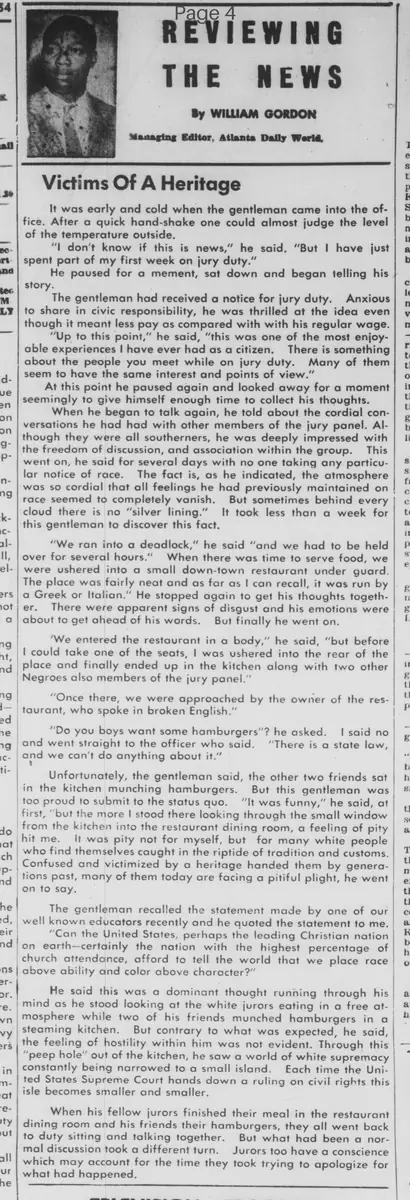
REVIEWING THE NEWS
By WILLIAM GORDON
Managing Editor, Atlanta Daily World
Victims Of A Heritage
It was early and cold when the gentleman came into the office. After a quick hand-shake one could almost judge the level of the temperature outside.
"I don't know if this is news," he said. "But I have just spent part of my first week on jury duty."
He paused for a moment, sat down and began telling his story.
The gentleman had received a notice for jury duty. Anxious to share in civic responsibility, he was thrilled at the idea even though it meant less pay as compared with his regular wage.
"Up to this point," he said, "this was one of the most enjoyable experiences I have ever had as a citizen. There is something about the people you meet while on jury duty. Many of them seem to have the same interest and points of view."
At this point he paused again and looked away for a moment seemingly to give himself enough time to collect his thoughts.
When he began to talk again, he told about the cordial conversations he had had with other members of the jury panel. Although they were all southerners, he was deeply impressed with the freedom of discussion, and association within the group.
This went on, he said for several days with no one taking any particular notice of race. The fact is, as he indicated, the atmosphere was so cordial that all feelings he had previously maintained on race seemed to completely vanish. But sometimes behind every cloud there is no "silver lining." It took less than a week for this gentleman to discover this fact.
"We ran into a deadlock," he said "and we had to be held over for several hours."
When there was time to serve food, we were ushered into a small down-town restaurant under guard.
The place was fairly neat and as far as I can recall, it was run by a Greek or Italian." He stopped again to get his thoughts together.
There were apparent signs of disgust and his emotions were about to get ahead of his words. But finally he went on.
We entered the restaurant in a body," he said, "but before I could take one of the seats, I was ushered into the rear of the place and finally ended up in the kitchen along with two other Negroes also members of the jury panel."
"Once there, we were approached by the owner of the restaurant, who spoke in broken English."
"Do you boys want some hamburgers"? he asked. I said no and went straight to the officer who said. "There is a state law, and we can't do anything about it."
Unfortunately, the gentleman said, the other two friends sat in the kitchen munching hamburgers. But this gentleman was too proud to submit to the status quo. "It was funny," he said, at first, "but the more I stood there looking through the small window from the kitchen into the restaurant dining room, a feeling of pity hit me. It was pity not for myself, but for many white people who find themselves caught in the riptide of tradition and customs.
Confused and victimized by a heritage handed them by generations past, many of them today are facing a pitiful plight, he went on to say.
The gentleman recalled the statement made by one of our well known educators recently and he quoted the statement to me.
"Can the United States, perhaps the leading Christian nation on earth-certainly the nation with the highest percentage of church attendance, afford to tell the world that we place race above ability and color above character?"
He said this was a dominant thought running through his mind as he stood looking at the white jurors eating in a free atmosphere while two of his friends munched hamburgers in a steaming kitchen. But contrary to what was expected, he said, the feeling of hostility within him was not evident. Through this "peep hole" out of the kitchen, he saw a world of white supremacy constantly being narrowed to a small island. Each time the United States Supreme Court hands down a ruling on civil rights this isle becomes smaller and smaller.
When his fellow jurors finished their meal in the restaurant dining room and his friends their hamburgers, they all went back to duty sitting and talking together. But what had been a normal discussion took a different turn. Jurors too have a conscience which may account for the time they took trying to apologize for what had happened.
By WILLIAM GORDON
Managing Editor, Atlanta Daily World
Victims Of A Heritage
It was early and cold when the gentleman came into the office. After a quick hand-shake one could almost judge the level of the temperature outside.
"I don't know if this is news," he said. "But I have just spent part of my first week on jury duty."
He paused for a moment, sat down and began telling his story.
The gentleman had received a notice for jury duty. Anxious to share in civic responsibility, he was thrilled at the idea even though it meant less pay as compared with his regular wage.
"Up to this point," he said, "this was one of the most enjoyable experiences I have ever had as a citizen. There is something about the people you meet while on jury duty. Many of them seem to have the same interest and points of view."
At this point he paused again and looked away for a moment seemingly to give himself enough time to collect his thoughts.
When he began to talk again, he told about the cordial conversations he had had with other members of the jury panel. Although they were all southerners, he was deeply impressed with the freedom of discussion, and association within the group.
This went on, he said for several days with no one taking any particular notice of race. The fact is, as he indicated, the atmosphere was so cordial that all feelings he had previously maintained on race seemed to completely vanish. But sometimes behind every cloud there is no "silver lining." It took less than a week for this gentleman to discover this fact.
"We ran into a deadlock," he said "and we had to be held over for several hours."
When there was time to serve food, we were ushered into a small down-town restaurant under guard.
The place was fairly neat and as far as I can recall, it was run by a Greek or Italian." He stopped again to get his thoughts together.
There were apparent signs of disgust and his emotions were about to get ahead of his words. But finally he went on.
We entered the restaurant in a body," he said, "but before I could take one of the seats, I was ushered into the rear of the place and finally ended up in the kitchen along with two other Negroes also members of the jury panel."
"Once there, we were approached by the owner of the restaurant, who spoke in broken English."
"Do you boys want some hamburgers"? he asked. I said no and went straight to the officer who said. "There is a state law, and we can't do anything about it."
Unfortunately, the gentleman said, the other two friends sat in the kitchen munching hamburgers. But this gentleman was too proud to submit to the status quo. "It was funny," he said, at first, "but the more I stood there looking through the small window from the kitchen into the restaurant dining room, a feeling of pity hit me. It was pity not for myself, but for many white people who find themselves caught in the riptide of tradition and customs.
Confused and victimized by a heritage handed them by generations past, many of them today are facing a pitiful plight, he went on to say.
The gentleman recalled the statement made by one of our well known educators recently and he quoted the statement to me.
"Can the United States, perhaps the leading Christian nation on earth-certainly the nation with the highest percentage of church attendance, afford to tell the world that we place race above ability and color above character?"
He said this was a dominant thought running through his mind as he stood looking at the white jurors eating in a free atmosphere while two of his friends munched hamburgers in a steaming kitchen. But contrary to what was expected, he said, the feeling of hostility within him was not evident. Through this "peep hole" out of the kitchen, he saw a world of white supremacy constantly being narrowed to a small island. Each time the United States Supreme Court hands down a ruling on civil rights this isle becomes smaller and smaller.
When his fellow jurors finished their meal in the restaurant dining room and his friends their hamburgers, they all went back to duty sitting and talking together. But what had been a normal discussion took a different turn. Jurors too have a conscience which may account for the time they took trying to apologize for what had happened.
What sub-type of article is it?
Biography
Curiosity
What themes does it cover?
Social Manners
Misfortune
Justice
What keywords are associated?
Jury Duty
Racial Segregation
Restaurant Discrimination
Southern Customs
Civil Rights
White Supremacy
What entities or persons were involved?
The Gentleman
William Gordon
Restaurant Owner
Where did it happen?
Downtown Restaurant, South
Story Details
Key Persons
The Gentleman
William Gordon
Restaurant Owner
Location
Downtown Restaurant, South
Story Details
A Black man enjoys civic camaraderie on jury duty but faces segregation in a restaurant, eating in the kitchen while white jurors dine in the main area, leading to pity for those bound by racial traditions amid advancing civil rights.