Thank you for visiting SNEWPapers!
Sign up free
Literary
September 9, 1845
The Rhode Islander
Newport, Newport County, Rhode Island
What is this article about?
In a village, wealthy heir Henry Connor returns and attracts young women, especially beautiful Isabel Warner. Pious Ellen Eden initially avoids him but wins his heart through her selfless act of aiding a dying woman instead of attending a picnic, highlighting themes of duty, piety, and true virtue over ostentation. They marry happily, while Isabel's hasty marriage fails.
Clipping
OCR Quality
95%
Excellent
Full Text
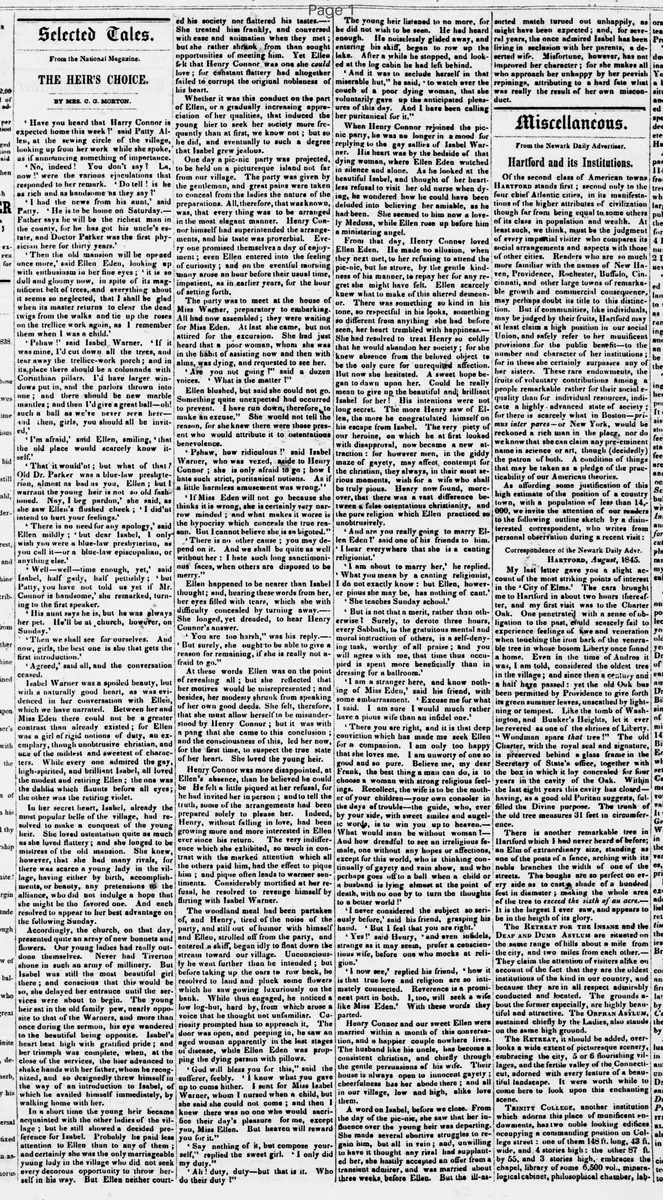
Selected Tales.
From the National Magazine
THE HEIR'S CHOICE
BY MRS. C. G. MORTON.
'Have you heard that Harry Connor is expected home this week?' said Patty Allen, at the sewing circle of the village, looking up from her work while she spoke, as if announcing something of importance.
'No, indeed! You don't say? La, now!' were the various ejaculations that responded to her remark. 'Do tell! Is he as rich and as handsome as they say?'
'I had the news from his aunt,' said Patty. 'He is to be home on Saturday. Father says he will be the richest man in the county, for he has got his uncle's estate, and Doctor Parker was the first physician here for thirty years.'
'Then the old mansion will be opened once more,' said Ellen Eden, looking up with enthusiasm in her fine eyes; 'it is so dull and gloomy now, in spite of its magnificent belt of trees, and everything about it seems so neglected, that I shall be glad when its master returns to clear the dead twigs from the walks and tie up the roses on the trellis work again, as I remember them when I was a child.'
'Pshaw!' said Isabel Warner. 'If it was mine, I'd cut down all the trees, and tear away the trellis-work porch; and in its place there should be a colonnade with Corinthian pillars. I'd have larger windows put in, and the parlors thrown into one; and there should be new marble mantles; and then I'd give a great ball—oh! such a ball as we've never seen here— and then, girls, you should all be invited.'
'I'm afraid,' said Ellen, smiling, 'that the old place would scarcely know itself.'
'That it would not; but what of that? Old Dr. Parker was a blue-law presbyterian, almost as bad as you, Ellen; but I warrant the young heir is not so old fashioned. Nay, I beg pardon,' she said, as she saw Ellen's flushed cheek; 'I did not intend to hurt your feelings.'
'There is no need for any apology,' said Ellen mildly; 'but dear Isabel, I only wish you were a blue-law presbyterian, as you call it—or a blue-law episcopalian, or anything else.'
'Well—well—time enough, yet,' said Isabel, half gaily, half pettishly; 'but Patty, you have not told us yet if Mr. Connor is handsome,' she remarked, turning to the first speaker.
'His aunt says he is, but he was always her pet. He'll be at church, however, on Sunday.'
'Then we shall see for ourselves. And now, girls, the best one is she that gets the first introduction.'
'Agreed,' said all, and the conversation ceased.
Isabel Warner was a spoiled beauty, but with a naturally good heart, as was evidenced in her conversation with Ellen, which we have narrated. Between her and Miss Eden there could not be a greater contrast than already existed; for Ellen was a girl of rigid notions of duty, an exemplary, though unobtrusive christian, and one of the mildest and sweetest of characters. While every one admired the gay, high-spirited, and brilliant Isabel, all loved the modest and retiring Ellen; the one was the dahlia which flaunts before all eyes; the other was the retiring violet.
In her secret heart, Isabel, already the most popular belle of the village, had resolved to make a conquest of the young heir. She loved ostentation quite as much as she loved flattery; and she longed to be mistress of the old mansion. She knew, however, that she had many rivals, for there was scarce a young lady in the village, having either by birth, accomplishments, or beauty, any pretensions to the alliance, who did not indulge a hope that she might be the favored one. And each resolved to appear to her best advantage on the following Sunday.
Accordingly, the church, on that day, presented quite an array of new bonnets and flowers. Our young ladies had really outdone themselves. Never had Tiverton shone in such an army of millinery. But Isabel was still the most beautiful girl there; and conscious that this would be so, she delayed her entrance until the services were about to begin. The young heir sat in the old family pew, nearly opposite to that of the Warners, and more than once during the sermon, his eye wandered to the beautiful being opposite. Isabel's heart beat high with gratified pride; and her triumph was complete, when, at the close of the services, the heir advanced to shake hands with her father, whom he recognized, and so designedly threw himself in the way of an introduction to Isabel, of which he availed himself immediately, by walking home with her.
In a short time the young heir became acquainted with the other ladies of the village; but he still showed a decided preference for Isabel. Probably he paid less attention to Ellen than to any of them; and certainly she was the only marriageable young lady in the village who did not seek every decorous opportunity to throw herself in his way. But Ellen neither courted his society nor flattered his tastes.
She treated him frankly, and conversed with ease and animation when they met; but she rather shrank from than sought opportunities of meeting him. Yet Ellen felt that Henry Connor was one she could love; for constant flattery had altogether failed to corrupt the original nobleness of his heart.
Whether it was this conduct on the part of Ellen, or a gradually increasing appreciation of her qualities, that induced the young heir to seek her society more frequently than at first, we know not; but so he did, and eventually to such a degree that Isabel grew jealous.
One day a pic-nic party was projected, to be held on a picturesque island not far from our village. The party was given by the gentlemen, and great pains were taken to conceal from the ladies the nature of the preparations. All, therefore, that was known, was, that every thing was to be arranged in the most elegant manner. Henry Connor himself had superintended the arrangements, and his taste was proverbial. Every one promised themselves a day of enjoyment; even Ellen entered into the feeling of curiosity; and on the eventful morning many arose an hour before their usual time, impatient, as in earlier years, for the hour of setting forth.
The party was to meet at the house of Miss Warner, preparatory to embarking. All had now assembled; they were waiting for Miss Eden. At last she came, but not attired for the excursion. She had just heard that a poor woman, whom she was in the habit of assisting now and then with alms, was dying, and requested to see her.
'Are you not going?' said a dozen voices. 'What is the matter?'
Ellen blushed, but said she could not go. Something quite unexpected had occurred to prevent. 'I have run down, therefore, to make an excuse.'
She would not tell the reason, or she knew there were those present who would attribute it to ostentatious benevolence.
'Pshaw, how ridiculous!' said Isabel Warner, who was vexed, aside to Henry Connor; 'she is only afraid to go; how I hate such strict, puritanical notions. As if a little harmless amusement was wrong. If Miss Eden will not go because she thinks it is wrong, she is certainly very narrow minded; and what makes it worse is the hypocrisy which conceals the true reason. But I cannot believe she is so bigoted.'
'There is no other cause; you may depend on it. And we shall be quite as well without her: I hate such long sanctimonious faces, when others are disposed to be merry.'
Ellen happened to be nearer than Isabel thought; and, hearing these words from her, her eyes filled with tears, which she with difficulty concealed by turning away. She longed, yet dreaded, to hear Henry Connor's answer.
'You are too harsh,' was his reply. 'But surely, she ought to be able to give a reason for remaining, if she is really not afraid to go.'
At these words Ellen was on the point of revealing all; but she reflected that her motives would be misrepresented; and besides, her modesty shrunk from speaking of her own good deeds. She felt, therefore, that she must allow herself to be misunderstood by Henry Connor; but it was with a pang that she came to this conclusion; and the consciousness of this, led her now, for the first time, to suspect the true state of her heart. She loved the young heir.
Henry Connor was more disappointed, at Ellen's absence, than he believed he could be. He felt a little piqued at her refusal, for he had invited her in person; and to tell the truth, some of the arrangements had been prepared solely to please her. Indeed, Henry, without falling in love, had been growing more and more interested in Ellen ever since his return. The very indifference which she exhibited, so much in contrast with the marked attention which all the others paid him, had the effect to pique him; and pique often leads to warmer sentiments. Considerably mortified at her refusal, he resolved to revenge himself by flirting with Isabel Warner.
The woodland meal had been partaken of, and Henry, tired of the noise of the party, and still out of humor with himself and Ellen, strolled off from the party, and entered a skiff, began idly to float down the stream toward our village. Unconsciously he went further than he intended; but before taking up the oars to row back, he resolved to land and pluck some flowers which he saw growing luxuriously on the bank. While thus engaged, he noticed a low log-hut, hard by, from which arose a voice that he thought not unfamiliar. Curiosity prompted him to approach it. The door was open, and peeping in, he saw an aged woman apparently in the last stages of disease, while Ellen Eden was propping the dying person with pillows.
'God will bless you for this,' said the sufferer, feebly. 'I know what you gave up to come hither. I sent for Miss Isabel Warner, whom I nursed when a child, but she said she could not come; and then I knew there was no one who would sacrifice their day's pleasure for me, except you, Miss Ellen. But heaven will reward you for it.'
'Say nothing of it, but compose yourself,' replied the sweet girl. 'I only did my duty.'
'Ah! duty, duty—but that is it. Who do their duty?'
The young heir listened to no more, for he did not wish to be seen. He had heard enough. He noiselessly glided away, and entering his skiff, began to row up the lake. After a while he stopped, and looked at the log cabin he had left behind.
'And it was to seclude herself in that miserable hut,' he said, 'to watch over the couch of a poor dying woman, that she voluntarily gave up the anticipated pleasures of this day. And I have been calling her puritanical for it.'
When Henry Connor rejoined the pic-nic party, he was no longer in a mood for replying to the gay sallies of Isabel Warner. His heart was by the bedside of that dying woman, where Ellen Eden watched in silence and alone. As he looked at the beautiful Isabel, and thought of her heartless refusal to visit her old nurse when dying, he wondered how he could have been deluded into believing her amiable, as he had been. She seemed to him now a lovely Medusa, while Ellen rose up before him a ministering angel.
From that day, Henry Connor loved Ellen Eden. He made no allusion, when they next met, to her refusing to attend the pic-nic, but he strove, by the gentle kindness of his manner, to repay her for any regret she might have felt. Ellen scarcely knew what to make of this altered demeanor. There was something so kind in his tone, so respectful in his looks, something so different from anything she had before seen, her heart trembled with happiness. She had resolved to treat Henry so coldly that he would abandon her society; for she knew absence from the beloved object to be the only cure for unrequited affection. But now she hesitated. A sweet hope began to dawn upon her. Could he really mean to give up the beautiful and brilliant Isabel for her! His intentions were not long secret. The more Henry saw of Ellen, the more he congratulated himself on his escape from Isabel. The very piety of our heroine, on which he at first looked with disapproval, now became a new attraction: for however men, in the giddy maze of gayety, may affect contempt for the christian, they always, in their most serious moments, wish for a wife who shall be truly pious. Henry now found, moreover, that there was a vast difference between a false ostentatious christianity, and the pure religion which Ellen practiced so unobtrusively.
'And are you really going to marry Ellen Eden?' said one of his friends to him. 'I hear everywhere that she is a canting religionist.'
'I am about to marry her,' he replied. 'What you mean by a canting religionist, I do not exactly know: but Ellen, however pious she may be, has nothing of cant.'
'She teaches Sunday school.'
'But is not that a merit, rather than otherwise? Surely, to devote three hours, every Sabbath, to the gratuitous mental and moral instruction of others, is a self-denying task, worthy of all praise; and you will agree with me, that time thus occupied is spent more beneficially than in dressing for a ballroom.'
'I am a stranger here, and know nothing of Miss Eden,' said his friend, with some embarrassment. 'Excuse me for what I said. I am sure I would much rather have a pious wife than an infidel one.'
'There you are right, and it is that deep conviction which has made me seek Ellen for a companion. I am only too happy that she loves me. I am unworthy of one so good and so pure. Believe me, my dear Frank, the best thing a man can do, is to choose a woman with strong religious feelings. Recollect, the wife is to be the mother of your children—your own consoler in the days of trouble—the guide, who, ever by your side, with sweet smiles and angelic words, is to win you up to heaven. What would man be without woman? And how dreadful to see an irreligious female, one without any hopes or affections, except for this world, who is thinking continually of gayety and vain show, and who perhaps goes off to a ball when a child or a husband is lying almost at the point of death, with no one by to turn the thoughts to a better world!'
'I never considered the subject so seriously before,' said his friend, grasping his hand. 'But I feel that you are right.'
'Yes!' said Henry, 'and even infidels, strange as it may seem, prefer a conscientious wife, before one who mocks at religion.'
'I now see,' replied his friend, 'how it is that true love and religion are so intimately connected. Reverence is a prominent part in both. I, too, will seek a wife like Miss Eden.' With these words they parted.
Henry Connor and our sweet Ellen were married within a month of this conversation, and a happier couple nowhere lives. The husband like his uncle, has become a consistent christian, and chiefly through the gentle persuasions of his wife. Their house is always open to innocent gayety; cheerfulness has her abode there; and all in our village, low and high, alike love them.
A word on Isabel, before we close. From the day of the pic-nic, she saw that her influence over the young heir was departing. She made several abortive struggles to regain him, but all in vain; and, unwilling to have it thought any rival had supplanted her, she hastily accepted an offer from a transient admirer, and was married about three weeks before Ellen. But the ill-assorted match turned out unhappily, as might have been expected; and, for several years, the once admired Isabel has been living in seclusion with her parents, a deserted wife. Misfortune, however, has not improved her character; for she makes all who approach her unhappy by her peevish repinings, attributing to a hard fate what was really the result of her own misconduct.
From the National Magazine
THE HEIR'S CHOICE
BY MRS. C. G. MORTON.
'Have you heard that Harry Connor is expected home this week?' said Patty Allen, at the sewing circle of the village, looking up from her work while she spoke, as if announcing something of importance.
'No, indeed! You don't say? La, now!' were the various ejaculations that responded to her remark. 'Do tell! Is he as rich and as handsome as they say?'
'I had the news from his aunt,' said Patty. 'He is to be home on Saturday. Father says he will be the richest man in the county, for he has got his uncle's estate, and Doctor Parker was the first physician here for thirty years.'
'Then the old mansion will be opened once more,' said Ellen Eden, looking up with enthusiasm in her fine eyes; 'it is so dull and gloomy now, in spite of its magnificent belt of trees, and everything about it seems so neglected, that I shall be glad when its master returns to clear the dead twigs from the walks and tie up the roses on the trellis work again, as I remember them when I was a child.'
'Pshaw!' said Isabel Warner. 'If it was mine, I'd cut down all the trees, and tear away the trellis-work porch; and in its place there should be a colonnade with Corinthian pillars. I'd have larger windows put in, and the parlors thrown into one; and there should be new marble mantles; and then I'd give a great ball—oh! such a ball as we've never seen here— and then, girls, you should all be invited.'
'I'm afraid,' said Ellen, smiling, 'that the old place would scarcely know itself.'
'That it would not; but what of that? Old Dr. Parker was a blue-law presbyterian, almost as bad as you, Ellen; but I warrant the young heir is not so old fashioned. Nay, I beg pardon,' she said, as she saw Ellen's flushed cheek; 'I did not intend to hurt your feelings.'
'There is no need for any apology,' said Ellen mildly; 'but dear Isabel, I only wish you were a blue-law presbyterian, as you call it—or a blue-law episcopalian, or anything else.'
'Well—well—time enough, yet,' said Isabel, half gaily, half pettishly; 'but Patty, you have not told us yet if Mr. Connor is handsome,' she remarked, turning to the first speaker.
'His aunt says he is, but he was always her pet. He'll be at church, however, on Sunday.'
'Then we shall see for ourselves. And now, girls, the best one is she that gets the first introduction.'
'Agreed,' said all, and the conversation ceased.
Isabel Warner was a spoiled beauty, but with a naturally good heart, as was evidenced in her conversation with Ellen, which we have narrated. Between her and Miss Eden there could not be a greater contrast than already existed; for Ellen was a girl of rigid notions of duty, an exemplary, though unobtrusive christian, and one of the mildest and sweetest of characters. While every one admired the gay, high-spirited, and brilliant Isabel, all loved the modest and retiring Ellen; the one was the dahlia which flaunts before all eyes; the other was the retiring violet.
In her secret heart, Isabel, already the most popular belle of the village, had resolved to make a conquest of the young heir. She loved ostentation quite as much as she loved flattery; and she longed to be mistress of the old mansion. She knew, however, that she had many rivals, for there was scarce a young lady in the village, having either by birth, accomplishments, or beauty, any pretensions to the alliance, who did not indulge a hope that she might be the favored one. And each resolved to appear to her best advantage on the following Sunday.
Accordingly, the church, on that day, presented quite an array of new bonnets and flowers. Our young ladies had really outdone themselves. Never had Tiverton shone in such an army of millinery. But Isabel was still the most beautiful girl there; and conscious that this would be so, she delayed her entrance until the services were about to begin. The young heir sat in the old family pew, nearly opposite to that of the Warners, and more than once during the sermon, his eye wandered to the beautiful being opposite. Isabel's heart beat high with gratified pride; and her triumph was complete, when, at the close of the services, the heir advanced to shake hands with her father, whom he recognized, and so designedly threw himself in the way of an introduction to Isabel, of which he availed himself immediately, by walking home with her.
In a short time the young heir became acquainted with the other ladies of the village; but he still showed a decided preference for Isabel. Probably he paid less attention to Ellen than to any of them; and certainly she was the only marriageable young lady in the village who did not seek every decorous opportunity to throw herself in his way. But Ellen neither courted his society nor flattered his tastes.
She treated him frankly, and conversed with ease and animation when they met; but she rather shrank from than sought opportunities of meeting him. Yet Ellen felt that Henry Connor was one she could love; for constant flattery had altogether failed to corrupt the original nobleness of his heart.
Whether it was this conduct on the part of Ellen, or a gradually increasing appreciation of her qualities, that induced the young heir to seek her society more frequently than at first, we know not; but so he did, and eventually to such a degree that Isabel grew jealous.
One day a pic-nic party was projected, to be held on a picturesque island not far from our village. The party was given by the gentlemen, and great pains were taken to conceal from the ladies the nature of the preparations. All, therefore, that was known, was, that every thing was to be arranged in the most elegant manner. Henry Connor himself had superintended the arrangements, and his taste was proverbial. Every one promised themselves a day of enjoyment; even Ellen entered into the feeling of curiosity; and on the eventful morning many arose an hour before their usual time, impatient, as in earlier years, for the hour of setting forth.
The party was to meet at the house of Miss Warner, preparatory to embarking. All had now assembled; they were waiting for Miss Eden. At last she came, but not attired for the excursion. She had just heard that a poor woman, whom she was in the habit of assisting now and then with alms, was dying, and requested to see her.
'Are you not going?' said a dozen voices. 'What is the matter?'
Ellen blushed, but said she could not go. Something quite unexpected had occurred to prevent. 'I have run down, therefore, to make an excuse.'
She would not tell the reason, or she knew there were those present who would attribute it to ostentatious benevolence.
'Pshaw, how ridiculous!' said Isabel Warner, who was vexed, aside to Henry Connor; 'she is only afraid to go; how I hate such strict, puritanical notions. As if a little harmless amusement was wrong. If Miss Eden will not go because she thinks it is wrong, she is certainly very narrow minded; and what makes it worse is the hypocrisy which conceals the true reason. But I cannot believe she is so bigoted.'
'There is no other cause; you may depend on it. And we shall be quite as well without her: I hate such long sanctimonious faces, when others are disposed to be merry.'
Ellen happened to be nearer than Isabel thought; and, hearing these words from her, her eyes filled with tears, which she with difficulty concealed by turning away. She longed, yet dreaded, to hear Henry Connor's answer.
'You are too harsh,' was his reply. 'But surely, she ought to be able to give a reason for remaining, if she is really not afraid to go.'
At these words Ellen was on the point of revealing all; but she reflected that her motives would be misrepresented; and besides, her modesty shrunk from speaking of her own good deeds. She felt, therefore, that she must allow herself to be misunderstood by Henry Connor; but it was with a pang that she came to this conclusion; and the consciousness of this, led her now, for the first time, to suspect the true state of her heart. She loved the young heir.
Henry Connor was more disappointed, at Ellen's absence, than he believed he could be. He felt a little piqued at her refusal, for he had invited her in person; and to tell the truth, some of the arrangements had been prepared solely to please her. Indeed, Henry, without falling in love, had been growing more and more interested in Ellen ever since his return. The very indifference which she exhibited, so much in contrast with the marked attention which all the others paid him, had the effect to pique him; and pique often leads to warmer sentiments. Considerably mortified at her refusal, he resolved to revenge himself by flirting with Isabel Warner.
The woodland meal had been partaken of, and Henry, tired of the noise of the party, and still out of humor with himself and Ellen, strolled off from the party, and entered a skiff, began idly to float down the stream toward our village. Unconsciously he went further than he intended; but before taking up the oars to row back, he resolved to land and pluck some flowers which he saw growing luxuriously on the bank. While thus engaged, he noticed a low log-hut, hard by, from which arose a voice that he thought not unfamiliar. Curiosity prompted him to approach it. The door was open, and peeping in, he saw an aged woman apparently in the last stages of disease, while Ellen Eden was propping the dying person with pillows.
'God will bless you for this,' said the sufferer, feebly. 'I know what you gave up to come hither. I sent for Miss Isabel Warner, whom I nursed when a child, but she said she could not come; and then I knew there was no one who would sacrifice their day's pleasure for me, except you, Miss Ellen. But heaven will reward you for it.'
'Say nothing of it, but compose yourself,' replied the sweet girl. 'I only did my duty.'
'Ah! duty, duty—but that is it. Who do their duty?'
The young heir listened to no more, for he did not wish to be seen. He had heard enough. He noiselessly glided away, and entering his skiff, began to row up the lake. After a while he stopped, and looked at the log cabin he had left behind.
'And it was to seclude herself in that miserable hut,' he said, 'to watch over the couch of a poor dying woman, that she voluntarily gave up the anticipated pleasures of this day. And I have been calling her puritanical for it.'
When Henry Connor rejoined the pic-nic party, he was no longer in a mood for replying to the gay sallies of Isabel Warner. His heart was by the bedside of that dying woman, where Ellen Eden watched in silence and alone. As he looked at the beautiful Isabel, and thought of her heartless refusal to visit her old nurse when dying, he wondered how he could have been deluded into believing her amiable, as he had been. She seemed to him now a lovely Medusa, while Ellen rose up before him a ministering angel.
From that day, Henry Connor loved Ellen Eden. He made no allusion, when they next met, to her refusing to attend the pic-nic, but he strove, by the gentle kindness of his manner, to repay her for any regret she might have felt. Ellen scarcely knew what to make of this altered demeanor. There was something so kind in his tone, so respectful in his looks, something so different from anything she had before seen, her heart trembled with happiness. She had resolved to treat Henry so coldly that he would abandon her society; for she knew absence from the beloved object to be the only cure for unrequited affection. But now she hesitated. A sweet hope began to dawn upon her. Could he really mean to give up the beautiful and brilliant Isabel for her! His intentions were not long secret. The more Henry saw of Ellen, the more he congratulated himself on his escape from Isabel. The very piety of our heroine, on which he at first looked with disapproval, now became a new attraction: for however men, in the giddy maze of gayety, may affect contempt for the christian, they always, in their most serious moments, wish for a wife who shall be truly pious. Henry now found, moreover, that there was a vast difference between a false ostentatious christianity, and the pure religion which Ellen practiced so unobtrusively.
'And are you really going to marry Ellen Eden?' said one of his friends to him. 'I hear everywhere that she is a canting religionist.'
'I am about to marry her,' he replied. 'What you mean by a canting religionist, I do not exactly know: but Ellen, however pious she may be, has nothing of cant.'
'She teaches Sunday school.'
'But is not that a merit, rather than otherwise? Surely, to devote three hours, every Sabbath, to the gratuitous mental and moral instruction of others, is a self-denying task, worthy of all praise; and you will agree with me, that time thus occupied is spent more beneficially than in dressing for a ballroom.'
'I am a stranger here, and know nothing of Miss Eden,' said his friend, with some embarrassment. 'Excuse me for what I said. I am sure I would much rather have a pious wife than an infidel one.'
'There you are right, and it is that deep conviction which has made me seek Ellen for a companion. I am only too happy that she loves me. I am unworthy of one so good and so pure. Believe me, my dear Frank, the best thing a man can do, is to choose a woman with strong religious feelings. Recollect, the wife is to be the mother of your children—your own consoler in the days of trouble—the guide, who, ever by your side, with sweet smiles and angelic words, is to win you up to heaven. What would man be without woman? And how dreadful to see an irreligious female, one without any hopes or affections, except for this world, who is thinking continually of gayety and vain show, and who perhaps goes off to a ball when a child or a husband is lying almost at the point of death, with no one by to turn the thoughts to a better world!'
'I never considered the subject so seriously before,' said his friend, grasping his hand. 'But I feel that you are right.'
'Yes!' said Henry, 'and even infidels, strange as it may seem, prefer a conscientious wife, before one who mocks at religion.'
'I now see,' replied his friend, 'how it is that true love and religion are so intimately connected. Reverence is a prominent part in both. I, too, will seek a wife like Miss Eden.' With these words they parted.
Henry Connor and our sweet Ellen were married within a month of this conversation, and a happier couple nowhere lives. The husband like his uncle, has become a consistent christian, and chiefly through the gentle persuasions of his wife. Their house is always open to innocent gayety; cheerfulness has her abode there; and all in our village, low and high, alike love them.
A word on Isabel, before we close. From the day of the pic-nic, she saw that her influence over the young heir was departing. She made several abortive struggles to regain him, but all in vain; and, unwilling to have it thought any rival had supplanted her, she hastily accepted an offer from a transient admirer, and was married about three weeks before Ellen. But the ill-assorted match turned out unhappily, as might have been expected; and, for several years, the once admired Isabel has been living in seclusion with her parents, a deserted wife. Misfortune, however, has not improved her character; for she makes all who approach her unhappy by her peevish repinings, attributing to a hard fate what was really the result of her own misconduct.
What sub-type of article is it?
Prose Fiction
What themes does it cover?
Moral Virtue
Religious
Love Romance
What keywords are associated?
Heirs Choice
Pious Wife
Village Romance
Duty Vs Pleasure
Moral Tale
Christian Virtue
Picnic Refusal
Dying Nurse
What entities or persons were involved?
By Mrs. C. G. Morton.
Literary Details
Title
The Heir's Choice
Author
By Mrs. C. G. Morton.
Key Lines
'God Will Bless You For This,' Said The Sufferer, Feebly. 'I Know What You Gave Up To Come Hither. I Sent For Miss Isabel Warner, Whom I Nursed When A Child, But She Said She Could Not Come; And Then I Knew There Was No One Who Would Sacrifice Their Day's Pleasure For Me, Except You, Miss Ellen. But Heaven Will Reward You For It.'
'Say Nothing Of It, But Compose Yourself,' Replied The Sweet Girl. 'I Only Did My Duty.'
'And It Was To Seclude Herself In That Miserable Hut,' He Said, 'To Watch Over The Couch Of A Poor Dying Woman, That She Voluntarily Gave Up The Anticipated Pleasures Of This Day. And I Have Been Calling Her Puritanical For It.'
'Believe Me, My Dear Frank, The Best Thing A Man Can Do, Is To Choose A Woman With Strong Religious Feelings. Recollect, The Wife Is To Be The Mother Of Your Children—Your Own Consoler In The Days Of Trouble—The Guide, Who, Ever By Your Side, With Sweet Smiles And Angelic Words, Is To Win You Up To Heaven.'