Thank you for visiting SNEWPapers!
Sign up free
The Daily Press
Cincinnati, Hamilton County, Ohio
What is this article about?
On February 21 in Washington, the House reduced Army Appropriation Bill by $1,473,000, passing it at $14,050,000. The Senate debated and passed the Consular and Diplomatic Bill, considered memorials for a St. Louis assay office, and discussed the Cuba acquisition bill with amendments affirming U.S. interest in purchasing the island from Spain.
Clipping
OCR Quality
Full Text
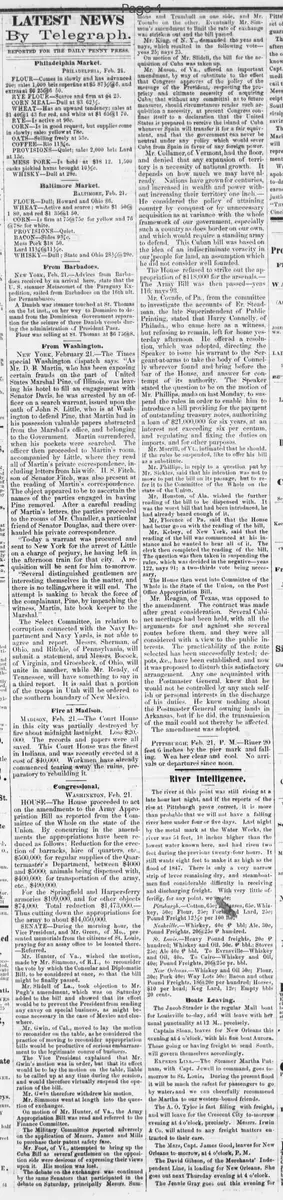
WASHINGTON, Feb. 21.
HOUSE—The House proceeded to act on the amendments to the Army Appropriation Bill as reported from the Committee of the Whole on the state of the Union. By concurring in the amendments the appropriations have been reduced as follows: Reduction for the erection of barracks, hire of quarters, etc., $500,000; for regular supplies of the Quartermaster's Department, between $4000 and $5000; animals being dispensed with, $400,000; for transportation of the army, etc., $490,000.
For the Springfield and Harpersferry armories $109,000, and for other objects $74,000. Total reduction $1,473,000.—
Thus cutting down the appropriations for the army to about $14,050,000.
SENATE—During the morning hour, the Vice President, and Mr. Green, of Mo., presented memorials from the citizens of St. Louis, praying for an assay office to be located there. -Referred.
Mr. Hunter, of Va., wished the motion, made by Mr. Simmons, of R.I., to reconsider the vote by which the Consular and Diplomatic Bill, to be considered at once, so that the bill might be finally passed.
Mr. Slidell of La., took objection to Mr. Pugh's amendment, which was on Saturday added to the bill and showed that its effect would be to prevent the President from sending any envoy on special business, as might become necessary in the case of Mexico and elsewhere.
Mr. Gwin, of Cal., moved to lay the motion to reconsider on the table, as he considered the practice of moving to reconsider appropriation bills would be productive of serious embarrassment to the legitimate course of business.
The Vice President explained that Mr. Gwin's motion was in order, but that its effect would be to lay the motion on the table, liable to be called up at any time during the session, and would therefore virtually suspend the operation of the bill.
Mr. Gwin therefore withdrew his motion,
Mr. Simmons went at length into the question of exchanges.
On motion of Mr. Hunter, of Va., the Army Appropriation Bill was read and referred to the Finance Committee.
The Military Committee reported adversely on the application of Messrs. James and Mills to purchase their patent safety fuse.
Mr. Foot, of Vt., attempted to bring up the Cuba Bill as several gentlemen on the opposition side were desirous of expressing their views upon it. His motion was lost.
The debate on the exchanges was continued by the same Senators that participated in the debate on Saturday, principally Messrs. Simmons and Trumbull on one side, and Mr. Toombs on the other. Eventually Mr. Simmons' amendment to limit the rate of exchange was stricken out and the bill passed.
Mr. King, of N. Y., demanded the yeas and nays, which resulted in the following vote-- yeas 25; nays 25.
On motion of Mr. Slidell, the bill for the acquisition of Cuba was taken up.
Mr. Mason, of Va., offered an important amendment, by way of substitute to the effect that Congress approves of the policy of the message of the President, respecting the propriety and ultimate necessity of acquiring Cuba: that without any commitment as to future measures, should circumstances render such acquisition a necessity, at present Congress confines itself to a declaration that the United States is prepared to receive the island of Cuba whenever Spain will transfer it for a fair equivalent, and "that the government can never be neutral under any policy which would sever Cuba from Spain in favor of any foreign power.
Mr. Collamer, of Vermont, had the floor, and denied that any expansion of territory is a necessity of national growth. It depends on how much we may have already. Nations have grown for centuries, and increased in wealth and power without increasing their territory one inch.
He considered the policy of attaining country by conquest or by unnecessary acquisition as at variance with the whole framework of our government, especially such a country as does border on our own, and which would require a standing army to defend. This Cuban bill was based on the idea of an indiscriminate voracity in our people for land, an assumption which he did not consider well founded.
The House refused to strike out the appropriation of $118,000 for the arsenals.
The Army Bill was then passed-yeas 116; nays 93.
Mr. Covode, of Pa., from the committee to investigate the accounts of Mr. Steadman, the late Superintendent of Public Printing, stated that Harry Connelly, of Philadelphia, who came here as a witness, but refusing to remain, left for home yesterday afternoon. He offered a resolution, which was adopted, directing the Speaker to issue his warrant to the Sergeant-at-arms to take the body of Connelly wherever found and bring before the bar of the House, and answer for contempt of its authority. The Speaker stated the question to be on the motion of Mr. Phillips, made on last Monday, to suspend the rules in order to enable him to introduce a bill providing for the payment of outstanding treasury notes, authorizing a loan of $21,000,000 for six years, at an interest not exceeding six per centum, and regulating and fixing the duties on imports, and for other purposes.
Mr. Morrill, of Vt., intimated that he should, if the rules be suspended, like to offer his bill as a substitute.
Mr. Phillips, in reply to a question put by Mr. Sickles, said that his intention was not to move to put the bill on its passage, but to refer it to the Committee of the Whole on the state of the Union.
Mr. Houston, of Ala, wished the further reading of the bill to be dispensed with. It was the worst bill that had been introduced, he had already heard enough of it,
Mr. Florence of Pa, said that the House had better go on with the reading of the bill,
Mr. Kelsey, of New York, said that the reading of the bill was commenced at his instance and he wanted to hear all of it, The clerk then completed the reading of the bill.
The question was then taken on suspending the rules, which was decided in the negative-yeas 122, nays 91; a two-thirds vote being necessary,
The House then went into Committee of the Whole in the State of the Union, on the Post Office Appropriation Bill,
Mr. Reagan, of Texas, was opposed to the amendment. The contract was made after great consideration. Several Cabinet meetings had been held, with all the arguments for and against the several routes before them, and they were all considered with a view to the public interests. The practicability of the route selected has been successfully tested; depots, &c., have been established, and now it was proposed to disturb this satisfactory arrangement. Any one acquainted with the Postmaster General, knew that he would not be controlled by any such selfish or personal interests in the discharge of his duties. He knew nothing about the Postmaster General owning lands in Arkansas, but if he did, the transmission of the mail could not thereby be affected.
The amendment was adopted.
What sub-type of article is it?
What keywords are associated?
What entities or persons were involved?
Where did it happen?
Domestic News Details
Primary Location
Washington
Event Date
Feb. 21
Key Persons
Outcome
army appropriation bill reduced by $1,473,000 and passed (house yeas 116, nays 93); consular and diplomatic bill passed (senate yeas 25, nays 25); cuba acquisition bill taken up with amendment; post office appropriation bill amendment adopted; warrant issued for harry connelly; rules suspension failed (yeas 122, nays 91).
Event Details
The House acted on amendments reducing the Army Appropriation Bill. The Senate handled memorials for a St. Louis assay office, reconsidered the Consular and Diplomatic Bill with debates on amendments and exchanges, referred the Army Bill, reported adversely on a patent, debated the Cuba Bill with an amendment approving acquisition policy, and continued Post Office Bill discussions.