Thank you for visiting SNEWPapers!
Sign up free
Editorial
June 8, 1808
The National Intelligencer And Washington Advertiser
Washington, District Of Columbia
What is this article about?
An American Whig defends the Embargo Act as a temporary measure to protect commerce from British and French aggressions, contrasting it with the likely long duration and severe costs of war, arguing it demonstrates the administration's support for trade rather than hostility.
Clipping
OCR Quality
95%
Excellent
Full Text
TO THE PEOPLE OF THE UNITED STATES.
No. VI.
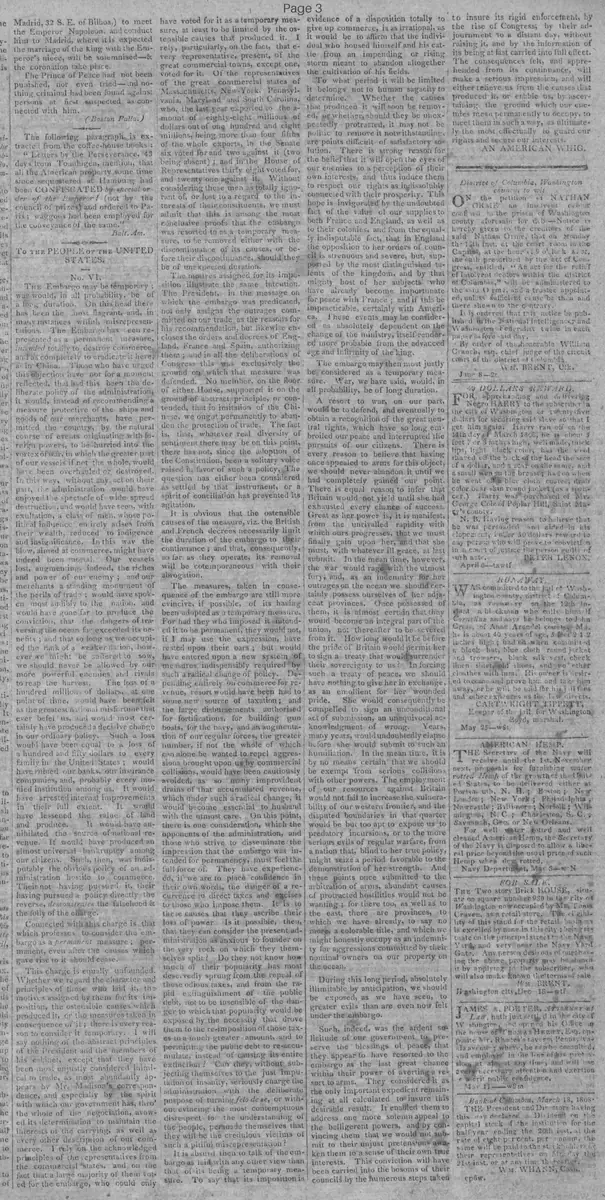
The Embargo may be temporary; war would, in all probability, be of long duration. On this head there has been the most flagrant, and, in many instances wilful, misrepresentations. The Embargo has been represented as a permanent measure, intended totally to destroy commerce, and as completely to eradicate it here, as in China. Those who have urged this objection have not for a moment reflected, that had this been the deliberate policy of the administration, it would, instead of recommending a measure protective of the ships and goods of our merchants, have permitted the country, by the natural course of events originating with foreign powers, to be hurried into the vortex of war, in which the greater part of our vessels if not the whole, would have been overhauled or destroyed. In this way, without any act on their part, the administration would have enjoyed the spectacle of wide spread destruction, and would have seen, with exultation, a class of men, whose political influence entirely arises from their wealth, reduced to indigence and insignificance. In this way the blow, aimed at commerce, might have indeed been mortal. Our vessels lost, augmenting, indeed, the riches and power of our enemy; and our merchants a standing monument of the perils of trade; would have spoken most audibly to the nation, and would have gone far to produce the conviction, that the dangers of traversing the ocean far exceeded its benefits; and that so long as we occupied the rank of a weaker nation, however we might be suffered to sow, we should never be allowed by our more powerful enemies and rivals to reap the harvest. The loss of a hundred millions of dollars, at one point of time, would have been felt as the greatest national misfortune that ever befell us, and would most certainly have produced a decisive change in our ordinary policy. Such a loss would have been equal to a loss of a hundred and fifty dollars to every family in the United States; would have ruined our banks, our insurance companies, and, probably every monied institution among us. It would have arrested internal improvements in their full extent. It would have lessened the value of land and produce. It would have annihilated the source of national revenue. It would have produced an almost universal bankruptcy among our citizens. Such, then, was indisputably the obvious policy of an administration hostile to commerce. Their not having pursued it, their having pursued a policy directly the reverse, demonstrates the falsehood & the folly of the charge.
Connected with this charge is that which professes to consider the embargo as a permanent measure; permanent, even after the causes which gave rise to it should cease. This charge is equally unfounded. Whether we regard the character and principles of those who laid it, the motives assigned by them for its imposition, the ostensible causes which produced it, or the measures taken in consequence of it; there is every reason to consider it temporary. I will say nothing of the abstract principles of the President and the members of his cabinet, except that they have been most unjustly considered inimical to trade, as most abundantly appears by Mr. Madison's correspondence, and especially by the spirit with which our government has, thro' the whole of the negociation, avowed its determination to maintain the interests of the carrying, as well as every other description of our commerce. I rely on the acknowledged principles of the representatives from the commercial states, and on the fact that a large majority of them voted for the embargo, who could only have voted for it as a temporary measure, at least to be limited by the ostensible causes that produced it. I rely, particularly, on the fact, that every representative, present, of the great commercial towns, except one, voted for it. Of the representatives of the great commercial states of Massachusetts, New-York, Pennsylvania, Maryland and South Carolina, who, the last year exported to the amount of eighty-eight millions of dollars out of one hundred and eight millions, being more than four fifths of the whole exports, in the Senate six voted for and two against it (two being absent); and in the House of Representatives thirty eight voted for, and twenty one against it. Without considering these men as totally ignorant of, or lost to a regard to the interests of their constituents, we must admit that this is among the most conclusive proofs that the embargo was resorted to as a temporary measure, to be removed either with the discontinuance of its causes, or before their discontinuance, should they be of unexpected duration.
The motives assigned for its imposition illustrate the same intention. The President, in the message on which the embargo was predicated, not only assigns the outrages committed on our trade as the reasons of his recommendation, but likewise encloses the orders and decrees of England, France and Spain, authorizing them; and in all the deliberations of Congress this was exclusively the ground on which that measure was defended. No member, on the floor of either House, supported it on the ground of abstract principle, or contended, that in imitation of the Chinese, we ought permanently to abandon the protection of trade. The fact is, that, whatever real diversity of sentiment there may be on this point, there has not, since the adoption of the Constitution, been a solitary voice raised in favor of such a policy. The question has either been considered as settled by that instrument, or a spirit of conciliation has prevented its agitation.
It is obvious that the ostensible causes of the measure, viz. the British and French decrees necessarily limit the duration of the embargo to their continuance; and that, consequently, so far as they operate, its removal will be contemporaneous with their abrogation.
The measures, taken in consequence of the embargo are still more evincive, if possible, of its having been adopted as a temporary measure. For had they who imposed it intended it to be permanent, they would not, if I may use the expression, have rested upon their oars; but would have entered upon a new system of measures indispensably required by such a radical change of policy. Depending entirely on commerce for revenue, resort would have been had to some new source of taxation; and the large disbursements authorised for fortifications, for building gun boats, or the navy, and an augmentation of our regular forces, the greater number, if not the whole of which can alone be wanted to repel aggressions brought upon us by commercial collisions, would have been cautiously avoided, as so many improvident drains of that accumulated revenue, which under such a radical change, it would become essential to husband with the utmost care. On this point, there is one consideration, which the opponents of the administration, and those who strive to disseminate the impression that the embargo was intended for permanency, must feel the full force of. They have experienced, if we are to place confidence in their own words, the danger of a recurrence to direct taxes and excises to those who impose them. It is to these causes that they ascribe their loss of power. Is it possible, then, that they can consider the present administration as anxious to founder on the very rock on which they themselves split? Do they not know how much of their popularity has most deservedly sprung from the repeal of those odious taxes, and from the rapid extinguishment of the public debt, not to be insensible of the danger to which that popularity would be exposed by the necessity that drove them to the re-imposition of those taxes to a much greater amount, and to permitting the public debt to re-accumulate, instead of causing its entire extinction? Can they, without subjecting themselves to the just imputation of insanity, seriously charge the administration with the deliberate purpose of turning felo de se, or without evincing the most contemptuous disrespect for the understanding of the people, persuade themselves that they will be the credulous victims of such a pitiful misrepresentation?
It is absurd then to talk of the embargo as laid with any other view than that of its being a temporary measure. To say that its imposition is evidence of a disposition totally to give up commerce, is as irrational, as it would be to affirm that the individual who housed himself and his cattle from an impending or rising storm meant to abandon altogether the cultivation of his fields.
To what period it will be limited it belongs not to human sagacity to determine. Whether the causes that produced it will soon be removed, or whether, should they be unexpectedly protracted, it may not be politic to remove it notwithstanding, are points difficult of satisfactory solution. There is strong reason for the belief that it will open the eyes of our enemies to a perception of their own interests, and thus induce them to respect our rights as indissolubly connected with their prosperity. This hope is invigorated by the undoubted fact of the value of our supplies to both France and England, as well as to their colonies, and from the equally indisputable fact, that in England the opposition to her orders of council is strenuous and severe, but, supported by the most distinguished talents of the kingdom, and by that mighty host of her subjects, who have already become importunate for peace with France; and if this be impracticable, certainly with America. These events may be considered as absolutely dependent on the change of the ministry, itself rendered more probable from the advanced age and infirmity of the king.
The embargo may then most justly be considered as a temporary measure. War, we have said, would, in all probability, be of long duration. A resort to war, on our part, would be to defend, and eventually to obtain a recognition of the great neutral rights, which have so long embroiled our peace and interrupted the pursuits of our citizens. There is every reason to believe that having once appealed to arms for this object, we should never abandon it until we had completely gained our point. There is equal reason to infer that Britain would not yield until she had exhausted every chance of success. Great as her power is, it is manifest, from the unrivalled rapidity with which ours progresses, that we must finally gain upon her, and that she must, with whatever ill grace, at last submit. In the mean time, however, the war would rage with the utmost fury, and, as an indemnity for her outrages on the ocean we should certainly possess ourselves of her adjacent provinces. Once possessed of them, it is almost certain that they would become an integral part of the union, not thereafter to be severed from it. How long would it be before the pride of Britain would permit her to sign a treaty that would surrender their sovereignty to us? In forcing such a treaty of peace, we should have nothing to give her in exchange, as an emollient for her wounded pride. She would consequently be compelled to sign an unconditional act of submission, an unequivocal acknowledgment of wrong. Years, many years, would undoubtedly elapse before she would submit to such an humiliation. In the mean time, it is by no means certain that we should be exempt from serious collisions with other powers. The employment of our resources against Britain would not fail to increase the vulnerability of our western frontier, and the disputed boundaries in that quarter would be but too apt to expose us to predatory incursions, or to the more serious evils of regular warfare, from a nation that, blind to her true policy, might seize a period favorable to the demonstration of her strength. And these points once submitted to the arbitration of arms, abundant causes of protracted hostilities would not be wanting; for there too, as well as to the east, there are provinces, to which we have already, to say no more, a colorable title, and which we might honestly occupy as an indemnity for aggressions committed by their nominal owners on our property on the ocean.
During this long period, absolutely illimitable by anticipation, we should be exposed, as we have seen, to greater evils than are even now felt under the embargo.
Such, indeed, was the ardent solicitude of our government to preserve the blessings of peace, that they appear to have resorted to the embargo as the last great chance within their power of averting a resort to arms. They considered it as the only important expedient remaining at all calculated to insure this desirable result. It enabled them to address one more solemn appeal to the belligerent powers, and by convincing them that we would not submit to their unjust pretensions awaken them to a sense of their own true interests. This conviction will have been carried into the bosoms of their councils by the numerous steps taken to insure its rigid enforcement, by the rise of Congress, by their adjournment to a distant day, without raising it, and by the information of its being at last carried into full effect.
The consequences felt, and apprehended from its continuance, will make a serious impression, and will either relieve us from the causes that produced it, or enable us, by ascertaining the ground which our enemies mean permanently to occupy, to meet them in such a way, as ultimately the most effectually to guard our rights and secure our interests.
AN AMERICAN WHIG.
No. VI.
The Embargo may be temporary; war would, in all probability, be of long duration. On this head there has been the most flagrant, and, in many instances wilful, misrepresentations. The Embargo has been represented as a permanent measure, intended totally to destroy commerce, and as completely to eradicate it here, as in China. Those who have urged this objection have not for a moment reflected, that had this been the deliberate policy of the administration, it would, instead of recommending a measure protective of the ships and goods of our merchants, have permitted the country, by the natural course of events originating with foreign powers, to be hurried into the vortex of war, in which the greater part of our vessels if not the whole, would have been overhauled or destroyed. In this way, without any act on their part, the administration would have enjoyed the spectacle of wide spread destruction, and would have seen, with exultation, a class of men, whose political influence entirely arises from their wealth, reduced to indigence and insignificance. In this way the blow, aimed at commerce, might have indeed been mortal. Our vessels lost, augmenting, indeed, the riches and power of our enemy; and our merchants a standing monument of the perils of trade; would have spoken most audibly to the nation, and would have gone far to produce the conviction, that the dangers of traversing the ocean far exceeded its benefits; and that so long as we occupied the rank of a weaker nation, however we might be suffered to sow, we should never be allowed by our more powerful enemies and rivals to reap the harvest. The loss of a hundred millions of dollars, at one point of time, would have been felt as the greatest national misfortune that ever befell us, and would most certainly have produced a decisive change in our ordinary policy. Such a loss would have been equal to a loss of a hundred and fifty dollars to every family in the United States; would have ruined our banks, our insurance companies, and, probably every monied institution among us. It would have arrested internal improvements in their full extent. It would have lessened the value of land and produce. It would have annihilated the source of national revenue. It would have produced an almost universal bankruptcy among our citizens. Such, then, was indisputably the obvious policy of an administration hostile to commerce. Their not having pursued it, their having pursued a policy directly the reverse, demonstrates the falsehood & the folly of the charge.
Connected with this charge is that which professes to consider the embargo as a permanent measure; permanent, even after the causes which gave rise to it should cease. This charge is equally unfounded. Whether we regard the character and principles of those who laid it, the motives assigned by them for its imposition, the ostensible causes which produced it, or the measures taken in consequence of it; there is every reason to consider it temporary. I will say nothing of the abstract principles of the President and the members of his cabinet, except that they have been most unjustly considered inimical to trade, as most abundantly appears by Mr. Madison's correspondence, and especially by the spirit with which our government has, thro' the whole of the negociation, avowed its determination to maintain the interests of the carrying, as well as every other description of our commerce. I rely on the acknowledged principles of the representatives from the commercial states, and on the fact that a large majority of them voted for the embargo, who could only have voted for it as a temporary measure, at least to be limited by the ostensible causes that produced it. I rely, particularly, on the fact, that every representative, present, of the great commercial towns, except one, voted for it. Of the representatives of the great commercial states of Massachusetts, New-York, Pennsylvania, Maryland and South Carolina, who, the last year exported to the amount of eighty-eight millions of dollars out of one hundred and eight millions, being more than four fifths of the whole exports, in the Senate six voted for and two against it (two being absent); and in the House of Representatives thirty eight voted for, and twenty one against it. Without considering these men as totally ignorant of, or lost to a regard to the interests of their constituents, we must admit that this is among the most conclusive proofs that the embargo was resorted to as a temporary measure, to be removed either with the discontinuance of its causes, or before their discontinuance, should they be of unexpected duration.
The motives assigned for its imposition illustrate the same intention. The President, in the message on which the embargo was predicated, not only assigns the outrages committed on our trade as the reasons of his recommendation, but likewise encloses the orders and decrees of England, France and Spain, authorizing them; and in all the deliberations of Congress this was exclusively the ground on which that measure was defended. No member, on the floor of either House, supported it on the ground of abstract principle, or contended, that in imitation of the Chinese, we ought permanently to abandon the protection of trade. The fact is, that, whatever real diversity of sentiment there may be on this point, there has not, since the adoption of the Constitution, been a solitary voice raised in favor of such a policy. The question has either been considered as settled by that instrument, or a spirit of conciliation has prevented its agitation.
It is obvious that the ostensible causes of the measure, viz. the British and French decrees necessarily limit the duration of the embargo to their continuance; and that, consequently, so far as they operate, its removal will be contemporaneous with their abrogation.
The measures, taken in consequence of the embargo are still more evincive, if possible, of its having been adopted as a temporary measure. For had they who imposed it intended it to be permanent, they would not, if I may use the expression, have rested upon their oars; but would have entered upon a new system of measures indispensably required by such a radical change of policy. Depending entirely on commerce for revenue, resort would have been had to some new source of taxation; and the large disbursements authorised for fortifications, for building gun boats, or the navy, and an augmentation of our regular forces, the greater number, if not the whole of which can alone be wanted to repel aggressions brought upon us by commercial collisions, would have been cautiously avoided, as so many improvident drains of that accumulated revenue, which under such a radical change, it would become essential to husband with the utmost care. On this point, there is one consideration, which the opponents of the administration, and those who strive to disseminate the impression that the embargo was intended for permanency, must feel the full force of. They have experienced, if we are to place confidence in their own words, the danger of a recurrence to direct taxes and excises to those who impose them. It is to these causes that they ascribe their loss of power. Is it possible, then, that they can consider the present administration as anxious to founder on the very rock on which they themselves split? Do they not know how much of their popularity has most deservedly sprung from the repeal of those odious taxes, and from the rapid extinguishment of the public debt, not to be insensible of the danger to which that popularity would be exposed by the necessity that drove them to the re-imposition of those taxes to a much greater amount, and to permitting the public debt to re-accumulate, instead of causing its entire extinction? Can they, without subjecting themselves to the just imputation of insanity, seriously charge the administration with the deliberate purpose of turning felo de se, or without evincing the most contemptuous disrespect for the understanding of the people, persuade themselves that they will be the credulous victims of such a pitiful misrepresentation?
It is absurd then to talk of the embargo as laid with any other view than that of its being a temporary measure. To say that its imposition is evidence of a disposition totally to give up commerce, is as irrational, as it would be to affirm that the individual who housed himself and his cattle from an impending or rising storm meant to abandon altogether the cultivation of his fields.
To what period it will be limited it belongs not to human sagacity to determine. Whether the causes that produced it will soon be removed, or whether, should they be unexpectedly protracted, it may not be politic to remove it notwithstanding, are points difficult of satisfactory solution. There is strong reason for the belief that it will open the eyes of our enemies to a perception of their own interests, and thus induce them to respect our rights as indissolubly connected with their prosperity. This hope is invigorated by the undoubted fact of the value of our supplies to both France and England, as well as to their colonies, and from the equally indisputable fact, that in England the opposition to her orders of council is strenuous and severe, but, supported by the most distinguished talents of the kingdom, and by that mighty host of her subjects, who have already become importunate for peace with France; and if this be impracticable, certainly with America. These events may be considered as absolutely dependent on the change of the ministry, itself rendered more probable from the advanced age and infirmity of the king.
The embargo may then most justly be considered as a temporary measure. War, we have said, would, in all probability, be of long duration. A resort to war, on our part, would be to defend, and eventually to obtain a recognition of the great neutral rights, which have so long embroiled our peace and interrupted the pursuits of our citizens. There is every reason to believe that having once appealed to arms for this object, we should never abandon it until we had completely gained our point. There is equal reason to infer that Britain would not yield until she had exhausted every chance of success. Great as her power is, it is manifest, from the unrivalled rapidity with which ours progresses, that we must finally gain upon her, and that she must, with whatever ill grace, at last submit. In the mean time, however, the war would rage with the utmost fury, and, as an indemnity for her outrages on the ocean we should certainly possess ourselves of her adjacent provinces. Once possessed of them, it is almost certain that they would become an integral part of the union, not thereafter to be severed from it. How long would it be before the pride of Britain would permit her to sign a treaty that would surrender their sovereignty to us? In forcing such a treaty of peace, we should have nothing to give her in exchange, as an emollient for her wounded pride. She would consequently be compelled to sign an unconditional act of submission, an unequivocal acknowledgment of wrong. Years, many years, would undoubtedly elapse before she would submit to such an humiliation. In the mean time, it is by no means certain that we should be exempt from serious collisions with other powers. The employment of our resources against Britain would not fail to increase the vulnerability of our western frontier, and the disputed boundaries in that quarter would be but too apt to expose us to predatory incursions, or to the more serious evils of regular warfare, from a nation that, blind to her true policy, might seize a period favorable to the demonstration of her strength. And these points once submitted to the arbitration of arms, abundant causes of protracted hostilities would not be wanting; for there too, as well as to the east, there are provinces, to which we have already, to say no more, a colorable title, and which we might honestly occupy as an indemnity for aggressions committed by their nominal owners on our property on the ocean.
During this long period, absolutely illimitable by anticipation, we should be exposed, as we have seen, to greater evils than are even now felt under the embargo.
Such, indeed, was the ardent solicitude of our government to preserve the blessings of peace, that they appear to have resorted to the embargo as the last great chance within their power of averting a resort to arms. They considered it as the only important expedient remaining at all calculated to insure this desirable result. It enabled them to address one more solemn appeal to the belligerent powers, and by convincing them that we would not submit to their unjust pretensions awaken them to a sense of their own true interests. This conviction will have been carried into the bosoms of their councils by the numerous steps taken to insure its rigid enforcement, by the rise of Congress, by their adjournment to a distant day, without raising it, and by the information of its being at last carried into full effect.
The consequences felt, and apprehended from its continuance, will make a serious impression, and will either relieve us from the causes that produced it, or enable us, by ascertaining the ground which our enemies mean permanently to occupy, to meet them in such a way, as ultimately the most effectually to guard our rights and secure our interests.
AN AMERICAN WHIG.
What sub-type of article is it?
War Or Peace
Foreign Affairs
Economic Policy
What keywords are associated?
Embargo
Temporary Measure
Commerce Protection
War Avoidance
Neutral Rights
British Decrees
French Decrees
American Whig
What entities or persons were involved?
Administration
President
Mr. Madison
Representatives From Commercial States
Congress
Britain
France
Spain
England's Opposition
English Ministry
King
Editorial Details
Primary Topic
Defense Of The Embargo As Temporary Measure To Avoid War
Stance / Tone
Strongly Supportive Of Administration's Embargo Policy
Key Figures
Administration
President
Mr. Madison
Representatives From Commercial States
Congress
Britain
France
Spain
England's Opposition
English Ministry
King
Key Arguments
Embargo Is Temporary, Not Permanent Destruction Of Commerce
Administration's Choice Of Embargo Over War Shows Support For Trade
Voting Patterns In Congress From Commercial States Indicate Temporary Intent
Motives And Causes (British And French Decrees) Limit Duration
Post Embargo Measures Inconsistent With Permanent Policy
War Would Be Long, Lead To Territorial Gains, And Greater Evils Than Embargo
Embargo As Last Chance To Avert War And Protect Neutral Rights