Thank you for visiting SNEWPapers!
Sign up free
The New Hampshire Gazette
Portsmouth, Rockingham County, New Hampshire
What is this article about?
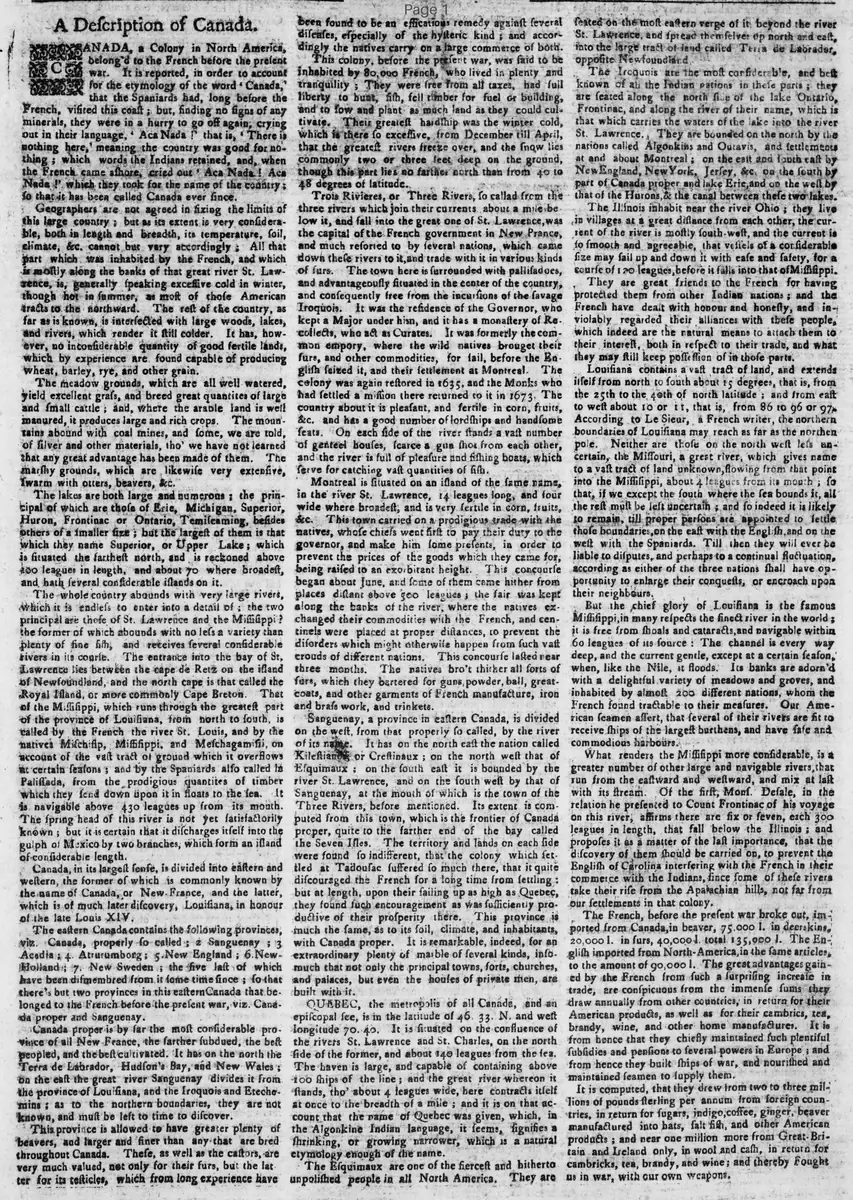
Detailed geographical, historical, and economic description of Canada as a French colony in North America before the current war, covering etymology, climate, resources, rivers, provinces like Canada proper, Sanguenay, Quebec, Montreal, Louisiana, indigenous nations, and fur trade.
Merged-components note: The image spatially overlaps with the bounding box of the story component and appears to be an illustration accompanying the 'A Description of Canada' article.
Clipping
OCR Quality
Full Text
CANADA, a Colony in North America, belong'd to the French before the present war. It is reported, in order to account for the etymology of the word "Canada," that the Spaniards had, long before the French, visited this coast; but, finding no signs of any minerals, they were in a hurry to go off again; crying out in their language, "Aca Nada" that is, "There is nothing here," meaning the country was good for nothing; which words the Indians retained, and, when the French came ashore, cried out "Aca Nada! Aca Nada!" which they took for the name of the country: So that it has been called Canada ever since.
Geographers are not agreed in fixing the limits of this large country; but as its extent is very considerable, both in length and breadth, its temperature, soil, climate, &c. cannot but vary accordingly: All that part which was inhabited by the French, and which is mostly along the banks of that great river St. Lawrence, is, generally speaking, excessive cold in winter, though hot in summer, as most of those American tracts to the northward. The rest of the country, as far as is known, is intersected with large woods, lakes, and rivers, which render it still colder. It has, however, no inconsiderable quantity of good fertile lands, which by experience are found capable of producing wheat, barley, rye, and other grain.
The meadow grounds, which are all well-watered, yield excellent grass, and breed great quantities of large and small cattle: and, where the arable land is well manured, it produces large and rich crops. The mountains abound with coal mines, and some, we are told, of silver and other materials, tho' we have not learned that any great advantage has been made of them. The marshy grounds, which are likewise very extensive, swarm with otters, beavers, &c.
The lakes are both large and numerous; the principal of which are those of Erie, Michigan, Superior, Huron, Frontinac or Ontario, Temieaming, besides others of a smaller size: but the largest of them is that which they name Superior, or Upper Lake; which is situated the farthest north, and is reckoned above 300 leagues in length, and about 70 where broadest, and hath several considerable islands on it.
The whole country abounds with very large rivers, which it is endless to enter into a detail of: the two principal are those of St. Lawrence and the Mississippi; the former of which abounds with no less a variety than plenty of fine fish, and receives several considerable rivers in its course. The entrance into the bay of St. Lawrence lies between the cape de Retz on the island of Newfoundland, and the north cape is that called the Royal Island, or more commonly Cape Breton. That of the Mississippi, which runs through the greatest part of the province of Louisiana, from north to south, is called by the French the river St. Louis, and by the natives Mississippi, Mississippi, and Mechagamiii, on account of the vast tract of ground which it overflows at certain seasons: and by the Spaniards also called la Palizada, from the prodigious quantities of timber which they send down upon it in floats to the sea. It is navigable above 430 leagues up from its mouth.
The spring head of this river is not yet satisfactorily known; but it is certain that it discharges itself into the gulf of Mexico by two branches; which form an island of considerable length.
Canada, in its largest sense, is divided into eastern and western, the former of which is commonly known by the name of Canada, or New-France, and the latter, which is of much later discovery, Louisiana, in honour of the late Louis XIV.
The eastern Canada contains the following provinces, viz. Canada, properly so-called; 2 Sanguenay; 3 Acadia; 4. Artrumborg; 5. New England; 6. New-Holland; 7. New Sweden; the five last of which have been dismembered from it some time since; so that there's but two provinces in this eastern Canada that belonged to the French before the present war, viz. Canada proper and Sanguenay.
Canada proper is by far the most considerable province of all New-France, the farthest subdued, the best peopled, and the best cultivated. It has on the north the Terra de Labrador, Hudson's Bay, and New Wales; on the east the great river Sanguenay divides it from the province of Louisiana, and the Iroquois and Etcheamins; as to the northern boundaries, they are not known, and must be left to time to discover.
This province is allowed to have greater plenty of beavers, and larger and finer than any that are bred throughout Canada. These, as well as the castors, are very much valued, not only for their furs, but the latter for its testicles, which from long experience have been found to be an efficacious remedy against several diseases, especially of the hysteric kind; and accordingly the natives carry on a large commerce of both.
This colony, before the present war, was said to be inhabited by 80,000 French, who lived in plenty and tranquility; They were free from all taxes, had full liberty to hunt, fish, fell timber for fuel or building, and to sow and plant as much land as they could cultivate. Their greatest hardship was the winter cold, which is there so excessive, from December till April, that the greatest rivers freeze over and the snow lies commonly two or three feet deep on the ground, though this part lies no farther north than from 40 to 48 degrees of latitude.
Trois Rivieres, or Three Rivers, so called from the three rivers which join their currents, about a mile below it, and fall into the great one of St. Lawrence, was the capital of the French government in New France, and much resorted to by several nations, which came down these rivers to it, and trade with it in various kinds of furs. The town here is surrounded with pallisadoes, and advantageously situated in the center of the country, and consequently free from the incursions of the savage Iroquois. It was the residence of the Governor, who kept a Major under him, and it has a monastery of Recollects, who act as Curates. It was formerly the common emporium, where the wild natives brought their furs, and other commodities, for sale, before the English seized it, and their settlement at Montreal. The colony was again restored in 1635, and the Monks who had settled a mission there returned to it in 1673. The country about it is pleasant, and fertile in corn, fruits, &c. and has a good number of lordships and handsome seats. On each side of the river stands a vast number of genteel houses, scarce a gun shot from each other, and the river is full of pleasure and fishing boats, which serve for catching vast quantities of fish.
Montreal is situated on an island of the same name, in the river St. Lawrence, 14 leagues long, and four wide where broadest, and is very fertile in corn, fruits, &c. This town carried on a prodigious trade with the natives, whose chiefs went first to pay their duty to the governor, and make him some presents, in order to prevent the prices of the goods which they came for, being raised to an exorbitant height. This concourse began about June, and some of them came hither from places distant above 100 leagues; the fair was kept along the banks of the river, where the natives exchanged their commodities with the French, and sentinels were placed at proper distances, to prevent the disorders which might otherwise happen from such vast crowds of different nations. This concourse lasted near three months. The natives brought thither all sorts of furs, which they bartered for guns, powder, ball, great-coats, and other garments of French manufacture, iron and brass work, and trinkets.
Sanguenay, a province in eastern Canada, is divided on the west, from that properly so called, by the river of its name. It has on the north east the nation called Kilestianot or Crettinaux: on the north west that of Esquimaux: on the south east it is bounded by the river St. Lawrence, and on the south west by that of Sanguenay, at the mouth of which is the town of the Three Rivers, before mentioned. Its extent is computed from this town, which is the frontier of Canada proper, quite to the farther end of the bay called the Seven Isles. The territory and lands on each side were found so indifferent, that the colony which settled at Tadouac suffered so much there, that it quite discouraged the French for a long time from settling: but at length, upon their sailing up as high as Quebec, they found such encouragement as was sufficiently productive of their prosperity there. This province is much the same, as to its soil, climate, and inhabitants, with Canada proper. It is remarkable, indeed, for an extraordinary plenty of marble of several kinds, insomuch that not only the principal towns, forts, churches, and palaces, but even the houses of private men, are built with it.
QUEBEC, the metropolis of all Canada, and an episcopal see, is in the latitude of 46. 33. N. and west longitude 70. 40. It is situated on the confluence of the rivers St. Lawrence and St. Charles, on the north side of the former, and about 140 leagues from the sea. The haven is large, and capable of containing above 100 ships of the line; and the great river whereon it stands, tho' about 4 leagues wide, here contracts itself at once to the breadth of a mile; and it is on that account that the name of Quebec was given, which, in the Algonkine Indian language, it seems, signifies a shrinking, or growing narrower, which is a natural etymology enough of the name.
The Esquimaux are one of the fiercest and hitherto unpolished people in all North America. They are seated on the most eastern verge of it beyond the river St. Lawrence, and spread themselves up north and east into the large tract of land called Terra de Labrador opposite Newfoundland.
The Iroquois are the most considerable, and best known of all the Indian nations in these parts; they are seated along the north side of the lake Ontario Frontinac, and along the river of their name, which is that which carries the waters of the lake into the river St. Lawrence. They are bounded on the north by the nations called Algonkins and Outawis, and settlements at and about Montreal; on the east and south east by New England, New York, Jersey, &c. on the south by part of Canada proper and lake Erie, and on the west by that of the Hurons, & the canal between these two lakes.
The Illinois inhabit near the river Ohio; they live in villages at a great distance from each other, the current of the river is mostly south-west, and the current is so smooth and agreeable, that vessels of a considerable size may sail up and down it with ease and safety, for a course of 120 leagues, before it falls into that of Mississippi.
They are great friends to the French for having protected them from other Indian nations; and the French have dealt with honour and honesty, and inviolably regarded their alliances with these people, which indeed are the natural means to attach them to their interest, both in respect to their trade, and what they may still keep possession of in those parts.
Louisiana contains a vast tract of land, and extends itself from north to south about 15 degrees, that is, from the 25th to the 40th of north latitude; and from east to west about 10 or 11, that is, from 86 to 96 or 97: According to Le Sieur, a French writer, the northern boundaries of Louisiana may reach as far as the northern pole. Neither are those on the north west less uncertain, the Missouri, a great river, which gives name to a vast tract of land unknown, flowing from that point into the Mississippi, about 200 leagues from its mouth; so that, if we except the south where the sea bounds it, all the rest must be left uncertain; and so indeed it is likely to remain, till proper persons are appointed to settle those boundaries on the east with the English, and on the west with the Spaniards. Till then they will ever be liable to disputes, and perhaps to a continual fluctuation, according as either of the three nations shall have opportunity to enlarge their conquests, or encroach upon their neighbours.
But the chief glory of Louisiana is the famous Mississippi, in many respects the finest river in the world; it is free from shoals and cataracts, and navigable within 60 leagues of its source: The channel is every way deep, and the current gentle, except at a certain season, when, like the Nile, it floods. Its banks are adorn'd with a delightful variety of meadows and groves, and inhabited by almost 20 different nations, whom the French found tractable to their measures. Our American seamen assert, that several of their rivers are fit to receive ships of the largest burthens, and have safe and commodious harbours.
What renders the Mississippi more considerable, is a greater number of other large and navigable rivers that run from the eastward and westward, and mix at last with its stream. Of the first, Mon. Deale, in the relation he presented to Count Frontinac of his voyage on this river, affirms there are six or seven, each 300 leagues in length, that fall below the Illinois; and proposes it as a matter of the last importance, that the discovery of them should be carried on, to prevent the English of Carolina interfering with the French in their commerce with the Indians, since some of these rivers take their rise from the Appalachian hills, not far from our settlements in that colony.
The French, before the present war broke out, imported from Canada, in beaver, 75,000 l. in deerskins, 20,000 l. in furs, 40,000 l. total 135,000 l. The English imported from North-America, in the same articles, to the amount of 90,000 l. The great advantages gained by the French from such a surprising increase in trade, are conspicuous from the immense sums they draw annually from other countries, in return for their American products, as well as for their cambrics, tea, brandy, wine, and other home manufactures. It is from hence that they chiefly maintained such plentiful subsidies and pensions to several powers in Europe; and from hence they built ships of war, and nourished and maintained seamen to supply them.
It is computed, that they drew from two to three millions of pounds sterling per annum from foreign countries, in return for sugars, indigo, coffee, ginger, beaver manufactured into hats, salt fish, and other American products; and near one million more from Great Britain and Ireland only, in wool and cash, in return for cambricks, tea, brandy, and wine; and thereby fought us in war, with our own weapons.
What sub-type of article is it?
What themes does it cover?
What keywords are associated?
Where did it happen?
Story Details
Location
Canada, North America
Event Date
Before The Present War
Story Details
Comprehensive account of Canada's etymology, geography, climate, resources, major rivers and lakes, provinces including Canada proper, Sanguenay, Quebec, Montreal, Louisiana; descriptions of indigenous nations like Esquimaux, Iroquois, Illinois; French colonial life, trade in furs, and economic benefits.