Thank you for visiting SNEWPapers!
Sign up free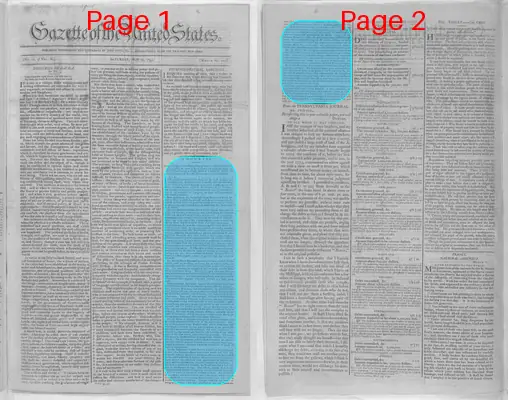
Gazette Of The United States
New York, New York County, New York
What is this article about?
On the 7th instant, in the House of Representatives, Mr. Page opposed a motion to reduce Baron Steuben's claim from $2700 to $1200 in a bill adjusting his claims, citing the Treasury report and praising Steuben's invaluable military services to the American Revolution.
Merged-components note: Continuation of Mr. Page's speech in Congress regarding Baron Steuben's claim; original labels were domestic_news and story, merged under domestic_news as it fits congressional proceedings.
Clippings
1 of 2
OCR Quality
Full Text
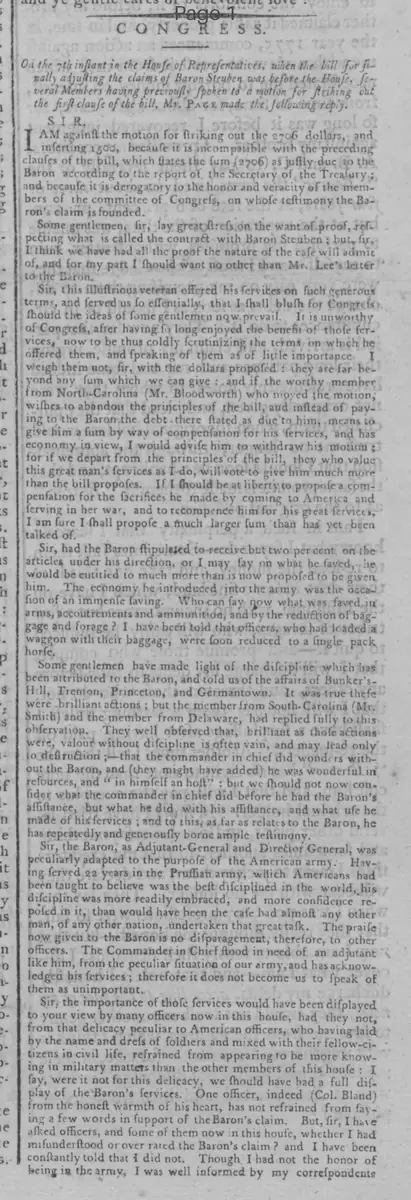
On the 7th instant in the House of Representatives, when the bill for finally adjusting the claims of Baron Steuben was before the House, several Members having previously spoken to a motion for striking out the first clause of the bill, Mr. Page made the following reply.
SIR,
I AM against the motion for striking out the 2700 dollars, and inserting 1200, because it is incompatible with the preceding clauses of the bill, which fixes the sum (2700) as justly due to the Baron according to the report of the Secretary of the Treasury; and because it is derogatory to the honor and veracity of the members of the committee of Congress, on whose testimony the Baron's claim is founded.
Some gentlemen, sir, lay great stress on the want of proof, respecting what is called the contract with Baron Steuben: but sir, I think we have had all the proof the nature of the case will admit of, and for my part I should want no other than Mr. Lee's letter to the Baron.
Sir, this illustrious veteran offered his services on such generous terms, and served us so essentially; that I shall blush for Congress, should the ideas of some gentlemen now prevail. It is unworthy of Congress, after having so long enjoyed the benefit of those services, now to be thus coldly scrutinizing the terms on which he offered them, and speaking of them as of little importance. I weigh them not, sir, with the dollars proposed: they are far beyond any sum, which we can give: and if the worthy member from North-Carolina (Mr. Bloodworth) who moved the motion; wishes to abandon the principles of the bill; and instead of paying to the Baron the debt there stated as due to him, means to give him a sum by way of compensation for his services, and has economy in view, I would advise him to withdraw his motion; for if we depart from the principles of the bill, they who value this great man's services as I do; will vote to give him much more than the bill proposes. If I should be at liberty to propose a compensation for the sacrifices he made by coming to America and serving in her war, and to recompense him for his great services, I am sure I shall propose, a much larger sum than has yet been talked of.
Sir, had the Baron stipulated to receive but two per cent. on the articles under his direction, or I may say on what he saved, he would be entitled to much more than is now proposed to be given him. The economy, he introduced into the army, was the occasion of an immense saving. Who can say now what was saved in arms, accoutrements and ammunition, and by the reduction of baggage and forage? I have been told that officers, who had loaded a waggon with their baggage; were soon reduced to a single pack horse.
Some gentlemen have made light of the discipline: which has been attributed to the Baron, and told us of the affairs of Bunker's-Hill, Trenton, Princeton, and Germantown: It was true these were brilliant actions; but the member from South-Carolina (Mr. Smith) and the member from Delaware, had replied fully to this observation. They well observed that, brilliant as those actions were, valour without discipline is often vain, and may lead only to destruction;—that the commander in chief did wonders without the Baron, and (they might have added) he was wonderful in resources, and in himself an host: but we should not now consider what the commander in chief did before he had the Baron's assistance, but what he did, with his assistance: and what use he made of his services; and to this; as far as relates to the Baron, he has repeatedly and generously borne ample testimony.
Sir, the Baron, as Adjutant-General and Director General, was peculiarly adapted to the purpose of the American army. Having served 22 years in the Prussian army, which Americans had been taught to believe was the best disciplined in the world, his discipline was more readily embraced, and more confidence reposed in it, than would have been the case had almost any other man, of any other nation, undertaken that great task. The praise now given to the Baron is no disparagement, therefore, to other officers. The Commander in Chief stood in need of an adjutant like him, from the peculiar situation of our army, and has acknowledged his services; therefore it does not become us to speak of them as unimportant.
Sir, the importance of those services would have been displayed to your view by many officers now in this house, had they not, from that delicacy peculiar to American officers, who having laid by the name and dress of soldiers and mixed with their fellow-citizens in civil life, refrained from appearing to be more knowing in military matters than the other members of this house: I say, were it not for this delicacy, we should have had a full display of the Baron's services. One officer, indeed (Col. Bland) from the honest warmth of his heart, has not refrained from saying a few words in support of the Baron's claim. But, sir, I have asked officers, and some of them now in this house, whether I had misunderstood or over rated the Baron's claim? and I have been constantly told that I did not. Though I had not the honor of being in the army, I was well informed by my correspondents.
In one of many important circumstances: and on inquiring what were the effects produced by the new Adjutant and Director General (the Baron Steuben) I was told that they were visible in many economical arrangements, in dispositions of corps, in manoeuvring in marches, in encampments, and particularly in more silent and rapid movements and preparations for action. I was told that when the Marquis de la Fayette, with a detachment under his command, was in danger of being cut off on his return to the army, and the Commander in Chief was determined to support that invaluable officer, the whole army was under arms and ready to march in less than fifteen minutes from the time the signal was given.
Sir, the effect of this discipline was seen in the marches of our army; they passed rivers in less time than the best troops in Europe could. Those excellent French troops, which served with them in the campaign of 1781, were inferior to them in this respect—the superiority of our troops, as to rapidity of movements, was seen in the attacks on the two redoubts of York-Town in Virginia.
Sir, I will affirm that, if the clause be stricken out, a larger sum ought to be inserted. We have been asked, what will our officers say to this vote in favor of the Baron? I will venture to say, Sir, they will be pleased with it; they acknowledge the obligations they were under to that great man; they view his circumstances in the same light as that gallant officer does who is now the Secretary and drew the report on which the bill before you is founded, and which does honor to his heart.
Sir, if any report deserves to be received without scrutiny, it is the one on which your bill is founded. I hope, therefore, we shall not depart from that report, in so material a point as is proposed by the motion now before you. I wish, indeed, sincerely, that the worthy member would withdraw his motion; if he will not, I must vote against it, and trust that a great majority will vote with me.
What sub-type of article is it?
What keywords are associated?
What entities or persons were involved?
Domestic News Details
Event Date
On The 7th Instant
Key Persons
Outcome
mr. page opposes motion to reduce claim from 2700 to 1200 dollars; urges adherence to treasury report and praises steuben's services.
Event Details
In the House of Representatives, during debate on bill adjusting Baron Steuben's claims, Mr. Page spoke against motion by Mr. Bloodworth to strike out first clause, arguing it contradicts Treasury report and undervalues Steuben's essential military contributions including discipline, economy, and rapid maneuvers in the American army.