Thank you for visiting SNEWPapers!
Sign up free
The Gazette
Cleveland, Cuyahoga County, Ohio
What is this article about?
In Bangville, young Danny Distin, recovering from malaria, fears missing the Fourth of July celebration. Friend Mabel Parmiter inspires a group of children to organize a surprise indoor party at his home, reroute the parade past his street, and provide fireworks, turning his disappointment into joy.
Merged-components note: Image overlaps spatially with the story text and serves as an illustration for the narrative about Danny's Fourth of July celebration.
Clipping
OCR Quality
Full Text
He had just been reading a glowing description of the celebration to be held in that lively town, and the thought that he could have no part in it filled him with impatience and discontent.
Generally Danny was not given to looking at the dark side of things; there was not a livelier, happier boy in Bangville, nor one that enjoyed fun more.
But, poor Danny! for a month he had endured the heat and cold and pains of malarial fever. And now, although the fever had left him, and he was getting well fast, he could only sit up a little while each day, and could scarcely walk from his chair to the lounge, where he lay all day, listening to the click of his mother's sewing machine, and the canary's singing.
To Danny the best day of all the year was the Fourth of July. Even the wonders of Christmas grew dim in comparison with the firecrackers and rockets, the music and processions, and, especially, the noise and confusion of that great day.
And, confidentially, I think most all boys—and some girls—hold the glorious Fourth the day of the 365.
Danny would have liked to read the wonderful things to be done the coming Wednesday to his mother, but he was too weak to raise his voice above the click of the sewing machine, and she was too busy to stop just then. And no wonder she had no time to spare, for her own nimble fingers, aided by the machine, were all she had to depend on for a living for herself and Danny.
After he dropped the paper, Danny lay very quiet, while big, hot tears determined to force their way through his closed eyelids; then there was a light tap on the door, which immediately after was opened, and two bursts of sunshine came in the room. One came from the cloudless July sky, and the other shone around the head and shoulders of a little girl about Danny's age—twelve.
At the opening of the door just then the contest between the tears and Danny's will ended in a sudden victory for the will, and a glad smile took the place of the sad look on his pale face as he said "Good morning" to Mabel Parmiter, the prettiest and most popular girl in the Bangville school.
Her dress was not quite done and she readily accepted Mrs. Distin's invitation to "sit down and talk with Danny" while she finished it. Mabel and Danny had been great friends at school and when he was first taken ill she and many other children had often visited him.
But Danny at first was too sick to be very good company himself, or to enjoy others' company, and when he began to get better other things of greater interest had drawn the children's thoughts from their visiting schoolmate.
So Danny was seldom cheered by a visit from anyone. Now he listened with pleased interest to the school news, which was all on the end of Mabel's lively little tongue.
"I s'pose they're going to have a great time this month," said Danny, at length, when Mabel paused to get breath.
"Well, I guess so," she said, starting in again with what was going to be done in Bangville to celebrate the great day.
"And, oh, Danny, don't yo s'pose you'll be well enough to go up to the corner of this street and see the fantastics? They say there's going to be a string of 'em a mile long. And if you could go to the park in the evening and see the fireworks?"
"Well, I can't," said Danny, somewhat shortly and hoarsely. "I can't sit up long at once, and I couldn't walk to the corner to save my life."
"They might just as well go down this street as Walnut," said Mabel, "it would be a good deal shadier for 'em anyway."
"Come and try on your dress, Mabel," said Mrs. Distin, putting a stop to the conversation.
"Do come again soon, Mabel," said Danny, entreatingly, "and ask some of the fellows to come soon. You don't know how lonesome I get here with mother sewing all the time and no one to talk to."
"It must be awful," said Mabel, sympathizingly. As Mabel walked quickly home she could think of nothing but Danny's hard lot, so different from her own. "How dreadful it must be," she thought, "to be there all day while all the other children are having such good vacation times.
"And the Fourth coming, too," was the climax of her pity.
When she reached home she went to her room and sat down by the window to finish a book in which she was much interested.
But it no longer pleased her, and she laid it down and went to the sewing-room, where her mother was at work.
"Mamma," she said, "he looks awful bad, so pale and thin, and they're very poor, I guess, and he isn't going to have anything the Fourth—"
"My dear child!" said her mother, "what are you talking about?"
"It's Danny Distin, mamma; he's been sick ever since long before school was out. Mamma, isn't it funny some children should have so much and others so little? Now, I am well, and papa has lots of money, and I'm going to see the procession and have everything the Fourth, and fireworks in the evening. Besides all that, I have that five dollars Aunt May gave me to buy fireworks with for myself. And Danny hasn't—a—single—thing. Mamma, don't you think people ought to divide up and all have something, and not some have it all?"
"My dear," said Mrs. Parmiter, "the things which are puzzling you have puzzled older and wiser heads for many years. All you can do to make the matter better is to divide your surplus with some one."
"That's just what I mean, mamma. Can I take my five dollars and buy fireworks for Danny instead of myself?"
"Your Aunt May gave you the money to do as you pleased with, and I have nothing to say about it. Do just as you think best."
"Then, mamma, I'll give it to Danny, and I do believe the big fireworks in the park will seem all the better to me if I don't see any little ones before I go."
When Mabel's brother came home she told him her plan, and asked him to go with her that very night and buy the fireworks.
"I declare, Mabel," he said, "you're a brick. It's a shame, anyhow, the way we've neglected Danny since he's been sick. And such a fellow as he is for fun when he's well. I'll help you buy the fireworks, and then I'll let you into a scheme of my own to help make Danny have a good Fourth. It's a pity if a fellow of my age can't do as much as a little girl."
"I'm not so much more of a little girl than you are a little boy!" said Mabel, indignantly; "you're only a year and eight months older than I am, anyway."
This was true, and Sam thought it was best to change the subject.
"Say, Mabel," he said, "are you sure you can keep it secret if I let you into it?"
"I know I can," said Mabel, eagerly. "I won't tell a person, honor bright, cross my heart." As this was the most solemn promise a Bangville child could make, Sam told her of the plan his quick mind had formed while they were talking.
What it was will appear later.
The third of July Mabel and Sam Parmiter called on Danny, and while Sam entertained him with an account of the last baseball game between the "Invincibles," of Bangville, and the "Invulnerables," of Clayton, in which games the former, but for the partiality of the umpire, would have scored a wonderful victory, Mabel beckoned Mrs. Distin into the hall and told her something that made her smile, although her eyes were moist, and say: "Bless the children!"
The morning of the Fourth of July everyone was awakened at daybreak by the ringing of bells and firing of cannon with which Bangville always ushered in the anniversary of independence. "Oh, dear!" thought Danny; "I wish the Fourth didn't come for a month yet; then, maybe, I'd be well enough to have some fun myself."
After breakfast his mother said to him: "I don't think it would hurt you to sit on the stoop a little while this morning, and—there's a box of torpedoes on the table, would it tire you very much to spoil a few of them?"
"Not much, it wouldn't," said Danny, his eyes sparkling, and looking more like himself than he had done for many long weeks.
As Danny was sitting on the stoop "spoiling" torpedoes he heard music at a distance. "O mother!" he said "there go the 'fantastics.' If I only felt strong enough to walk up to the corner and see them!"
His mother smiled to herself, but did not answer. Nearer and nearer sounded the music, and, could he believe his eyes? right by the house marched the motley throng!
When the last one was out of sight, Danny's mother told him he had better go in his bedroom and lie down awhile. He was glad to rest, for he was already tired out with pleased excitement.
As his mother expected, he at once fell asleep and slept several hours.
When he opened his eyes and looked out in the sitting-room, he closed them again, thinking what he saw was one of the pleasant dreams he had been having.
No wonder he hardly recognized the familiar room. It was draped with red, white and blue bunting. Small flags were fastened in every available place, bouquets were everywhere. In the center of the room was a table decorated with flowers, and spread with all kinds of delicacies. Around the room sat six girls in white dresses trimmed with red, white and blue ribbons and clusters of pansies, and five boys in their best clothes, each with a red rose and small flag in his buttonhole, and further ornamented with an enormous badge. These badges were supposed to be the crowning beauty of their attire, and to more than offset the girls' tricolored ribbons. There was enough variety in their badges to prevent any sameness of decoration. Two were G. A. R., one a Mason's badge, one an A. O. U. W., and one an I. O. G. T. badge.
"Hallo, old fellow, are you awake?" said Sam Parmiter, who had kept one eye on Danny all the while he had been there.
"I don't know for certain," said Danny, shutting his eyes, and then opening them to take another look, at which the company giggled in chorus. Then Danny walked out in the sitting-room and was conducted to the Boston rocking chair, the seat of honor, at the table, and the other children took their places around it. Then Sam stood up and made a speech. He was great on speech, and always worked in one wherever he could, which, as he expected to be president some day, was good practice for him.
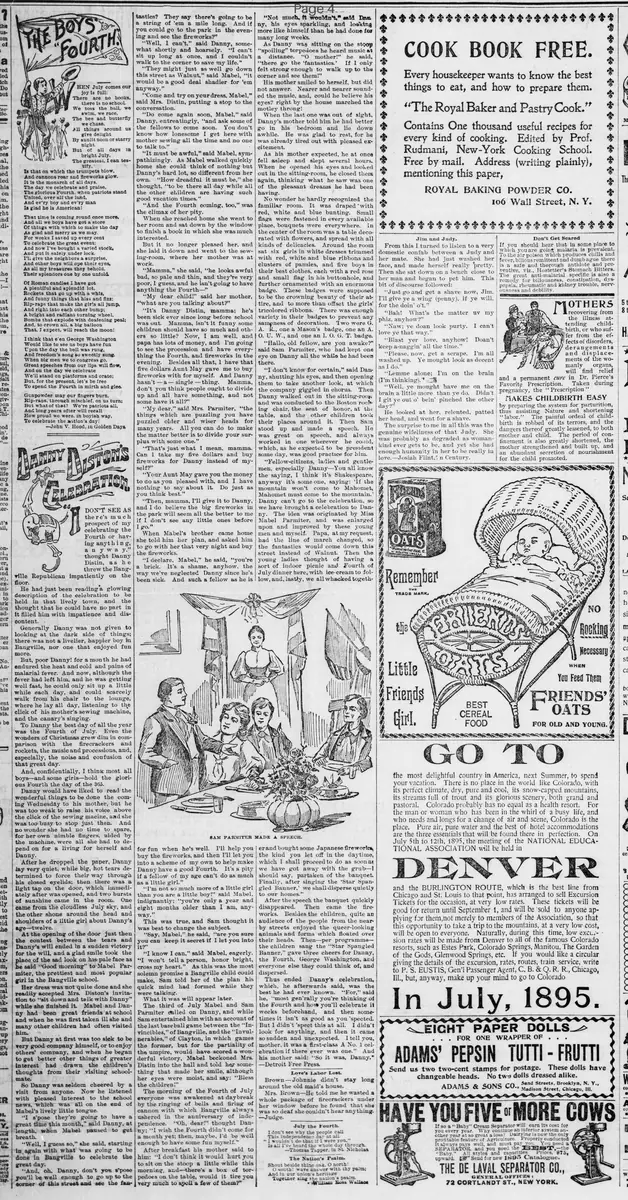
"Fellow-citizens, ladies and gentlemen, especially Danny—You all know the saying, I think it's Shakespeare, anyway it's some one, saying: 'If the mountain won't come to Mahomet, Mahomet must come to the mountain.' Danny can't go to the celebration, so we have brought a celebration to Danny. The idea was originated by Miss Mabel Parmiter, and was enlarged upon and improved by these young men and myself. Papa, at my request, had the line of march changed, so the fantastics would come down this street instead of Walnut. Then the young ladies thought of having a sort of indoor picnic and Fourth of July dinner here, with ice-cream to follow, and, lastly, we all whacked together and bought some Japanese fireworks the kind you let off in the daytime, which I shall proceed to do as soon as we have got away with the grub—I should say, partaken of the banquet. Finally, after singing the 'Star Spangled Banner,' we shall disperse quietly to our homes."
After the speech the banquet quickly disappeared. Then came the fireworks. Besides the children, quite an audience of the people from the nearby streets enjoyed the queer-looking animals and forms which floated over their heads. Then—per programme—the children sang the "Star Spangled Banner," gave three cheers for Danny, the Fourth, George Washington, and everyone else they could think of, and dispersed.
Thus ended Danny's celebration, which, he afterwards said, was the best he had ever known. "For," said he, "most gen'rally you're thinking of the Fourth and how you'll celebrate it weeks beforehand, and then sometimes it isn't as good as you 'spected. But I didn't 'spect this at all. I didn't look for anything, and then it came so sudden and unexpected. I tell you, mother, it was a first-class A No. 1 celebration if there ever was one."
And his mother said: "So it was, Danny."
-Detroit Free Press.
What sub-type of article is it?
What themes does it cover?
What keywords are associated?
What entities or persons were involved?
Where did it happen?
Story Details
Key Persons
Location
Bangville
Event Date
Fourth Of July
Story Details
Sick Danny Distin misses Bangville's Fourth of July festivities due to malarial fever recovery. Friend Mabel Parmiter uses her money for his fireworks; brother Sam and children reroute parade, host surprise indoor picnic with decorations, banquet, daytime fireworks, and singing, bringing the celebration to him.