Thank you for visiting SNEWPapers!
Sign up free
Editorial
November 8, 1947
The Wilmington Morning Star
Wilmington, New Hanover County, North Carolina
What is this article about?
The editorial examines Europe's 'war psychosis' amid Cold War tensions, where nations fear destruction from US-Soviet conflict and prepare for survival. The author urges the US to use its military superiority constructively—declaring defense commitments and non-aggressive use of atomic weapons—to ease fears, enable recovery, and negotiate peace treaties.
Clipping
OCR Quality
98%
Excellent
Full Text
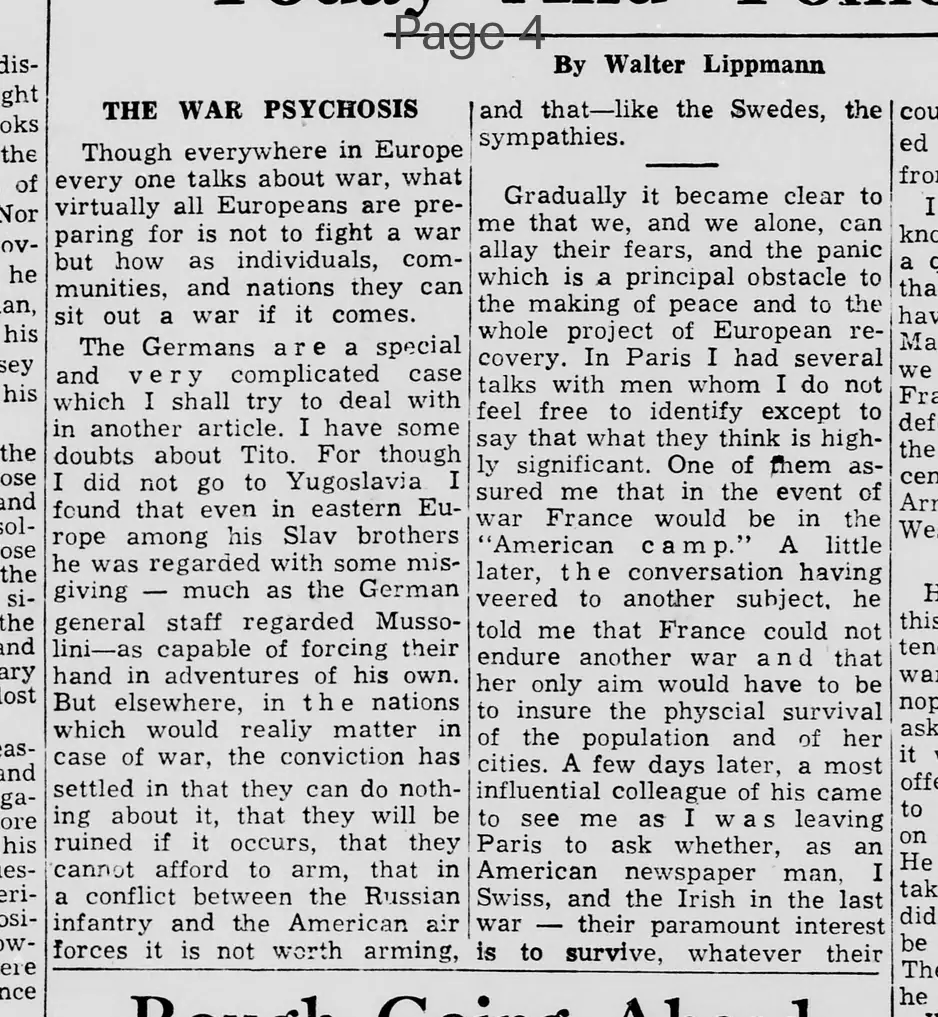
THE WAR PSYCHOSIS
Though everywhere in Europe everyone talks about war, what virtually all Europeans are preparing for is not to fight a war but how as individuals, communities, and nations they can sit out a war if it comes.
The Germans are a special and very complicated case which I shall try to deal with in another article. I have some doubts about Tito. For though I did not go to Yugoslavia I found that even in eastern Europe among his Slav brothers he was regarded with some misgiving--much as the German general staff regarded Mussolini--as capable of forcing their hand in adventures of his own.
But elsewhere, in the nations which would really matter in case of war, the conviction has settled in that they can do nothing about it, that they will be ruined if it occurs, that they cannot afford to arm, that in a conflict between the Russian infantry and the American air forces it is not worth arming.
and that like the Swedes, the Swiss, and the Irish in the last war--their paramount interest is to survive, whatever their sympathies.
Gradually it became clear to me that we, and we alone, can allay their fears, and the panic which is a principal obstacle to the making of peace and to the whole project of European recovery. In Paris I had several talks with men whom I do not feel free to identify except to say that what they think is highly significant. One of them assured me that in the event of war France would be in the "American camp." A little later, the conversation having veered to another subject, he told me that France could not endure another war and that her only aim would have to be to insure the physical survival of the population and of her cities. A few days later, a most influential colleague of his came to see me as I was leaving Paris to ask whether, as an American newspaper man, I could assure him that the United States would "defend the frontiers of France."
I replied that he ought to know better than to ask such a question. For he must know that the United States did not have the troops to man the Maginot line, that the only way we could defend the frontiers of France was the way we are now defending them, by possessing the power to strike at the vital centers of Russia if the Red Army started to invade the West.
He then asked me whether this meant that we were not intending to fight a preventive war while we still had a monopoly of the atomic bomb. I asked him how long he thought it would take us to mount an offensive near enough to Russia to drop enough atomic bombs on enough places to be decisive.
He thought it would certainly take several months. What then did he think the Russians would be doing in the mean time?
They will be occupying Paris, he replied.
Were these not the answers to his questions: That the Russians can ruin Europe and that the Americans can ruin Russia and that this is a military stalemate which only a criminal lunatic would attempt to upset?
These conversations reveal, I believe, the problem of the war psychosis which afflicts mankind, and what we can and should do about it. All of Europe outside the Russian orbit is obsessed with a dual fear.
The first is that we won't act decisively and effectively and before it is too late to stop the Red Army from advancing to the west; that the Red Army might advance to the west if Moscow believed we would not react promptly and adequately.
The second fear is that we shall decide to employ our manifest military superiority constructively, to allay fear, to provide a sense of security, to disarm suspicion, and to bring the world and ourselves back to sanity and to peace.
The time has come for the United States to transcend the cold war, and to clear the air for the European recovery program and the negotiation of treaties of peace for Germany and Austria and Japan. We can, I believe, clear the air if we decide to employ our manifest military superiority constructively, to allay fear, to provide a sense of security, to disarm suspicion, and to bring the world and ourselves back to sanity and to peace.
The remedy, it seems to me, is almost self-evident. It is to find a way of stating clearly and unequivocally that a military advance beyond the armistice line would be an act of war; that the armistice is not within the jurisdiction of the Security Council and that therefore in a violation of the armistice the veto is not pertinent.
Such a statement would not be a new commitment. But it would go a long way to allay the panic.
But that is not enough. It is necessary also to answer the fear that we could be provoked, incited, or tempted to use our tremendous offensive superiority. We should, therefore, declare--I think to the General Assembly before it adjourns--that we shall never use the atomic bomb or any other weapon except to retaliate against a deliberate, overt, and unmistakable act of military aggression by a first-class power.
They are afraid, in other words, that we won't defend them and at the same time that we shall drag them into a war.
Copyright, 1947, New York Herald Tribune Inc.
Though everywhere in Europe everyone talks about war, what virtually all Europeans are preparing for is not to fight a war but how as individuals, communities, and nations they can sit out a war if it comes.
The Germans are a special and very complicated case which I shall try to deal with in another article. I have some doubts about Tito. For though I did not go to Yugoslavia I found that even in eastern Europe among his Slav brothers he was regarded with some misgiving--much as the German general staff regarded Mussolini--as capable of forcing their hand in adventures of his own.
But elsewhere, in the nations which would really matter in case of war, the conviction has settled in that they can do nothing about it, that they will be ruined if it occurs, that they cannot afford to arm, that in a conflict between the Russian infantry and the American air forces it is not worth arming.
and that like the Swedes, the Swiss, and the Irish in the last war--their paramount interest is to survive, whatever their sympathies.
Gradually it became clear to me that we, and we alone, can allay their fears, and the panic which is a principal obstacle to the making of peace and to the whole project of European recovery. In Paris I had several talks with men whom I do not feel free to identify except to say that what they think is highly significant. One of them assured me that in the event of war France would be in the "American camp." A little later, the conversation having veered to another subject, he told me that France could not endure another war and that her only aim would have to be to insure the physical survival of the population and of her cities. A few days later, a most influential colleague of his came to see me as I was leaving Paris to ask whether, as an American newspaper man, I could assure him that the United States would "defend the frontiers of France."
I replied that he ought to know better than to ask such a question. For he must know that the United States did not have the troops to man the Maginot line, that the only way we could defend the frontiers of France was the way we are now defending them, by possessing the power to strike at the vital centers of Russia if the Red Army started to invade the West.
He then asked me whether this meant that we were not intending to fight a preventive war while we still had a monopoly of the atomic bomb. I asked him how long he thought it would take us to mount an offensive near enough to Russia to drop enough atomic bombs on enough places to be decisive.
He thought it would certainly take several months. What then did he think the Russians would be doing in the mean time?
They will be occupying Paris, he replied.
Were these not the answers to his questions: That the Russians can ruin Europe and that the Americans can ruin Russia and that this is a military stalemate which only a criminal lunatic would attempt to upset?
These conversations reveal, I believe, the problem of the war psychosis which afflicts mankind, and what we can and should do about it. All of Europe outside the Russian orbit is obsessed with a dual fear.
The first is that we won't act decisively and effectively and before it is too late to stop the Red Army from advancing to the west; that the Red Army might advance to the west if Moscow believed we would not react promptly and adequately.
The second fear is that we shall decide to employ our manifest military superiority constructively, to allay fear, to provide a sense of security, to disarm suspicion, and to bring the world and ourselves back to sanity and to peace.
The time has come for the United States to transcend the cold war, and to clear the air for the European recovery program and the negotiation of treaties of peace for Germany and Austria and Japan. We can, I believe, clear the air if we decide to employ our manifest military superiority constructively, to allay fear, to provide a sense of security, to disarm suspicion, and to bring the world and ourselves back to sanity and to peace.
The remedy, it seems to me, is almost self-evident. It is to find a way of stating clearly and unequivocally that a military advance beyond the armistice line would be an act of war; that the armistice is not within the jurisdiction of the Security Council and that therefore in a violation of the armistice the veto is not pertinent.
Such a statement would not be a new commitment. But it would go a long way to allay the panic.
But that is not enough. It is necessary also to answer the fear that we could be provoked, incited, or tempted to use our tremendous offensive superiority. We should, therefore, declare--I think to the General Assembly before it adjourns--that we shall never use the atomic bomb or any other weapon except to retaliate against a deliberate, overt, and unmistakable act of military aggression by a first-class power.
They are afraid, in other words, that we won't defend them and at the same time that we shall drag them into a war.
Copyright, 1947, New York Herald Tribune Inc.
What sub-type of article is it?
War Or Peace
Foreign Affairs
Military Affairs
What keywords are associated?
War Psychosis
European Fears
Cold War Tensions
Atomic Bomb
Red Army
Military Stalemate
European Recovery
Peace Negotiation
What entities or persons were involved?
United States
Russia
France
Germany
Tito
Yugoslavia
Sweden
Switzerland
Ireland
Editorial Details
Primary Topic
European War Fears And Us Role In Promoting Peace
Stance / Tone
Advocacy For Constructive Us Military Policy To Alleviate European Fears And Foster Peace
Key Figures
United States
Russia
France
Germany
Tito
Yugoslavia
Sweden
Switzerland
Ireland
Key Arguments
Europeans Are Preparing To Survive War Rather Than Fight It
Us Can Allay European Fears And Panic Obstructing Peace And Recovery
Military Stalemate Exists Where Russians Can Ruin Europe And Americans Can Ruin Russia
France Would Align With Us But Prioritizes Survival
Us Defends Europe By Striking Russian Vital Centers, Not Manning Frontiers
No Intention For Preventive Atomic War Due To Logistical Challenges
Declare Military Advance Beyond Armistice Line As Act Of War Outside Security Council Veto
Pledge Never To Use Atomic Bomb Except In Retaliation To Overt Aggression