Thank you for visiting SNEWPapers!
Sign up free
Letter to Editor
December 21, 1812
Virginia Argus
Richmond, Virginia
What is this article about?
In a letter to Hon. Langdon Cheves, 'Camillus' criticizes Cheves' advocacy for canceling bonds on merchants who illegally imported British goods during the War of 1812, arguing it rewards lawbreakers, benefits Britain, and weakens U.S. policy. He urges strict enforcement of laws to support the war effort.
Clipping
OCR Quality
98%
Excellent
Full Text
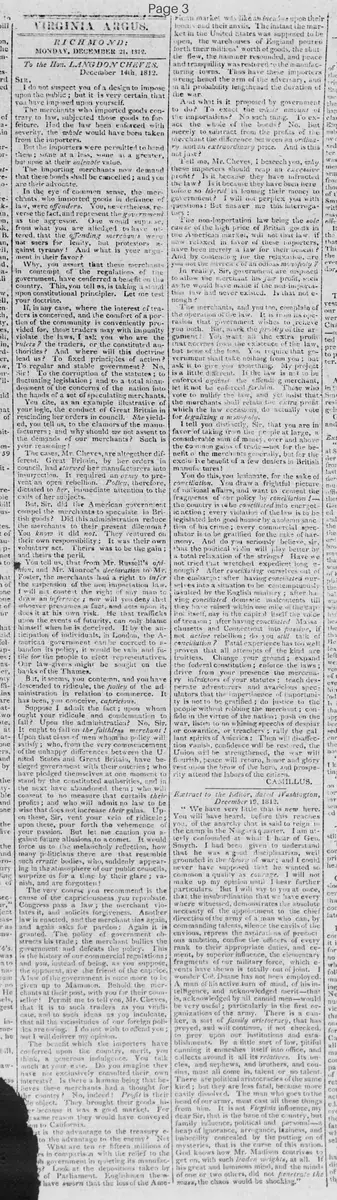
VIRGINIA ARGUS.
RICHMOND: MONDAY, DECEMBER 21, 1812.
To the Hon. LANGDON CHEVES,
December 14th, 1812.
SIR,
I do not suspect you of a design to impose upon the public; but it is very certain that you have imposed upon yourself.
The merchants who imported goods contrary to law, subjected those goods to forfeiture. Had the law been enforced with severity, the whole would have been taken from the importers.
But the importers were permitted to bond them; some at a less, some at a greater, but none at their saleable value.
The importing merchants now demand that these bonds shall be cancelled; and you are their advocate.
In the eye of common sense, the merchants who imported goods in defiance of law, were offenders. You, nevertheless, reverse the fact, and represent the government as the aggressor. One would suppose, from what you are alleged to have uttered, that the offending merchants were not suers for lenity, but protestors against tyranny! And what is your argument in their favor?
Why, you assert that these merchants in contempt of the regulations of the government, have conferred a benefit on the country. This, you tell us, is taking a stand upon constitutional principles. Let me test your doctrine.
If, in any case, where the interest of traders is concerned, and the comfort of a portion of the community is conveniently provided for, those traders may with impunity violate the laws, I ask you who are the rulers? the traders, or the constituted authorities? And where will this doctrine lead us? To fixed principles of action? To regular and stable government? No, Sir! To the corruption of the statutes: to fluctuating legislation; and to a total abandonment of the concerns of the nation into the hands of a set of speculating merchants.
You cite, as an example illustrative of your logic, the conduct of Great Britain in rescinding her orders in council. She yielded, you tell us, to the clamors of the manufacturers; and why should we not assent to the demands of our merchants? Such is your reasoning!
The cases, Mr. Cheves, are altogether different. Great Britain, by her orders in council, had starved her manufacturers into insurrection. It required an army to prevent an open rebellion. Policy, therefore, dictated to her, immediate attention to the calls of her subjects.
But, Sir, did the American government compel the merchants to speculate in British goods? Did this administration reduce the merchants to their present dilemma?
You know it did not. They ventured on their own responsibility: It was their own voluntary act. Theirs was to be the gain; and theirs the peril.
You tell us, that from Mr. Russell's opinion, and Mr. Monroe's declaration to Mr. Foster, the merchants had a right to infer the suspension of the non importation law.
I will not contest the right of any man to draw an inference; nor will you deny that whoever presumes a fact, and acts upon it, does it at his own risk. He that trafficks upon the events of futurity, can only blame himself when he is deceived. If by the anticipation of individuals, in London, the American government can be coerced to abandon its policy, it would be vain and futile for the people to elect representatives. Our law-givers might be sought on the banks of the Thames.
But it seems, you contemn, and you have descended to ridicule, the policy of the administration in relation to commerce. It has been, you conceive, capricious.
Suppose I admit the fact; upon whom ought your ridicule and condemnation to fall? Upon the administration? No. Sir. It ought to fall on the faithless merchant! Upon that class of men whom no policy will satisfy; who, from the very commencement of the unhappy differences between the United States and Great Britain, have besieged government with their outcries; who have pledged themselves at one moment to stand by the Constituted authorities, and in the next have abandoned them: who will consent to no measure that curtails their profits; and who will admit no law to be wise that does not increase their gains. Upon these, Sir, vent your vein of ridicule; upon these, pour forth the vehemence of your passion. But let me caution you against future allusions to a comet. It would force us to the melancholy reflection, how many politicians there are that resemble such erratic bodies, who, suddenly appearing in the atmosphere of our public councils, surprize us for a time by their glare; vanish, and are forgotten!
The very course you recommend is the cause of the capriciousness you reprobate. Congress pass a law: the merchant violates it, and solicits forgiveness. Another law is enacted, and the merchant sins again, and again asks for pardon: Again it is granted. The policy of government obstructs his trade; the merchant bullies the government and defeats the policy. This is the history of our commercial regulations; and you, instead of being, as you suppose, the opponent, are the friend of the caprice.
A law of the government is once more to be given up to Mammon. Behold the merchants at their post, with you for their counsellor! Permit me to tell you, Mr. Cheves, that it is to such traders as you vindicate, and to such ideas as you inculcate, that all the vicissitudes of our foreign politics are owing. I do not wish to offend you; but I will deliver my opinion.
The benefit which the importers have conferred upon the country, merit, you think, a generous indulgence. You talk much at your ease. Do you imagine they have not exclusively consulted their own interests? Is there a human being that believes these merchants had a thought for the country? No, indeed! Profit is their sole object. They brought their goods here because it was a good market. For the same reason they would have conveyed them to California.
But is the advantage to the treasury equal to the advantage to the enemy? Not what are ten or fifteen millions of dollars in comparison with the relief to the British government in quieting its manufacturers? Look at the depositions taken by the house of Parliament. Englishmen themselves have sworn that the loss of the American market was like an incubus upon their looms and their anvils. The instant the market in the United States was supposed to be open, the warehouses of England poured forth their millions' worth of goods, the shuttle flew, the hammer resounded, and peace and tranquillity was restored to the manufacturing towns. Thus have these importers strengthened the arm of the adversary, and in all probability lengthened the duration of the war.
And what is it proposed by government to do? To exact the whole amount of the importations? No such thing. To exact the whole of the bonds? No. But merely to subtract from the profits of the merchant the difference between an ordinary and an extraordinary price. And is this not just?
Tell me, Mr. Cheves, I beseech you, why these importers should reap an excessive profit? Is it because they have infringed the law? Is it because they have been heretofore so liberal in loaning their money to government? I will not perplex you with questions: But answer me this interrogatory:
The non-importation law being the sole cause of the high price of British goods in the American market, will not that law if now relaxed in favor of these importers, have been merely a law for their benefit? And by contending for the relaxation, are you not the advocate of an odious monopoly?
In reality, Sir, government are disposed to allow the merchant his fair profit, even as he would have made if the non-importation law had never existed. Is that not enough?
The merchants, and you too, complain of the operation of the law. It is in its operation that government wishes to relieve you both. But, mark the proviso of the argument! You want all the extra profit that accrues from the existence of the law, but none of the loss. You require that government shall take nothing from you; but ask it to give you something. My project is a little different. If the law is not to be enforced against the offending merchant, let it not be enforced for him. Those who vote to nullify the law, and yet insist that the merchants shall retain the extra profit which the law occasions, do actually vote for legalizing a monopoly.
I tell you distinctly, Sir, that you are in favor of taking from the people at large, a considerable sum of money, over and above the common gains of trade -- not for the benefit of the merchants generally, but for the exclusive benefit of a few dealers in British manufactures!
You do this, you insinuate, for the sake of conciliation. You draw a frightful picture of national affairs, and want to cement the fragments of our policy by conciliation! -- the country is to be conciliated into energetic action; every violation of the law is to be legislated into good humor by a solemn sanction of his crime; every commercial speculator is to be gratified for the sake of harmony. And do you seriously believe, sir, that the political violin will play better by a total relaxation of the strings? Have we not tried that wretched expedient long enough? After conciliating ourselves out of the embargo: after having conciliated ourselves into a situation to be contemptuously insulted by the English ministry; after having conciliated domestic malcontents till they have raised within one mile of the Capitol itself, nay in the capitol itself the voice of treason; after having conciliated Massachusetts and Connecticut into passive, if not active rebellion; do you still talk of conciliation? Fatal experience has too well proven that all attempts of the kind are fruitless. Change your ground; expand the federal constitution; enforce the laws; drive from your presence the mercenary infringers of your statutes; teach desperate adventurers and avaricious speculators that the impertinence of importunity is not to be gratified; do justice to the people without robbing the merchant; confide in the virtue of the nation; push on the war, listen to no whining speeches of despair or cowardice, or treachery; rally the gallant spirits of America: Then will disaffection vanish, confidence will be restored, the Union will be strengthened, the war will flourish, peace will return, honor and glory rest upon the brow of the hero, and prosperity attend the labors of the citizen.
CAMILLUS.
RICHMOND: MONDAY, DECEMBER 21, 1812.
To the Hon. LANGDON CHEVES,
December 14th, 1812.
SIR,
I do not suspect you of a design to impose upon the public; but it is very certain that you have imposed upon yourself.
The merchants who imported goods contrary to law, subjected those goods to forfeiture. Had the law been enforced with severity, the whole would have been taken from the importers.
But the importers were permitted to bond them; some at a less, some at a greater, but none at their saleable value.
The importing merchants now demand that these bonds shall be cancelled; and you are their advocate.
In the eye of common sense, the merchants who imported goods in defiance of law, were offenders. You, nevertheless, reverse the fact, and represent the government as the aggressor. One would suppose, from what you are alleged to have uttered, that the offending merchants were not suers for lenity, but protestors against tyranny! And what is your argument in their favor?
Why, you assert that these merchants in contempt of the regulations of the government, have conferred a benefit on the country. This, you tell us, is taking a stand upon constitutional principles. Let me test your doctrine.
If, in any case, where the interest of traders is concerned, and the comfort of a portion of the community is conveniently provided for, those traders may with impunity violate the laws, I ask you who are the rulers? the traders, or the constituted authorities? And where will this doctrine lead us? To fixed principles of action? To regular and stable government? No, Sir! To the corruption of the statutes: to fluctuating legislation; and to a total abandonment of the concerns of the nation into the hands of a set of speculating merchants.
You cite, as an example illustrative of your logic, the conduct of Great Britain in rescinding her orders in council. She yielded, you tell us, to the clamors of the manufacturers; and why should we not assent to the demands of our merchants? Such is your reasoning!
The cases, Mr. Cheves, are altogether different. Great Britain, by her orders in council, had starved her manufacturers into insurrection. It required an army to prevent an open rebellion. Policy, therefore, dictated to her, immediate attention to the calls of her subjects.
But, Sir, did the American government compel the merchants to speculate in British goods? Did this administration reduce the merchants to their present dilemma?
You know it did not. They ventured on their own responsibility: It was their own voluntary act. Theirs was to be the gain; and theirs the peril.
You tell us, that from Mr. Russell's opinion, and Mr. Monroe's declaration to Mr. Foster, the merchants had a right to infer the suspension of the non importation law.
I will not contest the right of any man to draw an inference; nor will you deny that whoever presumes a fact, and acts upon it, does it at his own risk. He that trafficks upon the events of futurity, can only blame himself when he is deceived. If by the anticipation of individuals, in London, the American government can be coerced to abandon its policy, it would be vain and futile for the people to elect representatives. Our law-givers might be sought on the banks of the Thames.
But it seems, you contemn, and you have descended to ridicule, the policy of the administration in relation to commerce. It has been, you conceive, capricious.
Suppose I admit the fact; upon whom ought your ridicule and condemnation to fall? Upon the administration? No. Sir. It ought to fall on the faithless merchant! Upon that class of men whom no policy will satisfy; who, from the very commencement of the unhappy differences between the United States and Great Britain, have besieged government with their outcries; who have pledged themselves at one moment to stand by the Constituted authorities, and in the next have abandoned them: who will consent to no measure that curtails their profits; and who will admit no law to be wise that does not increase their gains. Upon these, Sir, vent your vein of ridicule; upon these, pour forth the vehemence of your passion. But let me caution you against future allusions to a comet. It would force us to the melancholy reflection, how many politicians there are that resemble such erratic bodies, who, suddenly appearing in the atmosphere of our public councils, surprize us for a time by their glare; vanish, and are forgotten!
The very course you recommend is the cause of the capriciousness you reprobate. Congress pass a law: the merchant violates it, and solicits forgiveness. Another law is enacted, and the merchant sins again, and again asks for pardon: Again it is granted. The policy of government obstructs his trade; the merchant bullies the government and defeats the policy. This is the history of our commercial regulations; and you, instead of being, as you suppose, the opponent, are the friend of the caprice.
A law of the government is once more to be given up to Mammon. Behold the merchants at their post, with you for their counsellor! Permit me to tell you, Mr. Cheves, that it is to such traders as you vindicate, and to such ideas as you inculcate, that all the vicissitudes of our foreign politics are owing. I do not wish to offend you; but I will deliver my opinion.
The benefit which the importers have conferred upon the country, merit, you think, a generous indulgence. You talk much at your ease. Do you imagine they have not exclusively consulted their own interests? Is there a human being that believes these merchants had a thought for the country? No, indeed! Profit is their sole object. They brought their goods here because it was a good market. For the same reason they would have conveyed them to California.
But is the advantage to the treasury equal to the advantage to the enemy? Not what are ten or fifteen millions of dollars in comparison with the relief to the British government in quieting its manufacturers? Look at the depositions taken by the house of Parliament. Englishmen themselves have sworn that the loss of the American market was like an incubus upon their looms and their anvils. The instant the market in the United States was supposed to be open, the warehouses of England poured forth their millions' worth of goods, the shuttle flew, the hammer resounded, and peace and tranquillity was restored to the manufacturing towns. Thus have these importers strengthened the arm of the adversary, and in all probability lengthened the duration of the war.
And what is it proposed by government to do? To exact the whole amount of the importations? No such thing. To exact the whole of the bonds? No. But merely to subtract from the profits of the merchant the difference between an ordinary and an extraordinary price. And is this not just?
Tell me, Mr. Cheves, I beseech you, why these importers should reap an excessive profit? Is it because they have infringed the law? Is it because they have been heretofore so liberal in loaning their money to government? I will not perplex you with questions: But answer me this interrogatory:
The non-importation law being the sole cause of the high price of British goods in the American market, will not that law if now relaxed in favor of these importers, have been merely a law for their benefit? And by contending for the relaxation, are you not the advocate of an odious monopoly?
In reality, Sir, government are disposed to allow the merchant his fair profit, even as he would have made if the non-importation law had never existed. Is that not enough?
The merchants, and you too, complain of the operation of the law. It is in its operation that government wishes to relieve you both. But, mark the proviso of the argument! You want all the extra profit that accrues from the existence of the law, but none of the loss. You require that government shall take nothing from you; but ask it to give you something. My project is a little different. If the law is not to be enforced against the offending merchant, let it not be enforced for him. Those who vote to nullify the law, and yet insist that the merchants shall retain the extra profit which the law occasions, do actually vote for legalizing a monopoly.
I tell you distinctly, Sir, that you are in favor of taking from the people at large, a considerable sum of money, over and above the common gains of trade -- not for the benefit of the merchants generally, but for the exclusive benefit of a few dealers in British manufactures!
You do this, you insinuate, for the sake of conciliation. You draw a frightful picture of national affairs, and want to cement the fragments of our policy by conciliation! -- the country is to be conciliated into energetic action; every violation of the law is to be legislated into good humor by a solemn sanction of his crime; every commercial speculator is to be gratified for the sake of harmony. And do you seriously believe, sir, that the political violin will play better by a total relaxation of the strings? Have we not tried that wretched expedient long enough? After conciliating ourselves out of the embargo: after having conciliated ourselves into a situation to be contemptuously insulted by the English ministry; after having conciliated domestic malcontents till they have raised within one mile of the Capitol itself, nay in the capitol itself the voice of treason; after having conciliated Massachusetts and Connecticut into passive, if not active rebellion; do you still talk of conciliation? Fatal experience has too well proven that all attempts of the kind are fruitless. Change your ground; expand the federal constitution; enforce the laws; drive from your presence the mercenary infringers of your statutes; teach desperate adventurers and avaricious speculators that the impertinence of importunity is not to be gratified; do justice to the people without robbing the merchant; confide in the virtue of the nation; push on the war, listen to no whining speeches of despair or cowardice, or treachery; rally the gallant spirits of America: Then will disaffection vanish, confidence will be restored, the Union will be strengthened, the war will flourish, peace will return, honor and glory rest upon the brow of the hero, and prosperity attend the labors of the citizen.
CAMILLUS.
What sub-type of article is it?
Persuasive
Political
Provocative
What themes does it cover?
Commerce Trade
Economic Policy
Politics
What keywords are associated?
Non Importation Law
Merchant Bonds
Illegal Imports
War Of 1812
Langdon Cheves
British Goods
Government Policy
Commercial Speculation
Conciliation Failure
What entities or persons were involved?
Camillus
Hon. Langdon Cheves
Letter to Editor Details
Author
Camillus
Recipient
Hon. Langdon Cheves
Main Argument
opposes canceling bonds for merchants who illegally imported british goods, arguing it rewards violators, aids the enemy, undermines authority, and creates monopoly; urges enforcing laws to support war and national unity.
Notable Details
References Mr. Russell's Opinion And Mr. Monroe's Declaration To Mr. Foster
Cites Great Britain's Orders In Council And Manufacturers' Clamors
Alludes To Comet As Metaphor For Erratic Politicians
Mentions Embargo, Non Importation Law, Depositions In British Parliament
Criticizes Conciliation Policy Leading To Rebellion In Massachusetts And Connecticut