Thank you for visiting SNEWPapers!
Sign up free
Editorial
October 9, 1863
The Manitowoc Pilot
Manitowoc, Manitowoc County, Wisconsin
What is this article about?
A creed outlining Democratic Party principles, including equal justice, support for state governments, civil over military power, economic efficiency, and freedoms of religion, speech, press, and person, followed by a quote from Stephen A. Douglas's 1860 speech in Detroit urging adherence to these principles.
Clipping
OCR Quality
95%
Excellent
Full Text
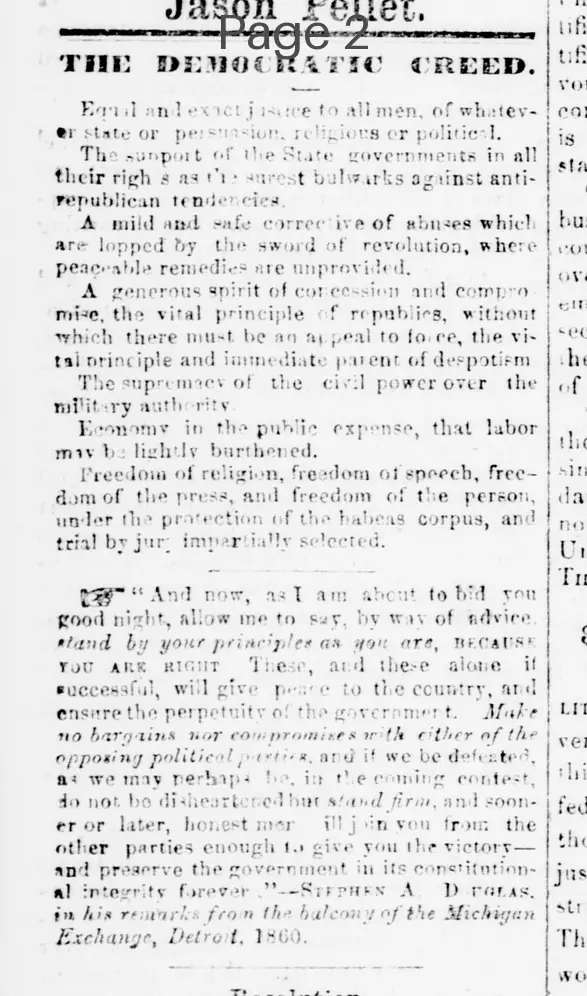
THE DEMOCRATIC CREED.
Equal justice to all men, of whatever state or persuasion, religion or politics.
The support of the State governments in all their rights as the best bulwarks against anti-republican tendencies.
A mild and safe corrective of abuses which are lopped by the sword of revolution, where peaceable remedies are unprovided.
A generous spirit of concession and compromise, the vital principle of republics, without which there must be an appeal to force, the vital principle and immediate parent of despotism.
The supremacy of the civil power over the military authority.
Economy in the public expense, that labor may be lightly burdened.
Freedom of religion, freedom of speech, freedom of the press, and freedom of the person, under the protection of the habeas corpus, and trial by jury impartially selected.
"And now, as I am about to bid you good night, allow me to say, by way of advice, stand by your principles as you are. Because you are right. These, and there alone, if successful, will give peace to the country, and ensure the perpetuity of the government. Make no bargains nor compromises with the other of the opposing political parties, and if we be defeated, as we may perhaps be, in the coming contest, do not be disheartened but stand firm, and sooner or later, honest men will join in with you from the other parties enough to give you the victory, and preserve the government in its constitutional integrity forever." - Stephen A. Douglas, in his remarks from the balcony of the Michigan Exchange, Detroit, 1860.
Equal justice to all men, of whatever state or persuasion, religion or politics.
The support of the State governments in all their rights as the best bulwarks against anti-republican tendencies.
A mild and safe corrective of abuses which are lopped by the sword of revolution, where peaceable remedies are unprovided.
A generous spirit of concession and compromise, the vital principle of republics, without which there must be an appeal to force, the vital principle and immediate parent of despotism.
The supremacy of the civil power over the military authority.
Economy in the public expense, that labor may be lightly burdened.
Freedom of religion, freedom of speech, freedom of the press, and freedom of the person, under the protection of the habeas corpus, and trial by jury impartially selected.
"And now, as I am about to bid you good night, allow me to say, by way of advice, stand by your principles as you are. Because you are right. These, and there alone, if successful, will give peace to the country, and ensure the perpetuity of the government. Make no bargains nor compromises with the other of the opposing political parties, and if we be defeated, as we may perhaps be, in the coming contest, do not be disheartened but stand firm, and sooner or later, honest men will join in with you from the other parties enough to give you the victory, and preserve the government in its constitutional integrity forever." - Stephen A. Douglas, in his remarks from the balcony of the Michigan Exchange, Detroit, 1860.
What sub-type of article is it?
Partisan Politics
Constitutional
What keywords are associated?
Democratic Creed
Stephen Douglas
1860
Political Principles
Civil Liberties
State Rights
Freedom Of Speech
Freedom Of Press
What entities or persons were involved?
Stephen A. Douglas
Democratic Party
State Governments
Editorial Details
Primary Topic
Democratic Party Creed And Principles
Stance / Tone
Affirmation Of Democratic Principles And Call To Stand Firm
Key Figures
Stephen A. Douglas
Democratic Party
State Governments
Key Arguments
Equal Justice To All Men Regardless Of State, Persuasion, Religion, Or Politics
Support State Governments As Bulwarks Against Anti Republican Tendencies
Mild Corrective Of Abuses To Avoid Revolution
Generous Concession And Compromise As Vital To Republics
Supremacy Of Civil Power Over Military
Economy In Public Expense To Lighten Labor's Burden
Freedoms Of Religion, Speech, Press, Person, Habeas Corpus, And Impartial Jury Trial
Stand By Principles Without Compromise To Ensure Peace And Government Perpetuity