Thank you for visiting SNEWPapers!
Sign up free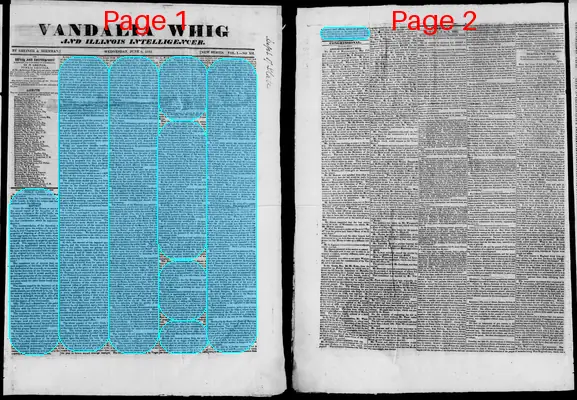
Vandalia Whig And Illinois Intelligencer
Vandalia, Fayette County, Illinois
What is this article about?
On April 17, 1832, the U.S. House Committee on Public Lands, via Mr. Wickliffe, rejected the Secretary of the Treasury's proposal to sell public lands to the states containing them and distribute proceeds among all states. They argued it would burden new states, advocated reducing land prices to aid settlement, and opposed pledging proceeds for state purposes, citing constitutional and policy concerns.
Merged-components note: Continuation of the congressional report on public lands across pages 1 and 2, based on sequential reading order and matching text content.
Clippings
1 of 2
OCR Quality
Full Text
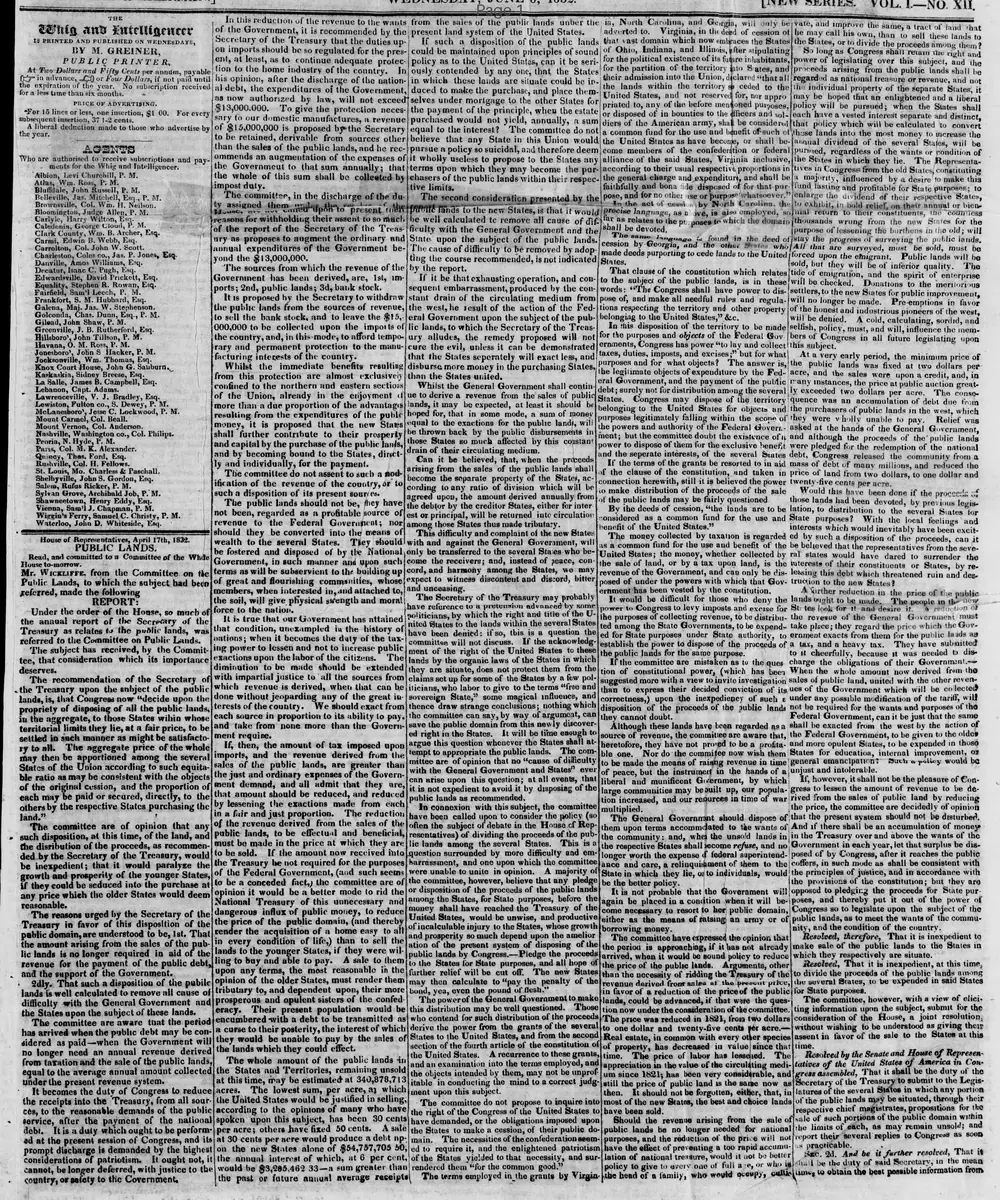
PUBLIC LANDS.
Read and committed to a Committee of the Whole House to-morrow.
Mr. Wickliffe, from the Committee on the Public Lands, to which the subject had been referred, made the following
REPORT:
Under the order of the House, so much of the annual report of the Secretary of the Treasury as relates to the public lands, was referred to the Committee on Public Lands.
The subject has received, by the Committee, that consideration which its importance deserves.
The recommendation of the Secretary of the Treasury upon the subject of the public lands, is, that Congress now "decide upon the propriety of disposing of all the public lands, in the aggregate, to those States within whose territorial limits they lie, at a fair price, to be settled in such manner as might be satisfactory to all. The aggregate price of the whole may then be apportioned among the several States of the Union according to such equitable ratio as may be consistent with the objects of the original cession, and the proportion of each may be paid or secured, directly, to the others by the respective States purchasing the land."
The committee are of opinion that any such disposition, at this time, of the land, and the distribution of the proceeds, as recommended by the Secretary of the Treasury, would be inexpedient; that it would paralyze the growth and prosperity of the younger States, if they could be seduced into the purchase at any price which the older States would deem reasonable.
The reasons urged by the Secretary of the Treasury in favor of this disposition of the public domain, are understood to be, 1st. That the amount arising from the sales of the public lands is no longer required in aid of the revenue or the payment of the public debt, and the support of the Government.
2dly. That such a disposition of the public lands is well calculated to remove all cause of difficulty with the General Government and the States upon the subject of these lands.
The committee are aware that the period has arrived when the public debt may be considered as paid—when the Government will no longer need an annual revenue derived from taxation and the sale of the public lands, equal to the average annual amount collected under the present revenue system.
It becomes the duty of Congress to reduce the receipts into the Treasury, from all sources, to the reasonable demands of the public service, after the payment of the national debt. It is a duty which ought to be performed at the present session of Congress, and its prompt discharge is demanded by the highest considerations of patriotism. It ought not, it cannot, be longer deferred, with justice to the country, or safety to the Government.
In this reduction of the revenue to the wants of the Government, it is recommended by the Secretary of the Treasury that the duties upon imports should be so regulated for the present, at least, as to continue adequate protection to the home industry of the country. In his opinion, after the discharge of the national debt, the expenditures of the Government, as now authorized by law, will not exceed $13,000,000. To give the protection necessary to our domestic manufactures, a revenue of $15,000,000 is proposed by the Secretary to be retained, derivable from sources other than the sales of the public lands, and he recommends an augmentation of the expenses of the Government to that sum annually; that the whole of this sum shall be collected by impost duty.
The committee, in the discharge of the duty and the report present reasons for withholding their assent to so much of the report of the Secretary of the Treasury as proposes to augment the ordinary and annual expenditures of the Government beyond the $13,000,000.
"The sources from which the revenue of the Government has been derived, are, 1st, imports; 2nd, public lands; 3d, bank stock.
It is proposed by the Secretary to withdraw the public lands from the sources of revenue, to sell the bank stock, and to leave the $15,000,000 to be collected upon the imports of the country, and, in this mode, to afford temporary and permanent protection to the manufacturing interests of the country.
Whilst the immediate benefits resulting from this protection are almost exclusively confined to the northern and eastern sections of the Union, already in the enjoyment of more than a due proportion of the advantages resulting from the expenditures of the public money, it is proposed that the new States shall further contribute to their prosperity and capital by the purchase of the public lands, and by becoming bound to the States, directly and individually, for the payment.
The committee do not assent to such a modification of the revenue of the country, or to such a disposition of its present sources.
The public lands should not be, they have not been, regarded as a profitable source of revenue to the Federal Government; nor should they be converted into the means of wealth to the several States. They should be fostered and disposed of by the National Government, in such manner and upon such terms as will be subservient to the building up of great and flourishing communities, whose members, when interested in and attached to, the soil, will give physical strength and moral force to the nation.
It is true that our Government has attained that condition, unexampled in the history of nations; when it becomes the duty of the taxing power to lessen and not to increase public exactions upon the labor of the citizens." The diminution to be made should be extended with impartial justice to all the sources from which revenue is derived, when that can be done without jeoparding any of the great interests of the country. We should exact from each source in proportion to its ability to pay, and take from none more than the Government requires.
If, then, the amount of tax imposed upon imports, and the revenue derived from the sales of the public lands, are greater than the just and ordinary expenses of the Government demand, and all admit that they are, that amount should be reduced, and reduced by lessening the exactions made from each in a fair and just proportion. The reduction of the revenue derived from the sales of the public lands, to be effectual and beneficial, must be made in the price at which they are to be sold. If the amount now received into the Treasury be not required for the purposes of the Federal Government, (and such seems to be a conceded fact,) the committee are of opinion it would be a better mode to rid the National Treasury of this unnecessary and dangerous influx of public money, to reduce the price of the public domain, (and thereby render the acquisition of a home easy to all in every condition of life,) than to sell the lands to the younger States, if they were willing to buy and able to pay. A sale to them upon any terms, the most reasonable in the opinion of the older States, must render them tributary to, and dependent upon, their more prosperous and opulent sisters of the confederacy. Their present population would be encumbered with a debt to be transmitted as a curse to their posterity, the interest of which they would be unable to pay by the sales of the lands which they could effect.
The whole amount of the public lands in the States and Territories, remaining unsold at this time, may be estimated at 340,878,713 acres. The lowest sum, per acre, at which the United States would be justified in selling, according to the opinions of many who have spoken upon this subject, has been 30 cents per acre; others have fixed 50 cents. A sale at 30 cents per acre would produce a debt upon the new States alone of $102,263,614, the annual interest of which, at 6 per cent, would be $6,135,816.84—a sum greater than from the sales of the public lands under the present land system of the United States.
If such a disposition of the public lands could be maintained upon principles of sound policy as to the United States, can it be seriously contended by any one, that the States in which these lands are situate could be induced to make the purchase, and place themselves under mortgage to the other States for the payment of the principle, when the estate purchased would not yield, annually, a sum equal to the interest? The committee do not believe that any State in this Union would pursue a policy so suicidal, and therefore deem it wholly useless to propose to the States any terms upon which they may become the purchasers of the public lands within their respective limits.
The second consideration presented by the public lands to the new States, is that it would be well calculated to remove all cause of difficulty with the General Government and the State upon the subject of the public lands.
The cause of difficulty to be removed by adopting the course recommended, is not indicated by the report.
If it be that exhausting operation, and consequent embarrassment, produced by the constant drain of the circulating medium from the west, the result of the action of the Federal Government upon the subject of the public lands, to which the Secretary of the Treasury alludes, the remedy proposed will not cure the evil, unless it can be demonstrated that the States separately will exact less, and disburse more money in the purchasing States, than the States united.
Whilst the General Government shall continue to derive a revenue from the sales of public lands, it may be expected, at least it should be hoped for, that in some mode, a sum of money equal to the exactions for the public lands, will be thrown back by the public disbursements in those States so much affected by this constant drain of their circulating medium.
Can it be believed, that, when the proceeds arising from the sales of the public lands shall become the separate property of the States, according to any ratio of division which will be agreed upon, the amount derived annually from the debtor by the creditor States, either for interest or principal, will be returned into circulation among those States thus made tributary.
This difficulty and complaint of the new States with and against the General Government, will only be transferred to the several States who become the receivers; and, instead of peace, concord, and harmony among the States, we may expect to witness discontent and discord, bitter and unceasing.
The Secretary of the Treasury may probably have reference to a pretension advanced by some politicians, by which the right and title of the United States to the lands within the several States have been denied: if so, this is a question the committee will not discuss. If the acknowledgment of the right of the United States to these lands by the organic laws of the States in which they are situate, does not protect them from the claims set up for some of the States by a few politicians, who labor to give to the terms "free and sovereign State," some magical influence, and thence draw strange conclusions; nothing which the committee can say, by way of argument, can save the public domain from this newly discovered right in the States. It will be time enough to argue this question whenever the States shall attempt to appropriate the public lands. The committee are of opinion that no "cause of difficulty with the General Government and States" ever can arise upon this question; at all events, that it is not expedient to avoid it by disposing of the public lands as recommended.
In connexion with this subject, the committee have been called upon to consider the policy (so often the subject of debate in the House of Representatives) of dividing the proceeds of the public lands among the several States. This is a question surrounded by more difficulty and embarrassment, and one upon which the committee were unable to unite in opinion. A majority of the committee, however, believe that any pledge or disposition of the proceeds of the public lands among the States, or State purposes, before the money shall have reached the Treasury of the United States, would be unwise, and productive of incalculable injury to the States, whose growth and prosperity so much depend upon the amelioration of the present system of disposing of the public lands by Congress.—Pledge the proceeds to the States for State purposes, and all hope of further relief will be cut off. The new States may then calculate to "pay the penalty of the bond, yea, even the pound of flesh."
The power of the General Government to make this distribution may be well questioned. Those who contend for such distribution of the proceeds derive the power from the grants of the several States to the United States, and from the second section of the fourth article of the constitution of the United States. A recurrence to these grants, and an examination into the terms employed, and the objects intended by them, may not be unprofitable in conducting the mind to a correct judgment upon this subject.
The committee do not propose to inquire into the right of the Congress of the United States to have demanded, or the obligations imposed upon the States to make a cession, of their public domain. The necessities of the confederation seemed to require it, and the enlightened patriotism of the States yielded to that necessity, and surrendered them "for the common good."
The terms employed in the grants by Virginia, North Carolina, and Georgia, will only be adverted to. Virginia, in the deed of cession of that vast domain which now embraces the States of Ohio, Indiana, and Illinois, after stipulating for the political existence of its future inhabitants, for the partition of the territory into States, and their admission into the Union, declared "that all the lands within the territory so ceded to the United States, and not reserved for, nor appropriated to, any of the before mentioned purposes, or disposed of in bounties to the officers and soldiers of the American army, shall be considered a common fund for the use and benefit of such of the United States as have become, or shall become members of the confederation or federal alliance of the said States, Virginia inclusive, according to their usual respective proportions in the general charge and expenditure, and shall be faithfully and bona fide disposed of for that purpose, and for no other use or purpose whatsoever."
In the act of cession by North Carolina, the precise language, as above, is also employed, so far as relates to the purposes to which the domain shall be devoted.
The same language is found in the deed of cession by Georgia, and the other States who made deeds purporting to cede lands to the United States.
That clause of the constitution which relates to the subject of the public lands, is in these words: "The Congress shall have power to dispose of, and make all needful rules and regulations respecting the territory and other property belonging to the United States," &c.
In this disposition of the territory to be made for the purposes and objects of the Federal Government, Congress has power "to lay and collect taxes, duties, imposts, and excises;" but for what purposes and for what objects? The answer is, the legitimate objects of expenditure by the Federal Government, and the payment of the public debt; surely not for distribution among the several States. Congress may dispose of the territory belonging to the United States for objects and purposes legitimately falling within the scope of the powers and authority of the Federal Government; but the committee doubt the existence of power to dispose of them for the exclusive benefit and the separate interests, of the several States.
If the terms of the grants be resorted to in aid of the clause of the constitution, and taken in connection herewith, still it is believed the power to make distribution of the proceeds of the sale of the public lands may be fairly questioned.
By the deeds of cession, "the lands are to be considered as a common fund for the use and benefit of the United States."
The money collected by taxation is regarded as a common fund for the use and benefit of the United States; the money, whether collected by the sale of land, or by a tax upon land, is the revenue of the Government, and can only be disposed of under the powers with which that Government has been vested by the constitution.
It would be difficult for those who deny the power to Congress to levy imposts and excise for the purposes of collecting revenue, to be distributed among the State Governments, to be expended for State purposes under State authority, to establish the power to dispose of the proceeds of the public lands for the same purpose.
If the committee are mistaken as to the question of constitutional power, (which has been suggested more with a view to invite investigation than to express their decided conviction of its correctness,) upon the inexpediency of such a disposition of the proceeds of the public land they cannot doubt.
Although these lands have been regarded as a source of revenue, the committee are aware that, heretofore, they have not proved to be a profitable one. Nor do the committee now wish them to be made the means of raising revenue in time of peace, but the instrument in the hands of a liberal and munificent Government, by which large communities may be built up, our population increased, and our resources in time of war multiplied.
The General Government should dispose of them upon terms accommodated to the wants of the community: and, when the unsold lands in the respective States shall become refuse, and no longer worth the expense of federal superintendence and care, a relinquishment of them to the State in which they lie, or to individuals, would be the better policy.
It is not probable that the Government will again be placed in a condition when it will become necessary to resort to her public domain, either as the means of raising an army or of borrowing money.
The committee have expressed the opinion that the period is approaching, if it has not already arrived, when it would be sound policy to reduce the price of the public lands. Arguments, other than the necessity of ridding the Treasury of the revenue derived from the sale at the present price, in favor of a reduction of the price of the public lands, could be advanced, if that were the question now under the consideration of the committee.
The price was reduced in 1821, from two dollars to one dollar and twenty-five cents per acre.
Real estate, in common with every other species of property, has decreased in value since that time. The price of labor has lessened. The appreciation in the value of the circulating medium since 1821, has been very considerable, and still the price of public land is the same now as then. It should not be forgotten, either, that, in most of the new States, the best and choice lands have been sold.
Should the revenue arising from the sale of public lands be no longer needed for national purposes, and the reduction of the price will not have the effect of preventing a too rapid accumulation of national treasure, would it not be better policy to give to every one of full age, or who is the head of a family, who would occupy, cultivate, and improve the same, a tract of land that he may call his own, than to sell these lands to the States, or to divide the proceeds among them?
So long as Congress shall retain the right and power of legislating over this subject, and the proceeds arising from the public lands shall be regarded as national treasure or revenue, and not the individual property of the separate States, it may be hoped that an enlightened and a liberal policy will be pursued; when the States shall each have a vested interest separate and distinct, that policy which will be calculated to convert these lands into the most money to increase the annual dividend of the several States, will be pursued, regardless of the wants or condition of the States in which they lie. The Representatives in Congress from the old States constituting a majority, influenced by a desire to make this fund lasting and profitable for State purposes; to enlarge the dividend of their respective States, to exhibit, in bold relief, on their annual or biennial return to their constituents, the countless thousands wrung from the new States for the purpose of lessening the burthens in the old; will stay the progress of surveying the public lands. All that are surveyed, must be sold, must be forced upon the emigrant. Public lands will be sold, but they will be of inferior quality. The tide of emigration, and the spirit of enterprise will be checked. Donations to the meritorious settlers, to the new States for public improvement, will no longer be made. Pre-emptions in favor of the honest and industrious pioneers of the west, will be denied. A cold, calculating, sordid, and selfish, policy, must, and will, influence the members of Congress in all future legislating upon this subject.
At a very early period, the minimum price of the public lands was fixed at two dollars per acre, and the sales were upon a credit, and, in many instances, the price at public auction greatly exceeded two dollars per acre. The consequence was an accumulation of debt due from the purchasers of public lands in the west, which they were wholly unable to pay. Relief was asked at the hands of the General Government, and although the proceeds of the public lands were pledged for the redemption of the national debt, Congress released the community from a mass of debt of many millions, and reduced the price of land from two dollars, to one dollar and twenty-five cents per acre.
Would this have been done if the proceeds of those lands had been devoted, by previous legislation, to distribution to the several States for State purposes? With the local feelings and interests which would inevitably have been excited by such a disposition of the proceeds, can it be believed that the representatives from the several states would have dared to surrender the interests of their constituents or States, by releasing this debt which threatened ruin and destruction to the new States?
A further reduction in the price of the public lands ought to be made. The people in the new States look for it and desire it. A reduction of the revenue of the General Government must take place; they regard the price which the Government exacts from them for the public lands as a tax, and a heavy tax. They have submitted to it cheerfully, because it was needed to discharge the obligations of their Government.
When the whole amount now derived from the sales of public land, united with the other revenues of the Government which will be collected under any possible modification of the tariff, will not be required for the wants and purposes of the Federal Government, can it be just that the same shall be exacted from the west by the action of the Federal Government, to be given to the older and more opulent States, to be expended in those States for education, internal improvement, or general emancipation?
Such a policy would be unjust and intolerable.
If, however, it shall not be the pleasure of Congress to lessen the amount of revenue to be derived from the sales of public land by reducing the price, the committee are decidedly of opinion that the present system should not be disturbed. And if there shall be an accumulation of money in the Treasury over and above the wants of the Government in each year, let that surplus be disposed of by Congress, after it reaches the public coffers, in such mode as shall be consistent with the principles of justice, and in accordance with the provisions of the constitution; but they are opposed to pledging the proceeds for State purposes, and thereby put it out of the power of Congress so to legislate upon the subject of the public lands, as to meet the wants of the community, and the condition of the country.
Resolved, therefore, That it is inexpedient to make sale of the public lands to the States in which they respectively are situate.
Resolved, That it is inexpedient, at this time, to divide the proceeds of the public lands among the several States, to be expended in said States for State purposes.
The committee, however, with a view of eliciting information upon the subject, submit for the consideration of the House, a joint resolution, without wishing to be understood as giving their assent in favor of the sale to the States at this time.
Resolved by the Senate and House of Representatives of the United States of America in Congress assembled, That it shall be the duty of the Secretary of the Treasury to submit to the Legislatures of the several States in which any portion of the public lands may be situated, through their respective chief magistrates, propositions for the sale of such portions of the public domain within the limits of each, as may remain unsold; and report their several replies to Congress as soon as practicable.
Sec. 2d. And be it further resolved, That it shall be the duty of said Secretary, in the mean time, to obtain the best possible information from
the several land offices, surveyors general, and such other sources as he may deem expedient, relative to the quantity, quality, and value of the public lands which remain unsold in each State, and report such information in like manner.
What sub-type of article is it?
What keywords are associated?
What entities or persons were involved?
Where did it happen?
Domestic News Details
Primary Location
United States
Event Date
1832 04 17
Key Persons
Outcome
the committee resolved that selling public lands to states and dividing proceeds among states is inexpedient; proposed reducing land prices instead and submitting propositions to state legislatures for information.
Event Details
The House Committee on Public Lands reported on the Secretary of the Treasury's recommendation to sell public lands to containing states and distribute proceeds. The committee opposed this, arguing it would harm new states' growth, create debt, and transfer difficulties between states. They advocated maintaining federal control, reducing land prices to facilitate settlement, and questioned constitutional power for distribution. Resolutions against sale and division were proposed, along with a joint resolution to seek state responses on potential sales.