Thank you for visiting SNEWPapers!
Sign up free
Story
May 1, 1868
The Jasper Weekly Courier
Jasper, Dubois County, Indiana
What is this article about?
Historical advice on horse breeding for cavalry, stressing selection of quality mares over sires, breeding seasons, gestation care, foal management, and superiority of certain bloodlines like Messenger stock and Normandy crosses.
Clipping
OCR Quality
98%
Excellent
Full Text
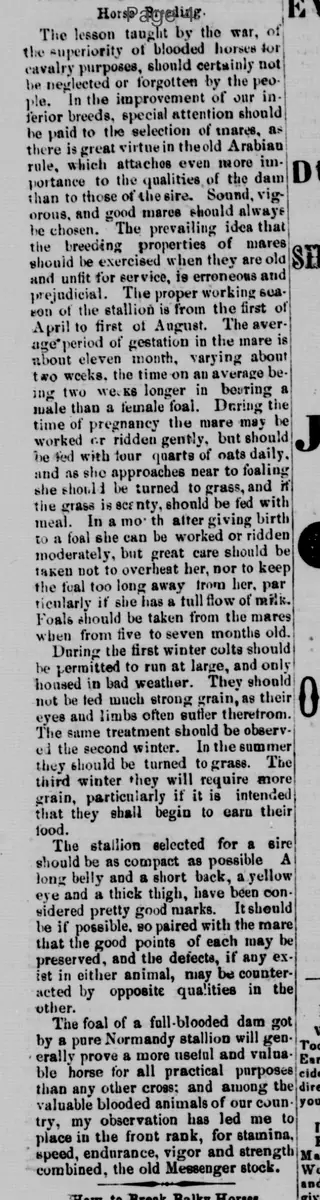
The lesson taught by the war, of the superiority of blooded horses for cavalry purposes, should certainly not be neglected or forgotten by the people. In the improvement of our inferior breeds, special attention should be paid to the selection of mares, as there is great virtue in the old Arabian rule, which attaches even more importance to the qualities of the dam than to those of the sire. Sound, vigorous, and good mares should always be chosen. The prevailing idea that the breeding properties of mares should be exercised when they are old and unfit for service, is erroneous and prejudicial. The proper working season of the stallion is from the first of April to first of August. The average period of gestation in the mare is about eleven months, varying about two weeks, the time on an average being two weeks longer in bearing a male than a female foal. During the time of pregnancy the mare may be worked or ridden gently, but should be fed with four quarts of oats daily, and as she approaches near to foaling she should be turned to grass, and if the grass is scanty, should be fed with meal. In a month after giving birth to a foal she can be worked or ridden moderately, but great care should be taken not to overheat her, nor to keep the foal too long away from her, particularly if she has a full flow of milk. Foals should be taken from the mares when from five to seven months old. During the first winter colts should be permitted to run at large, and only housed in bad weather. They should not be fed much strong grain, as their eyes and limbs often suffer therefrom. The same treatment should be observed the second winter. In the summer they should be turned to grass. The third winter they will require more grain, particularly if it is intended that they shall begin to earn their food.
The stallion selected for a sire should be as compact as possible. A long belly and a short back, a yellow eye and a thick thigh, have been considered pretty good marks. It should be, if possible, so paired with the mare that the good points of each may be preserved, and the defects, if any exist in either animal, may be counteracted by opposite qualities in the other.
The foal of a full-blooded dam got by a pure Normandy stallion will generally prove a more useful and valuable horse for all practical purposes than any other cross; and among the valuable blooded animals of our country, my observation has led me to place in the front rank, for stamina, speed, endurance, vigor and strength combined, the old Messenger stock.
The stallion selected for a sire should be as compact as possible. A long belly and a short back, a yellow eye and a thick thigh, have been considered pretty good marks. It should be, if possible, so paired with the mare that the good points of each may be preserved, and the defects, if any exist in either animal, may be counteracted by opposite qualities in the other.
The foal of a full-blooded dam got by a pure Normandy stallion will generally prove a more useful and valuable horse for all practical purposes than any other cross; and among the valuable blooded animals of our country, my observation has led me to place in the front rank, for stamina, speed, endurance, vigor and strength combined, the old Messenger stock.
What sub-type of article is it?
Curiosity
Animal Story
What themes does it cover?
Nature
Moral Virtue
What keywords are associated?
Horse Breeding
Cavalry Horses
Mare Selection
Stallion Choice
Foal Care
Blooded Stock
Normandy Cross
Messenger Stock
Story Details
Story Details
Lessons from war on superiority of blooded horses for cavalry; advice on selecting sound mares over old ones, stallion breeding season April to August, 11-month gestation, pregnancy and post-foaling care, foal weaning at 5-7 months, winter management without excess grain, stallion traits like compact build, pairing to counter defects, preference for Normandy cross and Messenger stock for endurance.