Thank you for visiting SNEWPapers!
Sign up free
The New Hampshire Gazette
Portsmouth, Rockingham County, New Hampshire
What is this article about?
A violent hurricane struck London and southern England on Friday morning, November 10, 1780, causing widespread destruction: houses demolished, trees uprooted, ships damaged, and several fatalities including a bride-to-be, a child, an old woman, and a young woman.
Clipping
OCR Quality
Full Text
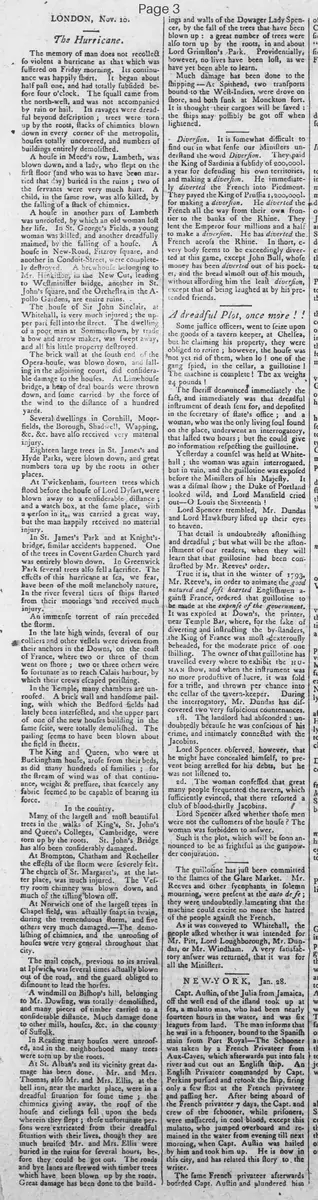
The Hurricane.
The memory of man does not recollect so violent a hurricane as that which was suffered on Friday morning. Its continuance was happily short. It began about half past one, and had totally subsided before four o'clock. The gale came from the north-west, and was not accompanied by rain or hail. Its ravages were dreadful beyond description; trees were torn up by the roots, stacks of chimneys blown down in every corner of the metropolis, houses totally uncovered, and numbers of buildings entirely demolished.
A house in Meard's row, Lambeth, was blown down, and a lady, who slept on the first floor (and who was to have been married that day) buried in the ruins; two of the servants were very much hurt. A child, in the same row, was also killed, by the falling of a stack of chimneys.
A house in another part of Lambeth was unroofed, by which an old woman lost her life. In St. George's Fields, a young woman was killed, and another dreadfully maimed, by the falling of a house. A house in New-Road, Fitzroy-square, and another in Conduit-Street, were completely destroyed. A brewhouse belonging to Mr. Hinkson, in the New Cut, leading to Westminster bridge, another in St. John's-square, and the Orchestra in the Apollo Gardens, are entire ruins.
The house of Sir John Sinclair, at Whitehall, is very much injured; the upper part fell into the street. The dwelling of a poor man at Somers-town, by trade a bow and arrow maker, was swept away, and all his little property destroyed.
The brick wall at the south end of the Opera-house, was blown down, and falling in the adjoining court, did considerable damage to the houses. At Limehouse bridge, a heap of deal boards were thrown down, and some carried by the force of the wind to the distance of a hundred yards.
Several dwellings in Cornhill, Moorfields, the Borough, Shadwell, Wapping, &c. &c. have also received very material injury.
Eighteen large trees in St. James's and Hyde Parks, were blown down, and great numbers torn up by the roots in other places.
At Twickenham, fourteen trees which stood before the house of Lord Dysart, were blown away to a considerable distance; and a watch box, at the same place, with a person in it, was carried a great way, but the man happily received no material injury.
In St. James's Park and at Knight's bridge, similar accidents happened. One of the trees in Covent Garden Church yard was entirely blown down. In Greenwich Park several trees also fell a sacrifice. The effects of this hurricane at sea, we fear, have been of the most melancholy nature.
In the river several tiers of ships started from their moorings and received much injury.
An immense torrent of rain preceded the storm.
In the late high winds, several of our colliers and other vessels were driven from their anchors in the Downs. On the coast of France, where two or three of them went on shore; two or three others were so fortunate as to reach Calais harbour, by which their crews escaped perishing.
In the Temple, many chambers are unroofed. A brick wall and handsome paling, with which the Bedford fields had lately been intersected, and the upper part of one of the new houses building in the same site, were totally demolished. The paling seems to have been blown about the field in sheets.
The King and Queen, who were at Buckingham house, arose from their beds, as did many hundreds of families; for the stream of wind was of that continuance, weight & pressure, that scarcely any fabric seemed to be capable of bearing its force.
In the country.
Many of the largest and most beautiful trees in the walks of King's, St. John's and Queen's Colleges, Cambridge, were torn up by the roots. St. John's Bridge has also been considerably damaged.
At Brompton, Chatham and Rochester the effects of the storm were severely felt. The church of St. Margaret's, at the latter place, was much injured. The Vestry room chimney was blown down, and much of the tiling blown off.
At Norwich one of the largest trees in Chapel field, was actually snapped in twain, during the tremendous storm, and five others very much damaged. The demolishing of chimneys, and the unroofing of houses were very general throughout that city.
The mail coach, previous to its arrival at Ipswich, was several times actually blown out of the road, and the guard obliged to dismount to lead the horses.
A windmill on Bishop's hill, belonging to Mr. Downing, was totally demolished, and many pieces of timber carried to a considerable distance. Much damage done to other mills, houses, &c. in the county of Suffolk.
In Reading many houses were unroofed, and in the neighbourhood many trees were torn up by the roots.
At St. Alban's and its vicinity great damage has been done. Mr. and Mrs. Thomas, also Mr. and Mrs. Ellis, at the Bell inn, near the market place, were in a dreadful situation for some time; the chimneys giving way, the roof of the house and ceilings fell, upon the beds wherein they slept; these unfortunate persons were extricated from their dreadful situation with their lives, though they are much bruised. Mr. and Mrs. Ellis were buried in the ruins for several hours, before they could be got out. The roads and bye lanes are strewed with timber trees which have been blown up by the roots.
Great damage has been done to the buildings and walls of the Dowager Lady Spencer's, by the fall of the trees that have been blown up: a great number of trees were also torn up by the roots, in and about Lord Grimston's Park. Providentially, however, no lives have been lost, as we have yet been able to learn.
Much damage has been done to the shipping. At Spithead, two transports bound to the West-Indies, were drove on shore, and both sunk at Monkton fort. It is thought their cargoes will be saved: the ships may possibly be got off when lightened.
What sub-type of article is it?
What keywords are associated?
What entities or persons were involved?
Where did it happen?
Foreign News Details
Primary Location
London
Event Date
Friday Morning, Nov. 10
Key Persons
Outcome
several fatalities including a lady buried in ruins, a child killed by falling chimney, an old woman lost her life from unroofed house, a young woman killed and another maimed by falling house; numerous injuries, buildings demolished, trees uprooted, ships damaged and sunk, no lives lost in some areas.
Event Details
A violent north-west hurricane struck London and southern England on Friday morning, lasting from half past one to four o'clock, causing extensive damage: houses blown down or unroofed, chimneys collapsed, trees uprooted in parks and estates, ships driven from moorings in the river and Downs, some wrecked on French coast but crews saved in Calais; effects felt in Cambridge, Norwich, Ipswich, Suffolk, Reading, St. Alban's, Chatham, Rochester, and Spithead with two transports sunk.