Thank you for visiting SNEWPapers!
Sign up free
Literary
July 15, 1824
Alexandria Gazette & Advertiser
Alexandria, Virginia
What is this article about?
An essay on the history and medical benefits of bathing, from ancient civilizations to modern uses, detailing types like cold, cool, warm, and hot baths as restorers of health and vigor, with references to Egyptian practices and British springs.
Merged-components note: Continuation of the article on bathing; both parts discuss different types of baths as a single literary piece.
Clipping
OCR Quality
95%
Excellent
Full Text
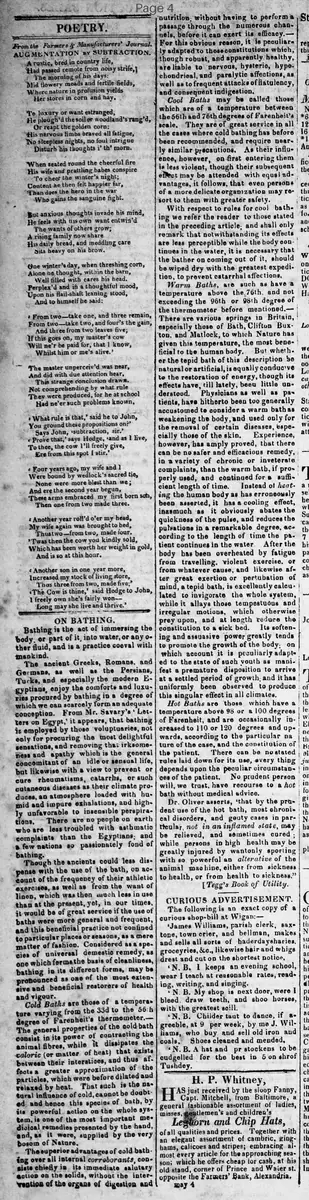
ON BATHING.
Bathing is the act of immersing the body, or part of it, into water, or any other fluid, and is a practice coeval with mankind.
The ancient Greeks, Romans, and Germans, as well as the Persians, Turks, and especially the modern Egyptians, enjoy the comforts and luxuries procured by bathing in a degree of which we can scarcely form an adequate conception. From Mr. Savary's Letters on Egypt, it appears, that bathing is employed by those voluptuaries, not only for procuring the most delightful sensations, and removing that irksomeness and apathy which is the general concomitant of an idle or sensual life, but likewise with a view to prevent or cure rheumatisms, catarrhs, or such cutaneous diseases as their climate produces, an atmosphere loaded with humid and impure exhalations, and highly unfavorable to insensible perspirations. There are no people on earth who are less troubled with asthmatic complaints than the Egyptians; and a few nations so passionately fond of bathing.
Though the ancients could less dispense with the use of the bath, on account of the frequency of their athletic exercises, as well as from the want of linen, which was then much less in use than at the present, yet, in our times, it would be of great service if the use of baths were more general and frequent, and this beneficial practice not confined to particular places or seasons, as a mere matter of fashion. Considered as a species of universal domestic remedy, as one which forms the basis of cleanliness, bathing in its different forms, may be pronounced as one of the most extensive and beneficial restorers of health and vigour.
Cold Baths are those of a temperature varying from the 33d to the 56th degree of Fahrenheit's thermometer.
The general properties of the cold bath consist in its power of contracting the animal fibres, while it dissipates the caloric (or matter of heat) that exists between their interstices, and thus effects a greater approximation of the particles, which were before dilated and relaxed by heat. That such is the natural influence of cold, cannot be doubted; and hence this species of bath, by its powerful action on the whole system, is one of the most important medical remedies presented by the hand, and, as it were, supplied by the very bosom of Nature.
The superior advantages of cold bathing over all internal corroborants, consist chiefly in its immediate salutary action on the solids, without the intervention of the organs of digestion and nutrition: without having to perform a passage through the numerous channels, before it can exert its efficacy. For this obvious reason, it is peculiarly adapted to those constitutions which, though robust, and apparently healthy, are liable to nervous, hysteric, hypochondriacal, and paralytic affections, as well as to frequent attacks of flatulency, and consequent indigestion.
Cool Baths may be called those which are of a temperature between the 56th and 76th degrees of Fahrenheit's scale. They are of great service in all the cases where cold bathing has before been recommended, and require nearly similar precautions. As their influence, however, on first entering them is less violent, though their subsequent effect may be attended with equal advantages, it follows, that even persons of a more delicate organization may resort to them with greater safety.
With respect to rules for cool bathing we refer the reader to those stated in the preceding article: and shall only remark that notwithstanding its effects are less perceptible while the body continues in the water, it is necessary that the bather on coming out of it, should be wiped dry with the greatest expedition, to prevent catarrhal affections.
Warm Baths, are such as have a temperature above the 76th, and not exceeding the 96th or 98th degree of the thermometer before mentioned.
There are various springs in Britain, especially those of Bath, Clifton, Buxton, and Matlock, to which Nature has given this temperature, the most beneficial to the human body. But whether the tepid bath of this description be natural or artificial, is equally conducive to the restoration of energy, though its effects have, till lately, been little understood. Physicians as well as patients, have hitherto been too generally accustomed to consider a warm bath as weakening the body, and used only for the removal of certain diseases, especially those of the skin. Experience, however, has amply proved, that there can be no safer and efficacious remedy, in a variety of chronic or inveterate complaints, than the warm bath, if properly used, and continued for a sufficient length of time. Instead of heating the human body as has erroneously been asserted, it has a cooling effect, inasmuch as it obviously abates the quickness of the pulse, and reduces the pulsations in a remarkable degree, according to the length of time the patient continues in the water. After the body has been overheated by fatigue from travelling, violent exercise, or from whatever cause, and likewise after great exertion or perturbation of mind, a tepid bath, is excellently calculated to invigorate the whole system, while it allays those tempestuous and irregular motions, which otherwise prey upon, and at length reduce the constitution to a sick bed. Its softening and assuasive power greatly tends to promote the growth of the body: on which account it is peculiarly adapted to the state of such youth as manifest a premature disposition to arrive at a settled period of growth: and it has uniformly been observed to produce this singular effect in all climates.
Hot Baths are those which have a temperature above 98 or 100 degrees of Fahrenheit, and are occasionally increased to 110 or 120 degrees and upward, according to the particular nature of the case, and the constitution of the patient. There can be no stated rules laid down for its use, every thing depends upon the peculiar circumstances of the patient. No prudent person will, we trust, have recourse to a hot bath without medical advice.
Dr. Oliver asserts, 'that by the prudent use of the hot bath, most chronical disorders, and gouty cases in particular, not in an inflamed state, may be relieved, and sometimes cured: while persons in high health may be greatly injured by wantonly sporting with so powerful an alterative of the animal machine, either from sickness to health, or from health to sickness.'
[Tegg's Book of Utility.
Bathing is the act of immersing the body, or part of it, into water, or any other fluid, and is a practice coeval with mankind.
The ancient Greeks, Romans, and Germans, as well as the Persians, Turks, and especially the modern Egyptians, enjoy the comforts and luxuries procured by bathing in a degree of which we can scarcely form an adequate conception. From Mr. Savary's Letters on Egypt, it appears, that bathing is employed by those voluptuaries, not only for procuring the most delightful sensations, and removing that irksomeness and apathy which is the general concomitant of an idle or sensual life, but likewise with a view to prevent or cure rheumatisms, catarrhs, or such cutaneous diseases as their climate produces, an atmosphere loaded with humid and impure exhalations, and highly unfavorable to insensible perspirations. There are no people on earth who are less troubled with asthmatic complaints than the Egyptians; and a few nations so passionately fond of bathing.
Though the ancients could less dispense with the use of the bath, on account of the frequency of their athletic exercises, as well as from the want of linen, which was then much less in use than at the present, yet, in our times, it would be of great service if the use of baths were more general and frequent, and this beneficial practice not confined to particular places or seasons, as a mere matter of fashion. Considered as a species of universal domestic remedy, as one which forms the basis of cleanliness, bathing in its different forms, may be pronounced as one of the most extensive and beneficial restorers of health and vigour.
Cold Baths are those of a temperature varying from the 33d to the 56th degree of Fahrenheit's thermometer.
The general properties of the cold bath consist in its power of contracting the animal fibres, while it dissipates the caloric (or matter of heat) that exists between their interstices, and thus effects a greater approximation of the particles, which were before dilated and relaxed by heat. That such is the natural influence of cold, cannot be doubted; and hence this species of bath, by its powerful action on the whole system, is one of the most important medical remedies presented by the hand, and, as it were, supplied by the very bosom of Nature.
The superior advantages of cold bathing over all internal corroborants, consist chiefly in its immediate salutary action on the solids, without the intervention of the organs of digestion and nutrition: without having to perform a passage through the numerous channels, before it can exert its efficacy. For this obvious reason, it is peculiarly adapted to those constitutions which, though robust, and apparently healthy, are liable to nervous, hysteric, hypochondriacal, and paralytic affections, as well as to frequent attacks of flatulency, and consequent indigestion.
Cool Baths may be called those which are of a temperature between the 56th and 76th degrees of Fahrenheit's scale. They are of great service in all the cases where cold bathing has before been recommended, and require nearly similar precautions. As their influence, however, on first entering them is less violent, though their subsequent effect may be attended with equal advantages, it follows, that even persons of a more delicate organization may resort to them with greater safety.
With respect to rules for cool bathing we refer the reader to those stated in the preceding article: and shall only remark that notwithstanding its effects are less perceptible while the body continues in the water, it is necessary that the bather on coming out of it, should be wiped dry with the greatest expedition, to prevent catarrhal affections.
Warm Baths, are such as have a temperature above the 76th, and not exceeding the 96th or 98th degree of the thermometer before mentioned.
There are various springs in Britain, especially those of Bath, Clifton, Buxton, and Matlock, to which Nature has given this temperature, the most beneficial to the human body. But whether the tepid bath of this description be natural or artificial, is equally conducive to the restoration of energy, though its effects have, till lately, been little understood. Physicians as well as patients, have hitherto been too generally accustomed to consider a warm bath as weakening the body, and used only for the removal of certain diseases, especially those of the skin. Experience, however, has amply proved, that there can be no safer and efficacious remedy, in a variety of chronic or inveterate complaints, than the warm bath, if properly used, and continued for a sufficient length of time. Instead of heating the human body as has erroneously been asserted, it has a cooling effect, inasmuch as it obviously abates the quickness of the pulse, and reduces the pulsations in a remarkable degree, according to the length of time the patient continues in the water. After the body has been overheated by fatigue from travelling, violent exercise, or from whatever cause, and likewise after great exertion or perturbation of mind, a tepid bath, is excellently calculated to invigorate the whole system, while it allays those tempestuous and irregular motions, which otherwise prey upon, and at length reduce the constitution to a sick bed. Its softening and assuasive power greatly tends to promote the growth of the body: on which account it is peculiarly adapted to the state of such youth as manifest a premature disposition to arrive at a settled period of growth: and it has uniformly been observed to produce this singular effect in all climates.
Hot Baths are those which have a temperature above 98 or 100 degrees of Fahrenheit, and are occasionally increased to 110 or 120 degrees and upward, according to the particular nature of the case, and the constitution of the patient. There can be no stated rules laid down for its use, every thing depends upon the peculiar circumstances of the patient. No prudent person will, we trust, have recourse to a hot bath without medical advice.
Dr. Oliver asserts, 'that by the prudent use of the hot bath, most chronical disorders, and gouty cases in particular, not in an inflamed state, may be relieved, and sometimes cured: while persons in high health may be greatly injured by wantonly sporting with so powerful an alterative of the animal machine, either from sickness to health, or from health to sickness.'
[Tegg's Book of Utility.
What sub-type of article is it?
Essay
What keywords are associated?
Bathing
Cold Baths
Cool Baths
Warm Baths
Hot Baths
Health Restoration
Ancient Practices
Medical Benefits
What entities or persons were involved?
Tegg's Book Of Utility
Literary Details
Title
On Bathing.
Author
Tegg's Book Of Utility
Key Lines
Bathing Is The Act Of Immersing The Body, Or Part Of It, Into Water, Or Any Other Fluid, And Is A Practice Coeval With Mankind.
The Ancient Greeks, Romans, And Germans, As Well As The Persians, Turks, And Especially The Modern Egyptians, Enjoy The Comforts And Luxuries Procured By Bathing In A Degree Of Which We Can Scarcely Form An Adequate Conception.
Considered As A Species Of Universal Domestic Remedy, As One Which Forms The Basis Of Cleanliness, Bathing In Its Different Forms, May Be Pronounced As One Of The Most Extensive And Beneficial Restorers Of Health And Vigour.
The Superior Advantages Of Cold Bathing Over All Internal Corroborants, Consist Chiefly In Its Immediate Salutary Action On The Solids, Without The Intervention Of The Organs Of Digestion And Nutrition.
Dr. Oliver Asserts, 'That By The Prudent Use Of The Hot Bath, Most Chronical Disorders, And Gouty Cases In Particular, Not In An Inflamed State, May Be Relieved, And Sometimes Cured'.