Thank you for visiting SNEWPapers!
Sign up free
Literary
February 6, 1872
The Bloomfield Times
New Bloomfield, Perry County, Pennsylvania
What is this article about?
An explanatory essay on dividing time into calendar units, detailing the solar year's length (365 days, 5 hours, 48 minutes, 49 seconds, and 0.7 seconds), leap year adjustments, and Pope Gregory's 1582 reform omitting the extra day three times every 400 years, ending with a moral on time's unceasing progress.
Clipping
OCR Quality
98%
Excellent
Full Text
The Division of Time.
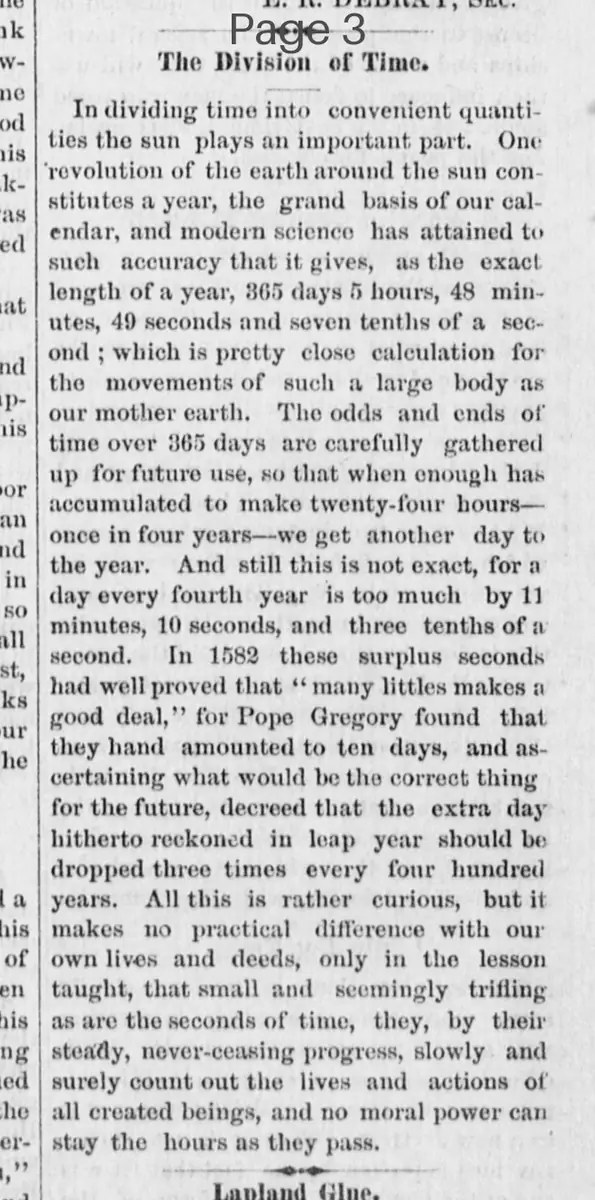
In dividing time into convenient quantities the sun plays an important part. One revolution of the earth around the sun constitutes a year, the grand basis of our calendar, and modern science has attained to such accuracy that it gives, as the exact length of a year, 365 days 5 hours, 48 minutes, 49 seconds and seven tenths of a second: which is pretty close calculation for the movements of such a large body as our mother earth. The odds and ends of time over 365 days are carefully gathered up for future use, so that when enough has accumulated to make twenty-four hours—once in four years—we get another day to the year. And still this is not exact, for a day every fourth year is too much by 11 minutes, 10 seconds, and three tenths of a second. In 1582 these surplus seconds had well proved that "many littles makes a good deal," for Pope Gregory found that they had amounted to ten days, and ascertaining what would be the correct thing for the future, decreed that the extra day hitherto reckoned in leap year should be dropped three times every four hundred years. All this is rather curious, but it makes no practical difference with our own lives and deeds, only in the lesson taught, that small and seemingly trifling as are the seconds of time, they, by their steady, never-ceasing progress, slowly and surely count out the lives and actions of all created beings, and no moral power can stay the hours as they pass.
In dividing time into convenient quantities the sun plays an important part. One revolution of the earth around the sun constitutes a year, the grand basis of our calendar, and modern science has attained to such accuracy that it gives, as the exact length of a year, 365 days 5 hours, 48 minutes, 49 seconds and seven tenths of a second: which is pretty close calculation for the movements of such a large body as our mother earth. The odds and ends of time over 365 days are carefully gathered up for future use, so that when enough has accumulated to make twenty-four hours—once in four years—we get another day to the year. And still this is not exact, for a day every fourth year is too much by 11 minutes, 10 seconds, and three tenths of a second. In 1582 these surplus seconds had well proved that "many littles makes a good deal," for Pope Gregory found that they had amounted to ten days, and ascertaining what would be the correct thing for the future, decreed that the extra day hitherto reckoned in leap year should be dropped three times every four hundred years. All this is rather curious, but it makes no practical difference with our own lives and deeds, only in the lesson taught, that small and seemingly trifling as are the seconds of time, they, by their steady, never-ceasing progress, slowly and surely count out the lives and actions of all created beings, and no moral power can stay the hours as they pass.
What sub-type of article is it?
Essay
What themes does it cover?
Seasonal Cycle
Moral Virtue
What keywords are associated?
Time Division
Solar Year
Calendar
Leap Year
Gregorian Reform
Passage Of Time
Moral Lesson
Literary Details
Title
The Division Of Time.
Key Lines
365 Days 5 Hours, 48 Minutes, 49 Seconds And Seven Tenths Of A Second
In 1582 These Surplus Seconds Had Well Proved That "Many Littles Makes A Good Deal," For Pope Gregory Found That They Had Amounted To Ten Days
Small And Seemingly Trifling As Are The Seconds Of Time, They, By Their Steady, Never Ceasing Progress, Slowly And Surely Count Out The Lives And Actions Of All Created Beings, And No Moral Power Can Stay The Hours As They Pass.