Thank you for visiting SNEWPapers!
Sign up free
Story
August 27, 1864
Springfield Weekly Republican
Springfield, Hampden County, Massachusetts
What is this article about?
Gen. Truman Seymour, recently released Union prisoner, writes that the Confederate cause is failing due to exhaustion. He shares a rebel letter decrying the war and urges the North to mobilize more troops to crush the rebellion swiftly, citing opportunities in Atlanta and other campaigns.
Clipping
OCR Quality
98%
Excellent
Full Text
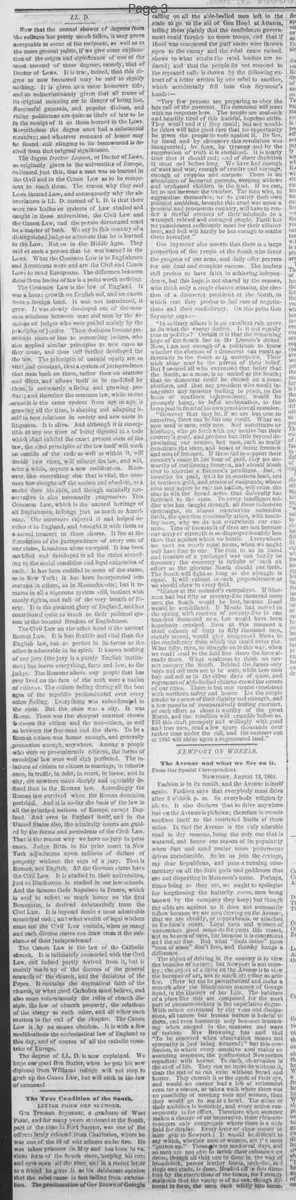
The True Condition of the South
LETTER FROM GEN SEYMOUR.
Gen Truman Seymour, a graduate of West Point, and for many years stationed at the South, part of the time in Fort Sumter, was one of the officers lately released from Charleston, where he was one of the 50 of our officers under fire. He was taken prisoner in May and has been in various forts of the South since, keeping his ears and eyes open all the time, and in a recent letter to a friend he gives it as his deliberate opinion that the rebel cause is fast failing from exhaustion. The proclamation of Gov Brown of Georgia calling on all the able-bodied men left in the state to go to the aid of Gen Hood at Atlanta, telling them plainly that the confederate government could furnish no more troops, and that if Hood was conquered the gulf states were thrown open to the enemy and the rebel cause ruined, shows to what straits the rebel leaders are reduced; and that the people do not respond to the repeated calls is shown by the following extract of a letter written by one rebel to another, which accidentally fell into Gen Seymour's hands:-
"Very few persons are preparing to obey the late call of the governor. His summons will meet with no response here. The people are soul-sick and heartily tired of this hateful, hopeless strife. They would end it if they could; but our would-be rulers will take good care that no opportunity be given the people to vote against it. By lies, by fraud and by chicanery this revolution was inaugurated; by force, by tyranny and by the suppression of truth it is sustained. It is nearly time that it should end; and of sheer depletion it must end before long. We have had enough of want and woe, enough of cruelty and carnage, enough of cripples and corpses. There is an abundance of bereaved parents, weeping widows and orphaned children in the land. If we can, let us not increase the number. The men who, to aggrandize themselves, or to gratify their own political ambition, brought this cruel war upon a peaceful and prosperous country, will have to render a fearful account of their misdeeds to a wronged, robbed and outraged people. Earth has no punishment sufficiently meet for their villainy here, and hell will hardly be hot enough to scathe them hereafter."
Gen Seymour also asserts that there is a large proportion of the people at the South who favor the progress of our arms, and daily offer prayers for our final and complete success. The leaders still profess to have faith in achieving independence, but this hope is not shared by the masses, who think only a single chance remains, the election of a democrat president at the North, in which case they profess to feel sure of negotiations and their confederacy. On this point Gen Seymour says:
"In military affairs it is an excellent rule never to do what the enemy desires. Is it not equally true in politics? Certain it is that the remaining hope of the South lies in Mr Lincoln's defeat. Now, I am not enough of a politician to know whether the election of a democrat can result as favorably to the South as it anticipates. Their wish alone may be the parent of their belief. But I assured all who expressed that belief that the North, as a mass, is as united as the South; that no democrat could be elected on a peace platform, and that any president who would inaugurate any measure leading to peace, on the basis of southern independence, would be promptly hung, by loyal acclamation, to the lamp post in front of his own presidential mansion.
"However that may be, if we are but true to ourselves, there can be but one result. What we now need is men, only men. Not substitutes or hirelings, who go forth with any motive but their country's good, and produce but little beyond depreciating our armies; but men, such as really constitute the state, and boast of being freemen and sons of freemen. If these fail to support their country's cause in her hour of peril, they are unworthy of continuing freemen, and should blush ever to exercise a freeman's privileges. But, if bounties be paid, let it be in southern land, not in northern gold, and armies of emigrants, whose sons may aspire to rule the nation, will cross the seas to win the broad acres that disloyalty has forfeited to the state. To every intelligent soldier who has fought through all these indecisive campaigns, on almost numberless indecisive fields, the question continually arises, with touching force, why we do not overwhelm our enemies. Tens of thousands of lives are lost because our array of strength is so disproportionately less than that against which we battle. Everywhere we meet on nearly equal terms, when we might well have four to one. The cost to us in blood and treasure of a prolonged war can hardly be foreseen; the economy is infinite of such an effort as the glorious North should put forth. The South will fight as long as the struggle is equal. It will submit to such preponderance as we should show in every field.
"Glance at the summer's campaigns. If Sherman had but fifty or seventy-five thousand more men the South would be lost, because Hood would be annihilated. If Meade had moved in the spring, with reserves of seventy-five to one hundred thousand men, Lee would have been hopelessly crushed. Even at this moment a third column of forty to fifty thousand men, rightly moved, would give unopposed blows to the confederacy from which she could never rise. What folly, then, to struggle on in this way, when we could send to the field five times the force already there. What weakness to think we cannot conquer the South. Behind the James only boys and old men are to be seen, while here men buy and sell as in the olden days of quiet, and regiments of able-bodied citizens crowd the streets of our cities. There is but one course consistent with northern safety and honor. Let the people awake to a sense of their dignity and strength, and a few months of comparatively trifling exertion, of such effort as alone is worthy of the great North, and the rebellion will crumble before us. Fill this draft promptly and willingly with good and true men, send a few spare thousands over rather than under the call, and the summer sun of 1865 will shine upon a regenerated land."
LETTER FROM GEN SEYMOUR.
Gen Truman Seymour, a graduate of West Point, and for many years stationed at the South, part of the time in Fort Sumter, was one of the officers lately released from Charleston, where he was one of the 50 of our officers under fire. He was taken prisoner in May and has been in various forts of the South since, keeping his ears and eyes open all the time, and in a recent letter to a friend he gives it as his deliberate opinion that the rebel cause is fast failing from exhaustion. The proclamation of Gov Brown of Georgia calling on all the able-bodied men left in the state to go to the aid of Gen Hood at Atlanta, telling them plainly that the confederate government could furnish no more troops, and that if Hood was conquered the gulf states were thrown open to the enemy and the rebel cause ruined, shows to what straits the rebel leaders are reduced; and that the people do not respond to the repeated calls is shown by the following extract of a letter written by one rebel to another, which accidentally fell into Gen Seymour's hands:-
"Very few persons are preparing to obey the late call of the governor. His summons will meet with no response here. The people are soul-sick and heartily tired of this hateful, hopeless strife. They would end it if they could; but our would-be rulers will take good care that no opportunity be given the people to vote against it. By lies, by fraud and by chicanery this revolution was inaugurated; by force, by tyranny and by the suppression of truth it is sustained. It is nearly time that it should end; and of sheer depletion it must end before long. We have had enough of want and woe, enough of cruelty and carnage, enough of cripples and corpses. There is an abundance of bereaved parents, weeping widows and orphaned children in the land. If we can, let us not increase the number. The men who, to aggrandize themselves, or to gratify their own political ambition, brought this cruel war upon a peaceful and prosperous country, will have to render a fearful account of their misdeeds to a wronged, robbed and outraged people. Earth has no punishment sufficiently meet for their villainy here, and hell will hardly be hot enough to scathe them hereafter."
Gen Seymour also asserts that there is a large proportion of the people at the South who favor the progress of our arms, and daily offer prayers for our final and complete success. The leaders still profess to have faith in achieving independence, but this hope is not shared by the masses, who think only a single chance remains, the election of a democrat president at the North, in which case they profess to feel sure of negotiations and their confederacy. On this point Gen Seymour says:
"In military affairs it is an excellent rule never to do what the enemy desires. Is it not equally true in politics? Certain it is that the remaining hope of the South lies in Mr Lincoln's defeat. Now, I am not enough of a politician to know whether the election of a democrat can result as favorably to the South as it anticipates. Their wish alone may be the parent of their belief. But I assured all who expressed that belief that the North, as a mass, is as united as the South; that no democrat could be elected on a peace platform, and that any president who would inaugurate any measure leading to peace, on the basis of southern independence, would be promptly hung, by loyal acclamation, to the lamp post in front of his own presidential mansion.
"However that may be, if we are but true to ourselves, there can be but one result. What we now need is men, only men. Not substitutes or hirelings, who go forth with any motive but their country's good, and produce but little beyond depreciating our armies; but men, such as really constitute the state, and boast of being freemen and sons of freemen. If these fail to support their country's cause in her hour of peril, they are unworthy of continuing freemen, and should blush ever to exercise a freeman's privileges. But, if bounties be paid, let it be in southern land, not in northern gold, and armies of emigrants, whose sons may aspire to rule the nation, will cross the seas to win the broad acres that disloyalty has forfeited to the state. To every intelligent soldier who has fought through all these indecisive campaigns, on almost numberless indecisive fields, the question continually arises, with touching force, why we do not overwhelm our enemies. Tens of thousands of lives are lost because our array of strength is so disproportionately less than that against which we battle. Everywhere we meet on nearly equal terms, when we might well have four to one. The cost to us in blood and treasure of a prolonged war can hardly be foreseen; the economy is infinite of such an effort as the glorious North should put forth. The South will fight as long as the struggle is equal. It will submit to such preponderance as we should show in every field.
"Glance at the summer's campaigns. If Sherman had but fifty or seventy-five thousand more men the South would be lost, because Hood would be annihilated. If Meade had moved in the spring, with reserves of seventy-five to one hundred thousand men, Lee would have been hopelessly crushed. Even at this moment a third column of forty to fifty thousand men, rightly moved, would give unopposed blows to the confederacy from which she could never rise. What folly, then, to struggle on in this way, when we could send to the field five times the force already there. What weakness to think we cannot conquer the South. Behind the James only boys and old men are to be seen, while here men buy and sell as in the olden days of quiet, and regiments of able-bodied citizens crowd the streets of our cities. There is but one course consistent with northern safety and honor. Let the people awake to a sense of their dignity and strength, and a few months of comparatively trifling exertion, of such effort as alone is worthy of the great North, and the rebellion will crumble before us. Fill this draft promptly and willingly with good and true men, send a few spare thousands over rather than under the call, and the summer sun of 1865 will shine upon a regenerated land."
What sub-type of article is it?
Historical Event
What themes does it cover?
Misfortune
Triumph
Justice
What keywords are associated?
Civil War
Confederacy Exhaustion
Gen Seymour Letter
Atlanta Campaign
Union Mobilization
Rebel Dissatisfaction
What entities or persons were involved?
Truman Seymour
Gov Brown
Gen Hood
Mr Lincoln
Sherman
Meade
Lee
Where did it happen?
The South
Story Details
Key Persons
Truman Seymour
Gov Brown
Gen Hood
Mr Lincoln
Sherman
Meade
Lee
Location
The South
Event Date
Summer 1864
Story Details
Gen. Seymour reports the Confederate cause is exhausted, shares a rebel letter expressing war fatigue and criticism of leaders, notes Southern hope in Northern election, and urges Union to draft more men to overwhelm the South in ongoing campaigns like Atlanta.