Thank you for visiting SNEWPapers!
Sign up free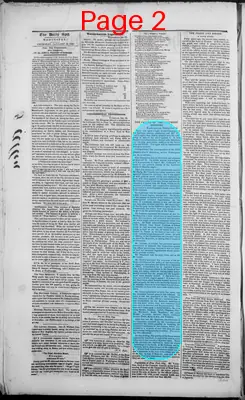
The Daily Spy
Worcester, Worcester County, Massachusetts
What is this article about?
In Washington on Jan. 13-14, Southern congressional members debated in caucus over adopting John C. Calhoun's address on Southern grievances. Opponents like Rusk and Clayton argued against sectional organization to preserve the Union. The committee adopted it by a 8-7 vote, with further debate planned.
Clipping
OCR Quality
Full Text
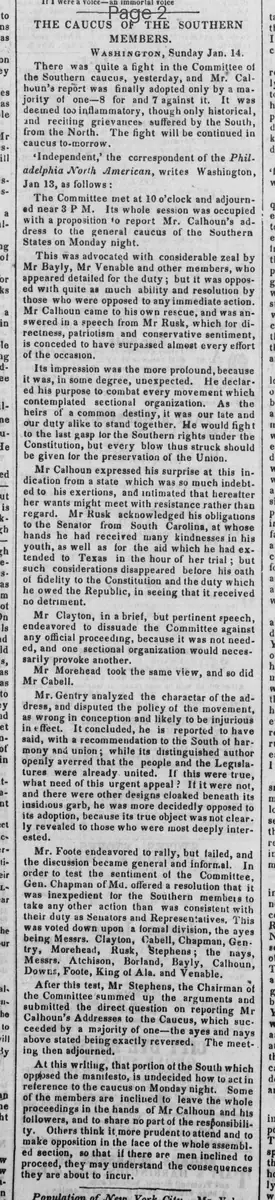
WASHINGTON, Sunday Jan. 14.
There was quite a fight in the Committee of the Southern caucus, yesterday, and Mr. Calhoun's report was finally adopted only by a majority of one—8 for and 7 against it. It was deemed too inflammatory, though only historical, and reciting grievances suffered by the South, from the North. The fight will be continued in caucus to-morrow.
'Independent,' the correspondent of the Philadelphia North American, writes Washington, Jan 13, as follows:
The Committee met at 10 o'clock and adjourned near 3 P. M. Its whole session was occupied with a proposition to report Mr. Calhoun's address to the general caucus of the Southern States on Monday night.
This was advocated with considerable zeal by Mr. Bayly, Mr. Venable and other members, who appeared detailed for the duty; but it was opposed with quite as much ability and resolution by those who were opposed to any immediate action.
Mr. Calhoun came to his own rescue, and was answered in a speech from Mr. Rusk, which for directness, patriotism and conservative sentiment, is conceded to have surpassed almost every effort of the occasion.
Its impression was the more profound, because it was, in some degree, unexpected. He declared his purpose to combat every movement which contemplated sectional organization. As the heirs of a common destiny, it was our fate and our duty alike to stand together. He would fight to the last gasp for the Southern rights under the Constitution, but every blow thus struck should be given for the preservation of the Union.
Mr. Calhoun expressed his surprise at this indication from a state which was so much indebted to his exertions, and intimated that hereafter her wants might meet with resistance rather than regard. Mr. Rusk acknowledged his obligations to the Senator from South Carolina, at whose hands he had received many kindnesses in his youth, as well as for the aid which he had extended to Texas in the hour of her trial; but such considerations disappeared before his oath of fidelity to the Constitution and the duty which he owed the Republic, in seeing that it received no detriment.
Mr. Clayton, in a brief, but pertinent speech, endeavored to dissuade the Committee against any official proceeding, because it was not needed, and one sectional organization would necessarily provoke another.
Mr. Morehead took the same view, and so did Mr. Cabell.
Mr. Gentry analyzed the character of the address, and disputed the policy of the movement, as wrong in conception and likely to be injurious in effect. It concluded, he is reported to have said, with a recommendation to the South of harmony and union; while its distinguished author openly averred that the people and the Legislatures were already united. If this were true, what need of this urgent appeal? If it were not, and there were other designs cloaked beneath its insidious garb, he was more decidedly opposed to its adoption, because its true object was not clearly revealed to those who were most deeply interested.
Mr. Foote endeavored to rally, but failed, and the discussion became general and informal. In order to test the sentiment of the Committee, Gen. Chapman of Md. offered a resolution that it was inexpedient for the Southern members to take any other action than was consistent with their duty as Senators and Representatives. This was voted down upon a formal division, the ayes being Messrs. Clayton, Cabell, Chapman, Gentry, Morehead, Rusk, Stephens; the nays, Messrs. Atchison, Borland, Bayly, Calhoun, Downs, Foote, King of Ala. and Venable.
After this test, Mr. Stephens, the Chairman of the Committee summed up the arguments and submitted the direct question on reporting Mr. Calhoun's Address to the Caucus, which succeeded by a majority of one—the ayes and nays above stated being exactly reversed. The meeting then adjourned.
At this writing, that portion of the South which opposed the manifesto, is undecided how to act in reference to the caucus on Monday night. Some of the members are inclined to leave the whole proceedings in the hands of Mr. Calhoun and his followers, and to share no part of the responsibility. Others think it more prudent to attend and to make opposition in the face of the whole assembled section, so that if there are men inclined to proceed, they may understand the consequences they are about to incur.
What sub-type of article is it?
What keywords are associated?
What entities or persons were involved?
Where did it happen?
Domestic News Details
Primary Location
Washington
Event Date
Jan. 13 14
Key Persons
Outcome
calhoun's report adopted by 8-7 vote in committee; debate to continue in caucus; opposition undecided on further action.
Event Details
Southern members' committee debated adopting Calhoun's address on Southern grievances for the general caucus. Proponents like Bayly and Venable supported it; opponents including Rusk, Clayton, and others argued against sectional organization to preserve the Union. Calhoun defended it personally. A test resolution against additional action failed; the address was reported by a one-vote majority.