Thank you for visiting SNEWPapers!
Sign up free
Literary
November 10, 1828
The New England Weekly Review
Hartford, Hartford County, Connecticut
What is this article about?
An essay praising the natural beauty, education, intelligence, and moral virtues of New England women, contrasting them favorably with the artificial accomplishments and limited knowledge of English and European ladies, emphasizing their suitability as wives, mothers, and companions rooted in genuine love and domestic happiness.
Clipping
OCR Quality
98%
Excellent
Full Text
WOMEN.
Our ideas of beauty, when applied to any form or structure, whether natural or artificial, unless we connect sublimity with it, are derived from our knowledge, and quick perception of symmetry. One part must compare with the other, and appear to be fitted to, and for it. Hence, when speaking of a beautiful woman, we mean that her body and chest, in length, breadth and form, are well proportioned to her height; that her neck sits easy upon, and rises full and gracefully from her shoulders; that her head and arms appear to be prepared expressly for the body to which they are attached; that the one is neither too large (nor too small) nor the other too long, but in the whole there is a perfect relationship. Whatever offends the eye of a person of sound judgment and correct taste, tells you in the strongest possible language— "there is a want of just proportion."
And there is probably no country west of the Albanian mountains, or certainly the Ionian Islands, where the eye is more seldom pained, or taste and judgment less often offended than in New-England. The ladies of Europe are indebted for the reputation of being beautiful, in a very considerable degree, to fictitious circumstances; to the rich dresses and splendid apartments in which they usually appear. I have seen them in their element, and out of it—in churches—at levees on a gala night—at balls—at theatres—and in retirement—divested of artificial aids—when their person appears what it really is—and the mind must unfold itself. And I will venture the assertion, that by collecting five-hundred, or if you please, a thousand women, promiscuously, from the well educated parts of New-England, you will form a brighter constellation of beauty and loveliness, than could be gathered up in the same way in any other part of the world.
It has been said, if my recollection is true, and by high authority, "that there are not five handsome women in America, so highly accomplished as are the generality of women in England." Against this, I ask permission to enter my protest.
It may be true that the women of New-England do not understand the French and Dutch languages so well as English women, yet they have received that kind of useful education, and possess those finished accomplishments, that fit them for domestic happiness, and will make them more intelligent, interesting companions for men of business or literature, than are the ladies of England, or any other part of Europe.
It may be, nay, it certainly is true, that they do not float in the light, lifeless upper region of air with the nobility of England. Nor are they very conversant in that insipid nothingness, called high life, which engrosses the whole attention of the aristocracy and upper class of gentry there. The knowledge and the information of these classes of women are confined, principally, to localities; it seldom or never ranges beyond the sea-beaten shores of their native island, except perhaps a trip to Paris may have given them a confused idea of the Palais-royal, the Boulevards and the Tuilleries, and enabled them to speak a few sentences of bad French. Otherwise, St. James, the Opera-House, Almacks, Hyde Park, and two or three of the most fashionable squares, constitute the entire field of their operations. Their knowledge of the world and its inhabitants extends no further. They have an idea, that if there is a literary or an accomplished man without that circle, he is in Paris—if not there, he can be nowhere.
But very different is the case with us in New-England. There are many, very many middle aged and even young women, not only in our seaports, but also in the interior, among the mountains of Maine, New-Hampshire and Vermont, who will converse with ease—with elegance, and with a clear understanding of what they are saying, on almost any subject that may be introduced—with all that is connected with a finished modern education—with the rise and fall of empires—the religion, manners and customs of the ancient and modern world—with the rise, growth, and present state of their native country. They are much better acquainted, and possess a clearer and more distinct knowledge, than do most of the blustering, noisy politicians of either Europe or America.
If a stranger is introduced in a party of ladies in New-England, his ears are not immediately assailed with a splendid harangue upon localities, of which it is impossible that he should possess any knowledge. But he will be allowed to choose his own subject for conversation, or different ones will be introduced, until his mind is drawn out on some one, with which he is familiar. Not so however in England;—there a high bred woman will chain your attention for hours, (I say chain, for she could not keep it without chains) while she is running through with a catalogue of great men—great women—and great little Misses, all of whom happen to be her very particular acquaintances, and she will continue, for hours again, giving you an account of their palaces—their establishments in town—their splendid equipages—their servants—their horses and poodle dogs—evidently delighted at the consequence she is every moment gaining in her own estimation—and in yours, as she imagines. With the pedigree of great families, with their cook books, and card racks, she will prove herself to be familiar; but on subjects that might be interesting to an intelligent stranger her knowledge is limited, and her tact at conversation more so.
But the well bred women of New-England have, if any—a very contemptible idea of that important consequence, "which arises only from a knowledge which they may accidentally have gained, that there are families in the country, whose names they know, that have assumed the right to lord it over the rest of creation—who consider themselves a superior race of beings, and affect to believe that the whole visible world, animal, vegetable and mineral, was created as merely an under-quoin for them to rest the foundation of their mighty consequence upon. Of this consequence, the women of New-England cannot boast.—They were brought up and educated, to bring up and educate others in their turn. They are prepared for wives—for mothers—for friends and companions. While they possess a general knowledge of the world at large, they possess, in a high degree, that most useful kind, which gives them a perfect understanding of their own little dominions—of their family, and the circle in which they move.
They are less masculine in their appearance and manners, than English women; and yet not so feminine as to appear insipid or dead. They possess a nicer sense of honour, and their cheek is sooner crimsoned, and their delicacy more easily offended—and they are more chaste in conversation than English ladies. Their passions are strong and steady, but they are neither wild nor ungovernable. Their friendship—their affections—and their love—are pure and holy, particularly the latter. The flame is not soon lighted up—but when once kindled, like the sacred flame before the holy altar, it burns with a pure and bright flame, and throws around a cheering and never dying light.
Marriage with them is a sacred contract that is never violated. It is not a business of bargain—of finesse and management, to secure a comfortable living, and after to riot in the luxury of unhallowed passions.—Money seldom, or never, has any thing to do with it. Love—by that word I mean the kindest, the holiest, and most affectionate feelings and passions of the heart—this love is the only article of exchange: and to the marriage state it is generally a prerequisite on both sides.
Portland Yankee.
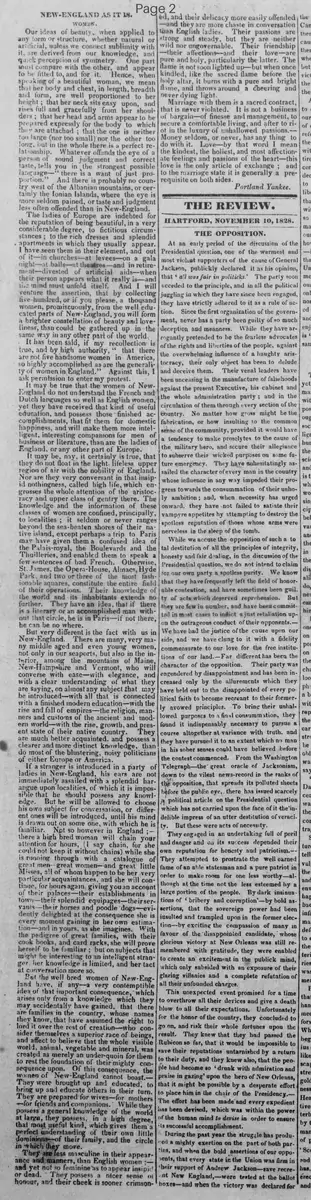
Our ideas of beauty, when applied to any form or structure, whether natural or artificial, unless we connect sublimity with it, are derived from our knowledge, and quick perception of symmetry. One part must compare with the other, and appear to be fitted to, and for it. Hence, when speaking of a beautiful woman, we mean that her body and chest, in length, breadth and form, are well proportioned to her height; that her neck sits easy upon, and rises full and gracefully from her shoulders; that her head and arms appear to be prepared expressly for the body to which they are attached; that the one is neither too large (nor too small) nor the other too long, but in the whole there is a perfect relationship. Whatever offends the eye of a person of sound judgment and correct taste, tells you in the strongest possible language— "there is a want of just proportion."
And there is probably no country west of the Albanian mountains, or certainly the Ionian Islands, where the eye is more seldom pained, or taste and judgment less often offended than in New-England. The ladies of Europe are indebted for the reputation of being beautiful, in a very considerable degree, to fictitious circumstances; to the rich dresses and splendid apartments in which they usually appear. I have seen them in their element, and out of it—in churches—at levees on a gala night—at balls—at theatres—and in retirement—divested of artificial aids—when their person appears what it really is—and the mind must unfold itself. And I will venture the assertion, that by collecting five-hundred, or if you please, a thousand women, promiscuously, from the well educated parts of New-England, you will form a brighter constellation of beauty and loveliness, than could be gathered up in the same way in any other part of the world.
It has been said, if my recollection is true, and by high authority, "that there are not five handsome women in America, so highly accomplished as are the generality of women in England." Against this, I ask permission to enter my protest.
It may be true that the women of New-England do not understand the French and Dutch languages so well as English women, yet they have received that kind of useful education, and possess those finished accomplishments, that fit them for domestic happiness, and will make them more intelligent, interesting companions for men of business or literature, than are the ladies of England, or any other part of Europe.
It may be, nay, it certainly is true, that they do not float in the light, lifeless upper region of air with the nobility of England. Nor are they very conversant in that insipid nothingness, called high life, which engrosses the whole attention of the aristocracy and upper class of gentry there. The knowledge and the information of these classes of women are confined, principally, to localities; it seldom or never ranges beyond the sea-beaten shores of their native island, except perhaps a trip to Paris may have given them a confused idea of the Palais-royal, the Boulevards and the Tuilleries, and enabled them to speak a few sentences of bad French. Otherwise, St. James, the Opera-House, Almacks, Hyde Park, and two or three of the most fashionable squares, constitute the entire field of their operations. Their knowledge of the world and its inhabitants extends no further. They have an idea, that if there is a literary or an accomplished man without that circle, he is in Paris—if not there, he can be nowhere.
But very different is the case with us in New-England. There are many, very many middle aged and even young women, not only in our seaports, but also in the interior, among the mountains of Maine, New-Hampshire and Vermont, who will converse with ease—with elegance, and with a clear understanding of what they are saying, on almost any subject that may be introduced—with all that is connected with a finished modern education—with the rise and fall of empires—the religion, manners and customs of the ancient and modern world—with the rise, growth, and present state of their native country. They are much better acquainted, and possess a clearer and more distinct knowledge, than do most of the blustering, noisy politicians of either Europe or America.
If a stranger is introduced in a party of ladies in New-England, his ears are not immediately assailed with a splendid harangue upon localities, of which it is impossible that he should possess any knowledge. But he will be allowed to choose his own subject for conversation, or different ones will be introduced, until his mind is drawn out on some one, with which he is familiar. Not so however in England;—there a high bred woman will chain your attention for hours, (I say chain, for she could not keep it without chains) while she is running through with a catalogue of great men—great women—and great little Misses, all of whom happen to be her very particular acquaintances, and she will continue, for hours again, giving you an account of their palaces—their establishments in town—their splendid equipages—their servants—their horses and poodle dogs—evidently delighted at the consequence she is every moment gaining in her own estimation—and in yours, as she imagines. With the pedigree of great families, with their cook books, and card racks, she will prove herself to be familiar; but on subjects that might be interesting to an intelligent stranger her knowledge is limited, and her tact at conversation more so.
But the well bred women of New-England have, if any—a very contemptible idea of that important consequence, "which arises only from a knowledge which they may accidentally have gained, that there are families in the country, whose names they know, that have assumed the right to lord it over the rest of creation—who consider themselves a superior race of beings, and affect to believe that the whole visible world, animal, vegetable and mineral, was created as merely an under-quoin for them to rest the foundation of their mighty consequence upon. Of this consequence, the women of New-England cannot boast.—They were brought up and educated, to bring up and educate others in their turn. They are prepared for wives—for mothers—for friends and companions. While they possess a general knowledge of the world at large, they possess, in a high degree, that most useful kind, which gives them a perfect understanding of their own little dominions—of their family, and the circle in which they move.
They are less masculine in their appearance and manners, than English women; and yet not so feminine as to appear insipid or dead. They possess a nicer sense of honour, and their cheek is sooner crimsoned, and their delicacy more easily offended—and they are more chaste in conversation than English ladies. Their passions are strong and steady, but they are neither wild nor ungovernable. Their friendship—their affections—and their love—are pure and holy, particularly the latter. The flame is not soon lighted up—but when once kindled, like the sacred flame before the holy altar, it burns with a pure and bright flame, and throws around a cheering and never dying light.
Marriage with them is a sacred contract that is never violated. It is not a business of bargain—of finesse and management, to secure a comfortable living, and after to riot in the luxury of unhallowed passions.—Money seldom, or never, has any thing to do with it. Love—by that word I mean the kindest, the holiest, and most affectionate feelings and passions of the heart—this love is the only article of exchange: and to the marriage state it is generally a prerequisite on both sides.
Portland Yankee.
What sub-type of article is it?
Essay
What themes does it cover?
Social Manners
Moral Virtue
Love Romance
What keywords are associated?
New England Women
Beauty Symmetry
Education
Domestic Happiness
English Society
Marriage Love
Moral Virtues
What entities or persons were involved?
Portland Yankee
Literary Details
Title
Women.
Author
Portland Yankee
Subject
Praise Of New England Women's Beauty, Education, And Virtues Compared To European Women
Form / Style
Prose Essay With Comparative Observations
Key Lines
And There Is Probably No Country West Of The Albanian Mountains, Or Certainly The Ionian Islands, Where The Eye Is More Seldom Pained, Or Taste And Judgment Less Often Offended Than In New England.
By Collecting Five Hundred, Or If You Please, A Thousand Women, Promiscuously, From The Well Educated Parts Of New England, You Will Form A Brighter Constellation Of Beauty And Loveliness, Than Could Be Gathered Up In The Same Way In Any Other Part Of The World.
They Are Prepared For Wives—For Mothers—For Friends And Companions.
Marriage With Them Is A Sacred Contract That Is Never Violated.
Love—By That Word I Mean The Kindest, The Holiest, And Most Affectionate Feelings And Passions Of The Heart—This Love Is The Only Article Of Exchange