Thank you for visiting SNEWPapers!
Sign up free
Editorial
April 23, 1828
Phenix Gazette
Alexandria, Virginia
What is this article about?
The New York American editorial defends John Quincy Adams against revived accusations of a pledge to federalists via a letter to Daniel Webster, shown to Richard Stockton. It declares the letter nonexistent and Stockton's quoted letter a forgery by Wm. M. P. Wood, whose shady character and political opportunism are exposed.
Clipping
OCR Quality
98%
Excellent
Full Text
From the New York American.
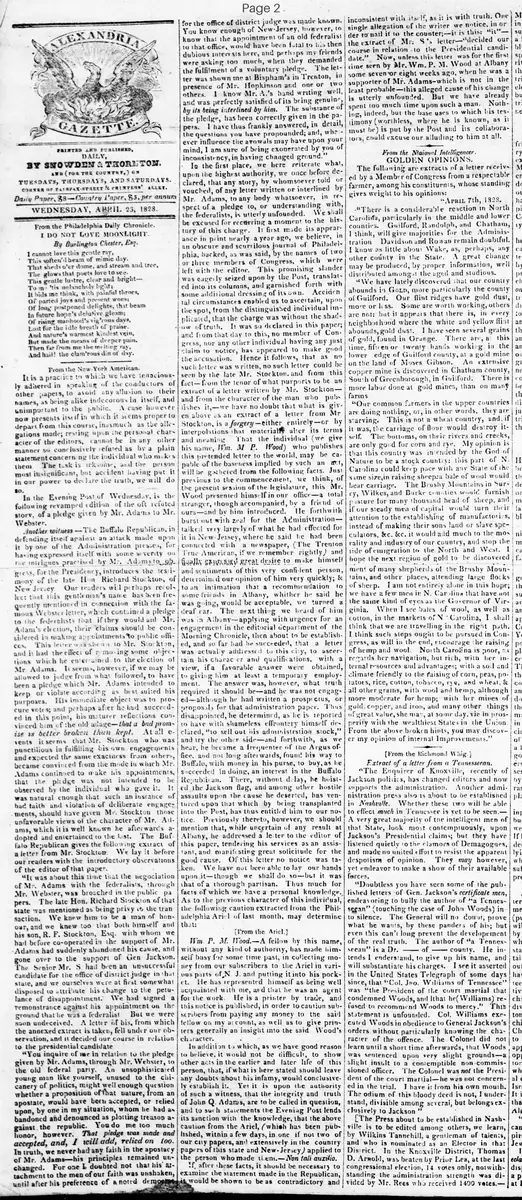
It is a practice to which we have tenaciously adhered in speaking of the conductors of other papers, to avoid any allusion to their names, as being alike indecorous in itself, and unimportant to the public. A case however now presents itself in which it seems proper to depart from this course, inasmuch as the allegations made, resting upon the personal character of the editors, cannot be in any other manner so conclusively refuted as by a plain statement concerning the individual who makes them. The task is irksome, and the person most insignificant, but accident having put it in our power to declare the truth, we will do so.
In the Evening Post of Wednesday, is the following revamped edition of the oft refuted story, of a pledge given by Mr. Adams to Mr. Webster.
Another witness—The Buffalo Republican, in defending itself against an attack made upon it by one of the Administration presses, for having expressed itself with some severity on the intrigues practiced by Mr. Adams to obtain the votes of Congress, for the Presidency, introduces the testimony of the late Hon. Richard Stockton, of New Jersey. Our readers will perhaps recollect that this gentleman's name has been frequently mentioned in connection with the famous Webster letter, which contained a pledge to the federalists that if they would aid Mr. Adam's election, their claims should be considered in making appointments to public offices. This letter was shown to Mr. Stockton, and it had the effect of removing some objections which he entertained to the election of Mr. Adams. It seems, however, if we may be allowed to judge from what followed, to have been a pledge which Mr. Adams intended to keep or violate according as best suited his purposes. His immediate object was to procure votes; and perhaps after he had succeeded in this point, his maturer reflections convinced him of the old adage—that a bad promise is better broken than kept. At all events it seems that Mr. Stockton who was punctilious in fulfilling his own engagements and expected the same exactness from others, became convinced from the mode in which Mr. Adams continued to make his appointments, that the pledge was not intended to be observed by the individual who gave it. It was natural enough that such an instance of bad faith and violation of deliberate engagements, should have given Mr. Stockton those unfavorable views of the character of Mr. Adams, which it is well known he afterwards adopted and entertained to the last. The Buffalo Republican gives the following extract of a letter from Mr. Stockton. We lay it before our readers with the introductory observations of the editor of that paper.
"It was about this time that the negociation of Mr. Adams with the Federalists, through Mr. Webster, was broached in the public papers. The late Hon. Richard Stockton of that state was mentioned as being privy to the transaction. We knew him to be a man of honor, and we knew too that both himself and his son, R. F. Stockton, Esq. with whom we had before co-operated in the support of Mr. Adams had suddenly abandoned his cause, and gone over to the support of Gen Jackson. The Senior Mr. S had been an unsuccessful Candidate for the office of district judge in that state, and we ourselves were at first somewhat disposed to attribute his change to the petulance of disappointment." He had signed a remonstrance against his appointment on the ground that he was a federalist But we were soon undeceived. A letter of his, from which the annexed extract is taken, fell under our observation, and n decided our course in relation to the presidential candidate
"You inquire of me in relation to the pledge given by Mr. Adams, through Mr. Webster, to the old federal party. An unsophisticated young man like yourself, unused to the chicanery of politics, might well enough question whether a proposition of that nature, from an apostate, would have been accepted, or relied upon, by one in my situation, whom he had abandoned and denounced as plotting treason against the republic. You do me too much honor, however. That pledge was made and accepted, and, I will add, relied on too. In truth, we never had any faith in the apostasy of Mr. Adams---his principles remained unchanged. For one I doubted not that his attachment to the men of our faith was unshaken, until after his preference of a noted democrat For the office of district judge was made known. You know enough of New-Jersey, however, to know that the appointment of an old federalist to that office, would have been fatal to his then dubious interests here, and perhaps my friends were asking too much, when they demanded the fulfilment of a voluntary pledge. The letter was shown me at Bispham's in Trenton, in presence of Mr. Hopkinson and one or two others. I know Mr. A.'s hand writing well, and was perfectly satisfied of its being genuine, by its being interlined by him. The substance of the pledge, has been correctly given in the papers. I have thus frankly answered, in detail, the questions you have propounded; and, whatever influence the avowals may have upon your mind, I am sure of being exonerated by you of inconsistency, in having changed ground."
In the first place, we here reiterate what, upon the highest authority, we once before declared, that any story, by whomsoever told or vouched, of any letter written or interlined by Mr. Adams, to any body whatsoever, in respect of a pledge to, or understanding with, the federalists, is utterly unfounded. We shall be excused for recurring a moment to the history of this charge. It first made its appearance in print nearly a year ago, we believe, in an obscure and scurrilous journal of Philadelphia, backed, as was said, by the names of two or three members of Congress, which were left with the editor. This promising slander was eagerly seized upon by the Post, translated into its columns, and garnished forth with some additional dressing of its own. Accidental circumstances enabled us to ascertain, upon the spot, from the distinguished individual implicated, that the charge was without the shadow of truth. It was so declared in this paper; and from that day to this, no member of Congress, nor any other individual having any just claim to notice, has appeared to make good the accusation. Hence it follows, that as no such letter was written, no such letter could be seen by the late Mr. Stockton. and from this fact--from the tenor of what purports to be an extract of a letter written by Mr. Stockton--and from the character of the man who publishes it,--we have no doubt that what is given above as an extract of a letter from Mr. Stockton, is a forgery—either entirely—or by interpolations that materially alter its terms and meaning That the individual (we give his name, Wm. M P. Wood) who publishes this pretended letter to the world, may be capable of the baseness implied by such an act, will be gathered from the following facts. Just previous to the commencement, we think, of the present session of the legislature, this Mr. Wood presented himself in our office—a total stranger, though accompanied, by a friend of ours—and by him introduced. He forthwith burst out with zeal for the Administration—talked very largely of what he had effected for it in New-Jersey, where he said he had been connected with a newspaper, (The Trenton True American, if we remember rightly) and quietly expressed great desire to make himself useful to us. We determined our opinion of him very quickly; & to an intimation that a recommendation to some friends in Albany, whither he said he was going, would be acceptable, we turned a deaf ear. The next thing we heard of him was in Albany--applying with urgency for an engagement in the editorial department of the Morning Chronicle, then about to be established. and so far had he succeeded, that a letter was actually addressed to this city, to ascertain his character and qualifications, with a view, if a favorable answer were obtained, to giving him at least a temporary employment. The answer was, however, what truth required it should be--and he was not engaged--although he had written a prospectus, or proposal, for that administration paper. Thus disappointed, he determined, as he is reported to have with shameless effrontery himself declared, "to sell out his administration stock," and try the other side—and forthwith, as we hear, he became a frequenter of the Argus office. and not long afterwards, found his way to Buffalo, with money in his purse, to buy, as he succeeded in doing, an interest in the Buffalo Republican. There, without delay, he hoisted the Jackson flag, and among other hostile assaults upon the cause he deserted, has ventured upon that which by being transplanted into the Post, has thus entitled him to our notice. Previously thereto, however, we should mention that, while uncertain of any result at Albany, he addressed a letter to the editor of this paper, tendering his services as an assistant, and manifesting great solicitude for the good cause. Of this letter no notice was taken. We have not been able to lay our hands upon it—though we shall do so—but it was that of a thorough partisan. Thus much for facts of which we have a personal knowledge As to the previous character of this individual, the following caution extracted from the Philadelphia Ariel of last month, may determine that:
[From the Ariel.]
Wm P. M. Wood.—A fellow by this name, without any kind of authority, has made himself busy for some time past, in collecting money from our subscribers to the Ariel in various parts of N J. and putting it into his pocket. He has represented himself as being well acquainted with me, and that he was an agent for the work. He is a printer by trade, and this notice is published, in order to caution subscribers from paying any money to the said fellow on my account, as well as to give printers generally an insight into the said Wood's character.
In addition to which, as we have good reason to believe, it would not be difficult, to show other acts in the earlier and later life of this person, that, if what is here stated should leave any doubts about his infamy, would conclusively establish it. Yet it is upon the authority of such a witness, that the integrity and truth of John Q. Adams, are to be called in question, and to such statements the Evening Post lends its sanction with the knowledge that the above caution from the Ariel, (which has been published, within a few days, in one if not two of our city papers, and extensively in the country papers of this state and New-Jersey) applied to the person who made them.—Non tali auxilio.
If, after these facts, it should be necessary to examine the statement made in the Republican, it would be shown to be as contradictory and inconsistent with itself, as it is with truth. One single allegation of the writer we notice, in order to nail it to the counter;--it is this: "it"-course in relation to the Presidential candidate."—the extract of Mr: S's letter—"decided our date." Now, unless this letter was for the first time seen by Mr. Wm. P. M. Wood at Albany some seven or eight weeks ago, when he was a supporter of Mr. Adams—which is not in the least probable—this alleged cause of his change is utterly unfounded. But we have already spent too much time upon such a man. Nothing, indeed, but the base uses to which his testimony (worthless, where he is known, as it must be) is put by the Post and its collators, could excuse our alluding to him at all.
It is a practice to which we have tenaciously adhered in speaking of the conductors of other papers, to avoid any allusion to their names, as being alike indecorous in itself, and unimportant to the public. A case however now presents itself in which it seems proper to depart from this course, inasmuch as the allegations made, resting upon the personal character of the editors, cannot be in any other manner so conclusively refuted as by a plain statement concerning the individual who makes them. The task is irksome, and the person most insignificant, but accident having put it in our power to declare the truth, we will do so.
In the Evening Post of Wednesday, is the following revamped edition of the oft refuted story, of a pledge given by Mr. Adams to Mr. Webster.
Another witness—The Buffalo Republican, in defending itself against an attack made upon it by one of the Administration presses, for having expressed itself with some severity on the intrigues practiced by Mr. Adams to obtain the votes of Congress, for the Presidency, introduces the testimony of the late Hon. Richard Stockton, of New Jersey. Our readers will perhaps recollect that this gentleman's name has been frequently mentioned in connection with the famous Webster letter, which contained a pledge to the federalists that if they would aid Mr. Adam's election, their claims should be considered in making appointments to public offices. This letter was shown to Mr. Stockton, and it had the effect of removing some objections which he entertained to the election of Mr. Adams. It seems, however, if we may be allowed to judge from what followed, to have been a pledge which Mr. Adams intended to keep or violate according as best suited his purposes. His immediate object was to procure votes; and perhaps after he had succeeded in this point, his maturer reflections convinced him of the old adage—that a bad promise is better broken than kept. At all events it seems that Mr. Stockton who was punctilious in fulfilling his own engagements and expected the same exactness from others, became convinced from the mode in which Mr. Adams continued to make his appointments, that the pledge was not intended to be observed by the individual who gave it. It was natural enough that such an instance of bad faith and violation of deliberate engagements, should have given Mr. Stockton those unfavorable views of the character of Mr. Adams, which it is well known he afterwards adopted and entertained to the last. The Buffalo Republican gives the following extract of a letter from Mr. Stockton. We lay it before our readers with the introductory observations of the editor of that paper.
"It was about this time that the negociation of Mr. Adams with the Federalists, through Mr. Webster, was broached in the public papers. The late Hon. Richard Stockton of that state was mentioned as being privy to the transaction. We knew him to be a man of honor, and we knew too that both himself and his son, R. F. Stockton, Esq. with whom we had before co-operated in the support of Mr. Adams had suddenly abandoned his cause, and gone over to the support of Gen Jackson. The Senior Mr. S had been an unsuccessful Candidate for the office of district judge in that state, and we ourselves were at first somewhat disposed to attribute his change to the petulance of disappointment." He had signed a remonstrance against his appointment on the ground that he was a federalist But we were soon undeceived. A letter of his, from which the annexed extract is taken, fell under our observation, and n decided our course in relation to the presidential candidate
"You inquire of me in relation to the pledge given by Mr. Adams, through Mr. Webster, to the old federal party. An unsophisticated young man like yourself, unused to the chicanery of politics, might well enough question whether a proposition of that nature, from an apostate, would have been accepted, or relied upon, by one in my situation, whom he had abandoned and denounced as plotting treason against the republic. You do me too much honor, however. That pledge was made and accepted, and, I will add, relied on too. In truth, we never had any faith in the apostasy of Mr. Adams---his principles remained unchanged. For one I doubted not that his attachment to the men of our faith was unshaken, until after his preference of a noted democrat For the office of district judge was made known. You know enough of New-Jersey, however, to know that the appointment of an old federalist to that office, would have been fatal to his then dubious interests here, and perhaps my friends were asking too much, when they demanded the fulfilment of a voluntary pledge. The letter was shown me at Bispham's in Trenton, in presence of Mr. Hopkinson and one or two others. I know Mr. A.'s hand writing well, and was perfectly satisfied of its being genuine, by its being interlined by him. The substance of the pledge, has been correctly given in the papers. I have thus frankly answered, in detail, the questions you have propounded; and, whatever influence the avowals may have upon your mind, I am sure of being exonerated by you of inconsistency, in having changed ground."
In the first place, we here reiterate what, upon the highest authority, we once before declared, that any story, by whomsoever told or vouched, of any letter written or interlined by Mr. Adams, to any body whatsoever, in respect of a pledge to, or understanding with, the federalists, is utterly unfounded. We shall be excused for recurring a moment to the history of this charge. It first made its appearance in print nearly a year ago, we believe, in an obscure and scurrilous journal of Philadelphia, backed, as was said, by the names of two or three members of Congress, which were left with the editor. This promising slander was eagerly seized upon by the Post, translated into its columns, and garnished forth with some additional dressing of its own. Accidental circumstances enabled us to ascertain, upon the spot, from the distinguished individual implicated, that the charge was without the shadow of truth. It was so declared in this paper; and from that day to this, no member of Congress, nor any other individual having any just claim to notice, has appeared to make good the accusation. Hence it follows, that as no such letter was written, no such letter could be seen by the late Mr. Stockton. and from this fact--from the tenor of what purports to be an extract of a letter written by Mr. Stockton--and from the character of the man who publishes it,--we have no doubt that what is given above as an extract of a letter from Mr. Stockton, is a forgery—either entirely—or by interpolations that materially alter its terms and meaning That the individual (we give his name, Wm. M P. Wood) who publishes this pretended letter to the world, may be capable of the baseness implied by such an act, will be gathered from the following facts. Just previous to the commencement, we think, of the present session of the legislature, this Mr. Wood presented himself in our office—a total stranger, though accompanied, by a friend of ours—and by him introduced. He forthwith burst out with zeal for the Administration—talked very largely of what he had effected for it in New-Jersey, where he said he had been connected with a newspaper, (The Trenton True American, if we remember rightly) and quietly expressed great desire to make himself useful to us. We determined our opinion of him very quickly; & to an intimation that a recommendation to some friends in Albany, whither he said he was going, would be acceptable, we turned a deaf ear. The next thing we heard of him was in Albany--applying with urgency for an engagement in the editorial department of the Morning Chronicle, then about to be established. and so far had he succeeded, that a letter was actually addressed to this city, to ascertain his character and qualifications, with a view, if a favorable answer were obtained, to giving him at least a temporary employment. The answer was, however, what truth required it should be--and he was not engaged--although he had written a prospectus, or proposal, for that administration paper. Thus disappointed, he determined, as he is reported to have with shameless effrontery himself declared, "to sell out his administration stock," and try the other side—and forthwith, as we hear, he became a frequenter of the Argus office. and not long afterwards, found his way to Buffalo, with money in his purse, to buy, as he succeeded in doing, an interest in the Buffalo Republican. There, without delay, he hoisted the Jackson flag, and among other hostile assaults upon the cause he deserted, has ventured upon that which by being transplanted into the Post, has thus entitled him to our notice. Previously thereto, however, we should mention that, while uncertain of any result at Albany, he addressed a letter to the editor of this paper, tendering his services as an assistant, and manifesting great solicitude for the good cause. Of this letter no notice was taken. We have not been able to lay our hands upon it—though we shall do so—but it was that of a thorough partisan. Thus much for facts of which we have a personal knowledge As to the previous character of this individual, the following caution extracted from the Philadelphia Ariel of last month, may determine that:
[From the Ariel.]
Wm P. M. Wood.—A fellow by this name, without any kind of authority, has made himself busy for some time past, in collecting money from our subscribers to the Ariel in various parts of N J. and putting it into his pocket. He has represented himself as being well acquainted with me, and that he was an agent for the work. He is a printer by trade, and this notice is published, in order to caution subscribers from paying any money to the said fellow on my account, as well as to give printers generally an insight into the said Wood's character.
In addition to which, as we have good reason to believe, it would not be difficult, to show other acts in the earlier and later life of this person, that, if what is here stated should leave any doubts about his infamy, would conclusively establish it. Yet it is upon the authority of such a witness, that the integrity and truth of John Q. Adams, are to be called in question, and to such statements the Evening Post lends its sanction with the knowledge that the above caution from the Ariel, (which has been published, within a few days, in one if not two of our city papers, and extensively in the country papers of this state and New-Jersey) applied to the person who made them.—Non tali auxilio.
If, after these facts, it should be necessary to examine the statement made in the Republican, it would be shown to be as contradictory and inconsistent with itself, as it is with truth. One single allegation of the writer we notice, in order to nail it to the counter;--it is this: "it"-course in relation to the Presidential candidate."—the extract of Mr: S's letter—"decided our date." Now, unless this letter was for the first time seen by Mr. Wm. P. M. Wood at Albany some seven or eight weeks ago, when he was a supporter of Mr. Adams—which is not in the least probable—this alleged cause of his change is utterly unfounded. But we have already spent too much time upon such a man. Nothing, indeed, but the base uses to which his testimony (worthless, where he is known, as it must be) is put by the Post and its collators, could excuse our alluding to him at all.
What sub-type of article is it?
Partisan Politics
What keywords are associated?
Adams Pledge
Webster Letter
Forgery
Richard Stockton
Wm M P Wood
Partisan Intrigue
1828 Election
What entities or persons were involved?
John Quincy Adams
Daniel Webster
Richard Stockton
Wm. M. P. Wood
Evening Post
Buffalo Republican
Editorial Details
Primary Topic
Refutation Of Adams Webster Pledge Forgery
Stance / Tone
Defensive Of Adams, Accusatory Of Forgery And Character
Key Figures
John Quincy Adams
Daniel Webster
Richard Stockton
Wm. M. P. Wood
Evening Post
Buffalo Republican
Key Arguments
No Letter From Adams Pledging To Federalists Exists, Per Highest Authority.
Previous Refutations Of The Story.
Quoted Stockton Letter Is A Forgery By Wood.
Wood's Opportunistic Political Shifts And Dishonest Character.
Story's Internal Contradictions Undermine Its Credibility.