Thank you for visiting SNEWPapers!
Sign up free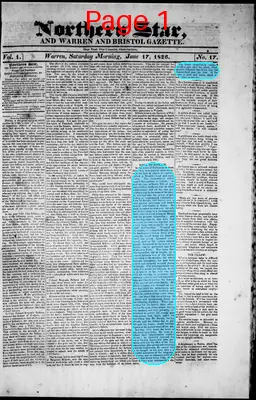
Northern Star, And Warren And Bristol Gazette
Warren, Bristol County, Rhode Island
What is this article about?
In late 15th- or early 16th-century Galway, Ireland, Mayor John de Burgh sentences his son to death for murdering a Spanish youth and stealing a fortune during a trade voyage to Cadiz. To uphold justice despite public sympathy, he executes him at his own home, inspiring a skull and crossbones carving over the door.
Clipping
OCR Quality
Full Text
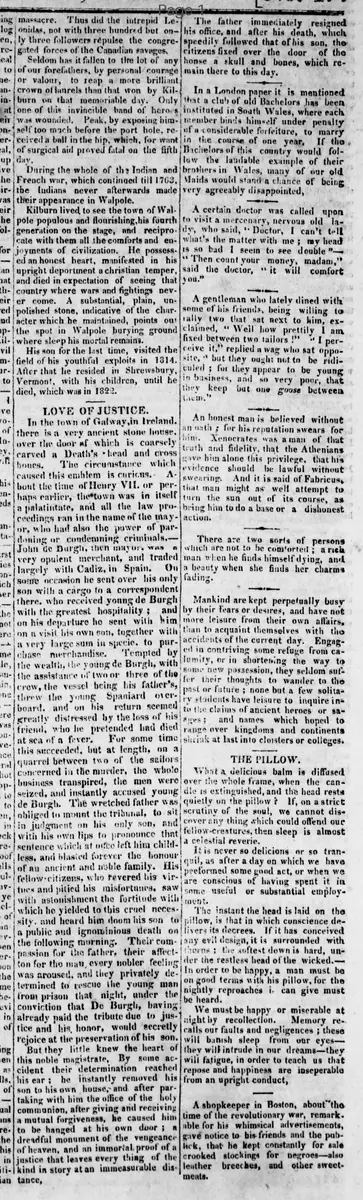
In the town of Galway, in Ireland, there is a very ancient stone house, over the door of which is coarsely carved a Death's head and cross bones.
The circumstance which caused this emblem is curious. About the time of Henry VII, or perhaps earlier, the town was in itself a palatinate, and all the law proceedings ran in the name of the mayor, who had also the power of pardoning or condemning criminals.—John de Burgh, then mayor, was a very opulent merchant, and traded largely with Cadiz, in Spain. On some occasion he sent over his only son with a cargo to a correspondent there, who received young de Burgh with the greatest hospitality; and on his departure he sent with him on a visit his own son, together with a very large sum in specie, to purchase merchandise. Tempted by the wealth, the young de Burgh, with the assistance of two or three of the crew, the vessel being his father's, threw the young Spaniard overboard, and on his return seemed greatly distressed by the loss of his friend, who he pretended had died at sea of a fever. For some time this succeeded, but at length, on a quarrel between two of the sailors concerned in the murder, the whole business transpired, the men were seized, and instantly accused young de Burgh. The wretched father was obliged to mount the tribunal, to sit in judgment on his only son, and with his own lips to pronounce that sentence which at once left him childless, and blasted forever the honour of an ancient and noble family. His fellow-citizens, who revered his virtues and pitied his misfortunes, saw with astonishment the fortitude with which he yielded to this cruel necessity, and heard him doom his son to a public and ignominious death on the following morning. Their compassion for the father, their affection for the man, every nobler feeling was aroused, and they privately determined to rescue the young man from prison that night, under the conviction that De Burgh, having already paid the tribute due to justice and his honor, would secretly rejoice at the preservation of his son. But they little knew the heart of this noble magistrate. By some accident their determination reached his ear; he instantly removed his son to his own house, and after partaking with him the office of the holy communion, after giving and receiving a mutual forgiveness, he caused him to be hanged at his own door; a dreadful monument of the vengeance of heaven, and an immortal proof of a justice that leaves every thing of the kind in story at an immeasurable distance.
The father immediately resigned his office, and after his death, which speedily followed that of his son, the citizens fixed over the door of the house a skull and bones, which remain there to this day.
What sub-type of article is it?
What themes does it cover?
What keywords are associated?
What entities or persons were involved?
Where did it happen?
Story Details
Key Persons
Location
Galway, Ireland
Event Date
About The Time Of Henry Vii Or Perhaps Earlier
Story Details
Mayor John de Burgh of Galway judges his son guilty of murdering a Spanish boy and stealing money during a voyage to Cadiz. Despite citizens' plan to rescue the son, de Burgh executes him at his own door after communion and forgiveness, upholding justice and honor, leading to a skull and crossbones emblem.