Thank you for visiting SNEWPapers!
Sign up free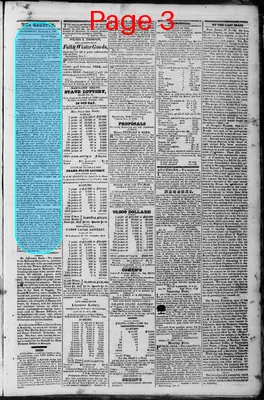
Editorial
November 9, 1826
Martinsburg Gazette And Public Advertiser
Martinsburg, Berkeley County, West Virginia
What is this article about?
An editorial in the Martinsburg Gazette urges citizens to support local merchants and mechanics for mutual prosperity, emphasizing economic interdependence among farmers, merchants, and mechanics, and criticizes importing goods that harm local artisans.
Clipping
OCR Quality
98%
Excellent
Full Text
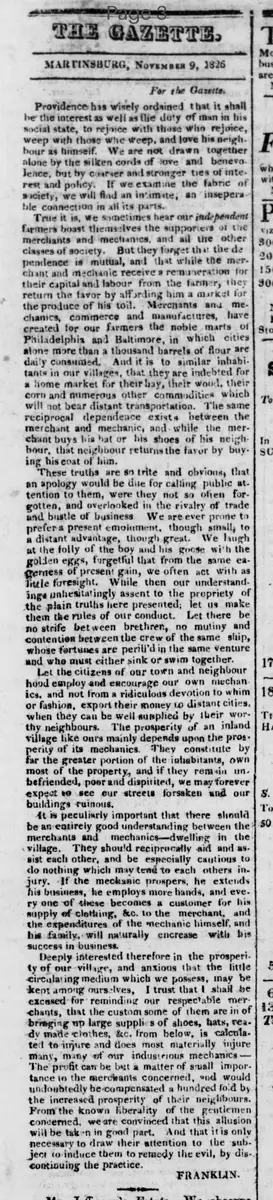
THE GAZETTE,
MARTINSBURG, NOVEMBER 9, 1826.
For the Gazette.
Providence has wisely ordained that it shall be the interest as well as the duty of man in his social state, to rejoice with those who rejoice, weep with those who weep, and love his neighbour as himself. We are not drawn together alone by the silken cords of love and benevolence, but by coarser and stronger ties of interest and policy. If we examine the fabric of society, we will find an intimate, an inseparable connection in all its parts.
True it is, we sometimes hear our independent farmers boast themselves the supporters of the merchants and mechanics, and all the other classes of society. But they forget that the dependence is mutual, and that while the merchant and mechanic receive a remuneration for their capital and labour from the farmer, they return the favor by affording him a market for the produce of his toil. Merchants and mechanics, commerce and manufactures, have created for our farmers the noble marts of Philadelphia and Baltimore, in which cities alone more than a thousand barrels of flour are daily consumed. And it is to similar inhabitants in our villages, that they are indebted for a home market for their hay, their wood, their corn and numerous other commodities which will not bear distant transportation. The same reciprocal dependence exists between the merchant and mechanic, and while the merchant buys his hat or his shoes of his neighbour, that neighbour returns the favor by buying his coat of him.
These truths are so trite and obvious, that an apology would be due for calling public attention to them, were they not so often forgotten, and overlooked in the rivalry of trade and bustle of business. We are ever prone to prefer a present emolument, though small, to a distant advantage, though great. We laugh at the folly of the boy and his goose with the golden eggs, forgetful that from the same eagerness of present gain, we often act with as little foresight. While then our understanding unhesitatingly assent to the propriety of the plain truths here presented; let us make them the rules of our conduct. Let there be no strife between brethren, no mutiny and contention between the crew of the same ship, whose fortunes are perilled in the same venture and who must either sink or swim together.
Let the citizens of our town and neighbourhood employ and encourage our own mechanics, and not from a ridiculous devotion to whim or fashion, export their money to distant cities, when they can be well supplied by their worthy neighbours. The prosperity of an inland village like ours mainly depends upon the prosperity of its mechanics. They constitute by far the greater portion of the inhabitants, own most of the property, and if they remain unfriended, poor and dispirited, we may forever expect to see our streets forsaken and our buildings ruinous.
It is peculiarly important that there should be an entirely good understanding between the merchants and mechanics dwelling in the village. They should reciprocally aid and assist each other, and be especially cautious to do nothing which may tend to each others injury. If the mechanic prospers, he extends his business, he employs more hands, and every one of these becomes a customer for his supply of clothing, &c. to the merchant, and the expenditures of the mechanic himself, and his family, will naturally increase with his success in business.
Deeply interested therefore in the prosperity of our village, and anxious that the little circulating medium which we possess, may be kept among ourselves, I trust that I shall be excused for reminding our respectable merchants, that the custom some of them are in of bringing up large supplies of shoes, hats, ready made clothes, &c. from below, is calculated to injure and does most materially injure many, many of our industrious mechanics. The profit can be but a matter of small importance to the merchants concerned, and would undoubtedly be compensated a hundred fold by the increased prosperity of their neighbours.
From the known liberality of the gentlemen concerned, we are convinced that this allusion will be taken in good part. And that it is only necessary to draw their attention to the subject to induce them to remedy the evil, by discontinuing the practice.
FRANKLIN.
MARTINSBURG, NOVEMBER 9, 1826.
For the Gazette.
Providence has wisely ordained that it shall be the interest as well as the duty of man in his social state, to rejoice with those who rejoice, weep with those who weep, and love his neighbour as himself. We are not drawn together alone by the silken cords of love and benevolence, but by coarser and stronger ties of interest and policy. If we examine the fabric of society, we will find an intimate, an inseparable connection in all its parts.
True it is, we sometimes hear our independent farmers boast themselves the supporters of the merchants and mechanics, and all the other classes of society. But they forget that the dependence is mutual, and that while the merchant and mechanic receive a remuneration for their capital and labour from the farmer, they return the favor by affording him a market for the produce of his toil. Merchants and mechanics, commerce and manufactures, have created for our farmers the noble marts of Philadelphia and Baltimore, in which cities alone more than a thousand barrels of flour are daily consumed. And it is to similar inhabitants in our villages, that they are indebted for a home market for their hay, their wood, their corn and numerous other commodities which will not bear distant transportation. The same reciprocal dependence exists between the merchant and mechanic, and while the merchant buys his hat or his shoes of his neighbour, that neighbour returns the favor by buying his coat of him.
These truths are so trite and obvious, that an apology would be due for calling public attention to them, were they not so often forgotten, and overlooked in the rivalry of trade and bustle of business. We are ever prone to prefer a present emolument, though small, to a distant advantage, though great. We laugh at the folly of the boy and his goose with the golden eggs, forgetful that from the same eagerness of present gain, we often act with as little foresight. While then our understanding unhesitatingly assent to the propriety of the plain truths here presented; let us make them the rules of our conduct. Let there be no strife between brethren, no mutiny and contention between the crew of the same ship, whose fortunes are perilled in the same venture and who must either sink or swim together.
Let the citizens of our town and neighbourhood employ and encourage our own mechanics, and not from a ridiculous devotion to whim or fashion, export their money to distant cities, when they can be well supplied by their worthy neighbours. The prosperity of an inland village like ours mainly depends upon the prosperity of its mechanics. They constitute by far the greater portion of the inhabitants, own most of the property, and if they remain unfriended, poor and dispirited, we may forever expect to see our streets forsaken and our buildings ruinous.
It is peculiarly important that there should be an entirely good understanding between the merchants and mechanics dwelling in the village. They should reciprocally aid and assist each other, and be especially cautious to do nothing which may tend to each others injury. If the mechanic prospers, he extends his business, he employs more hands, and every one of these becomes a customer for his supply of clothing, &c. to the merchant, and the expenditures of the mechanic himself, and his family, will naturally increase with his success in business.
Deeply interested therefore in the prosperity of our village, and anxious that the little circulating medium which we possess, may be kept among ourselves, I trust that I shall be excused for reminding our respectable merchants, that the custom some of them are in of bringing up large supplies of shoes, hats, ready made clothes, &c. from below, is calculated to injure and does most materially injure many, many of our industrious mechanics. The profit can be but a matter of small importance to the merchants concerned, and would undoubtedly be compensated a hundred fold by the increased prosperity of their neighbours.
From the known liberality of the gentlemen concerned, we are convinced that this allusion will be taken in good part. And that it is only necessary to draw their attention to the subject to induce them to remedy the evil, by discontinuing the practice.
FRANKLIN.
What sub-type of article is it?
Trade Or Commerce
Economic Policy
Social Reform
What keywords are associated?
Local Economy
Mutual Dependence
Support Mechanics
Village Prosperity
Reciprocal Trade
Martinsburg Merchants
What entities or persons were involved?
Merchants
Mechanics
Farmers
Citizens Of Martinsburg
Franklin
Editorial Details
Primary Topic
Mutual Economic Dependence And Support For Local Mechanics In Martinsburg
Stance / Tone
Advocacy For Reciprocity And Local Prosperity
Key Figures
Merchants
Mechanics
Farmers
Citizens Of Martinsburg
Franklin
Key Arguments
Society's Parts Are Inseparably Connected By Interest And Policy.
Farmers, Merchants, And Mechanics Depend Mutually For Markets And Remuneration.
Citizens Should Encourage Local Mechanics Instead Of Importing Goods From Distant Cities.
Prosperity Of Mechanics Is Essential To The Village's Success.
Merchants Should Discontinue Importing Items Like Shoes And Hats To Avoid Injuring Local Mechanics.
Reciprocal Aid Between Merchants And Mechanics Benefits All.