Thank you for visiting SNEWPapers!
Sign up free
Literary
August 6, 1929
The Bismarck Tribune
Bismarck, Mandan, Burleigh County, Morton County, North Dakota
What is this article about?
Molly quarrels with fiancé Jack over her ambitions to write a crime play based on a real murder trial, preferring sensational journalism for money and fame over traditional pursuits. At work, her article prejudices a juror, causing a mistrial; she's warned but not punished. She hosts a dinner with old friends, learns of Ruth's miscarriage, and comforts a distraught Zip.
Clipping
OCR Quality
85%
Good
Full Text
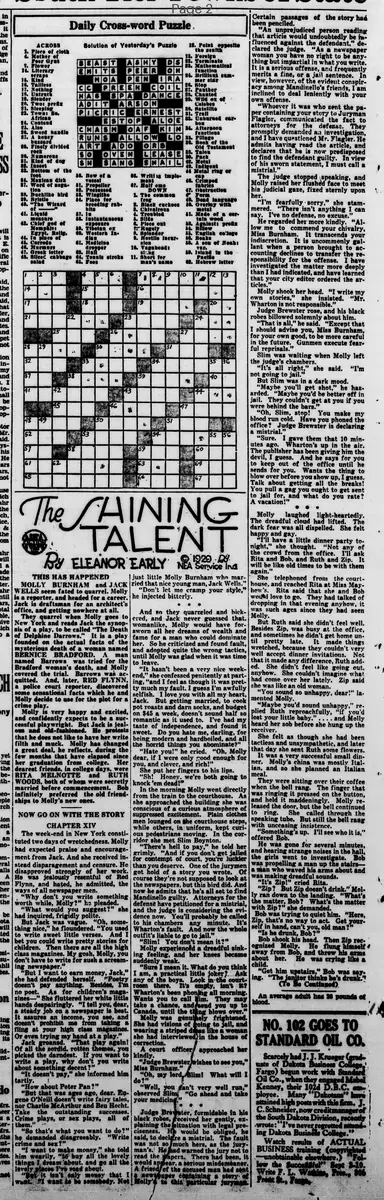
This has happened MOLLY BURNHAM and JACK WELLS seem fated to quarrel. Molly is a reporter, and headed for a career. Jack is draftsman for an architect's office, and getting nowhere at all. They quarrel when Molly goes to New York and reads Jack the synopsis of a play, to be called "The Death of Delphine Darrows." It is a play founded on the actual facts of the mysterious death of a woman named BERNICE BRADFORD. A man named Barrows was tried for the Bradford woman's death, and Molly covered the trial. Barrows was acquitted. And, later, RED FLYNN, a police court reporter, discovered some sensational facts which he and Molly decide to use for the plot for a crime play. Molly is very happy and excited, and confidently expects to be a successful playwright. But Jack is jealous and old-fashioned. He protests that he does not like to have her write filth and muck. Molly has changed a great deal, he reflects, during the few months that have elapsed since her graduation from college. Her dearest friends, in college days, were RITA MELNOTTE and RUTH WOODS, both of whom were secretly married before commencement. Bob infinitely preferred the old friendships to Molly's new ones.
NOW GO ON WITH THE STORY
CHAPTER XIV
The week-end in New York constituted two days of wretchedness. Molly had expected praise and encouragement from Jack. And she received instead disparagement and censure. He disapproved strongly of her work. He was jealously resentful of Red Flynn, and hated, he admitted, the ways of all newspaper men.
"Why don't you write something worth while, Molly?" he pleaded.
"What would you suggest?" she had inquired, frigidly polite. But Jack was vague.
"Oh, something nice." he floundered, "You used to write sweet little verses. And I bet you could write pretty stories for children. Then there are all the high class magazines. My gosh, Molly, you don't have to write for such a screaming newspaper."
"But I want to earn money, Jack," she had defended herself. "Poetry doesn't pay anything. Besides, I'm no poet. As for children's magazines-" She fluttered her white little hands despairingly. "I tell you, dear a steady job on a newspaper is best. It assures an income, you see, and doesn't prohibit me from taking a fling at your high class magazines. Or even trying my hand at a play."
Jack groaned. "That play again! Of all the sordid, rotten themes, you picked the darndest. If you want to write a play, why don't you write about something decent?"
"It doesn't pay," she informed him tartly. "How about Peter Pan?"
"But that was ages ago, dear. Eugene O'Neill doesn't write fairy tales, nor Charlie McArthur and Ben Hecht. Take the outstanding successes. Crime plays, or sex plays, all of them."
"So that's what you want to do?" he demanded disagreeably, "Write crime and sex?"
"I want to make money," she told him wearily, "to buy all the lovely things I dream about, and go all the lovely places I've read about. But it isn't only money that I want. I want to be somebody. Not just little Molly Burnham who married that nice young man, Jack Wells."
"Don't let me cramp your style," he injected bitterly. And so they quarreled and bickered, and Jack never guessed that, womanlike, Molly would have forsworn all her dreams of wealth and fame for a man who could dominate her. So he criticized and found fault, and adopted quite the wrong tactics, until Molly was glad when it was time to leave.
"It hasn't been a very nice week-end," she confessed penitently at parting. "and I feel as though it was pretty much my fault. I guess I'm awfully selfish. I love you with all my heart, Jack. But getting married, to cook pot roasts and darn socks, and budget on $45 a week, doesn't sound half so romantic as it used to. I've had my taste of independence, and found it sweet. Do you hate me, darling, for being modern and hardboiled, and all the horrid things you abominate?"
"Hate you!" he cried. "Oh, Molly dear. if I were only good enough for you, and clever, and rich!"
She put her fingers to his lips. "Sh! Honey. we're both going to knock 'em dead!"
In the morning Molly went directly from the train to the courthouse. As she approached the building she was conscious of a curious atmosphere of suppressed excitement. Plain clothes men lounged on the courthouse steps, while others, in uniform, kept curious pedestrians moving. In the corridor she met Slim Boynton.
"There's hell to pay," he told her grimly. "And if you don't get jailed for contempt of court, you're luckier than you deserve. One of the jurymen got hold of a story you wrote. Of course they're not supposed to look at the newspapers, but this bird did. And now-he admits that he's all set to find Mandinello guilty. Attorneys for the defense have petitioned for a mistrial, and the judge is considering the evidence now. You'll probably be called to his chambers any minute. It's Wharton's fault. And now the whole outfit's liable to go to jail."
"Slim! You don't mean it?" Molly experienced a dreadful-sinking feeling, and her knees became suddenly weak.
"Sure I mean it. What do you think I am, a practical little joker? Ask any of the boys. Look in the court room there. It's empty, isn't it? Wharton's been phoning all morning. Wants you to call him. They may take a chance, and send you up to Canada, until the thing blows over."
Molly was genuinely frightened. She had visions of going to jail, and wearing a striped dress like a woman she had interviewed in the house of correction. A court officer approached her kindly.
"Judge Brewster wishes to see you," Miss Burnham.
"Oh, my lord Slim! What will I do?"
"Well, you can't very well run," observed Slim "Go ahead and take your medicine "
Judge Brewster, formidable in his black robes, received her gently, explaining the situation with legal preciseness. He would be obliged, he said, to declare a mistrial. The fault was not so much hers, as the jury-man's. He had warned the jury not to read the papers.
"There had been, it would appear, a serious misdemeanor. A friend of the accused man had sent newspaper containing a story by Molly to this particular juror. Certain passages of the story had been penciled.
"An unprejudiced person reading that article would undoubtedly be influenced against the defendant," declared the judge. "As a newspaper woman you have no right to be anything but impartial in what you write. It is a serious offense, and frequently merits a fine, or a jail sentence. In view, however, of the evident conspiracy among Mandinello's friends, I am inclined to deal leniently with your own offense. "
"Whoever it was who sent the paper containing your story to Juryman Flagler, communicated the fact to attorneys for the defense. They promptly demanded an investigation, and I have questioned Mr. Flagler. He admits having read the article, and declares that he is now predisposed to find the defendant guilty. In view of his sworn statement, I must call a mistrial."
The judge stopped speaking, and Molly raised her flushed face to meet his judicial gaze, fixed sternly upon her.
"I'm fearfully sorry," she stammered. "There isn't anything I can say. I've no defense, no excuse."
He regarded her more kindly. "Allow me to commend your chivalry. Miss Burnham. It transcends your indiscretion. It is uncommonly gallant when a person brought to accounting declines to transfer the responsibility for the offense. I have investigated the matter more deeply than I had indicated, and have learned that your city editor ordered the articles."
Molly shook her head. "I write my own stories," she insisted. "Mr. Wharton is not responsible."
Judge Brewster rose, and his black robes billowed solemnly about him. "That is all." he said. "Except that I should advise you, Miss Burnham, for your own good, to be more careful in the future. Gunmen execute fearful reprisals."
Slim was waiting when Molly left the judge's chambers.
"It's all right." she said. "I'm not going to jail."
But Slim was in a dark mood. "Maybe you'll get shot," he hazarded. "Maybe you'd be better off in jail. They couldn't get at you if you were behind the bars."
"Oh, Slim, stop! You make my blood run cold. Have you phoned the office? Judge Brewster is declaring a mistrial."
"Sure. I gave them that 10 minutes ago. Wharton's up in the air. The publisher has been giving him the devil, I guess. And he says for you to keep out of the office until he sends for you. Wants the thing to blow over before you show up, I guess. Talk about getting all the breaks You pull a gag you ought to get sent to jail for, and what do you rate? A vacation!"
Molly laughed light-heartedly. The dreadful cloud had lifted. The dark fear was all dispelled. She felt happy and gay.
"I'll have a little dinner party tonight." she thought, "Not any of the crowd from the office. I'll ask Rita and Bob. and Ruth and Zip. It will be like old times to be with them again,"
She telephoned from the courthouse, and reached Rita at Miss Mayhew's. Rita said that she and Bob would love to go. They had talked of dropping in that evening anyhow, it was such ages since they had seen Molly. But Ruth said she didn't feel well. Besides Zip was busy at the office. and sometimes he didn't get home until pretty late. It made things wretched. because they couldn't very well accept dinner invitations. Not that it made any difference., Ruth added. She didn't feel like going out, anyhow. She couldn't imagine what had come over her lately. Zip said she was like an old woman.
"You sound so unhappy, dear!" lamented Molly.
"Maybe you'd sound unhappy," replied Ruth reproachfully, "if you'd lost your little baby."
... . and Molly heard her sob before she hung up the receiver. She felt as though she had been tactless and unsympathetic, and later that day she sent Ruth some flowers.
It was a very successful small dinner. Molly's china was mostly Italian, and so she planned an Italian meal. They were sitting over their coffee when the bell rang. The finger that was ringing it pressed on the button, and held it maddeningly. Molly released the door. but the bell continued to ring. She called through the speaking tube. But still the bell rang with unceasing insistence.
"Something's up. I'll see who it is," offered Bob. He was gone for several minutes, and hearing strange noises in the hall, the girls went to investigate. Bob was propelling a man up the stairs- a man who waved his arms about and was making dreadful sounds.
"It's Zip!" cried Rita.
"Zip? But Zip doesn't drink." Molly ran down to the landing.
"What's the matter, Bob? What's the matter with Zip?" she demanded.
Bob was trying to quiet him. "Here, Zip, that's no way to act. Get yourself in hand, can't you, old man?"
"Is he drunk, Bob?"
Bob shook his head. Then Zip recognized Molly. He flung himself away from Bob, and threw his arms about her. He was crying like a child.
"Get him upstairs," Bob was saying. "The janitor thinks he's drunk."
(To Be Continued)
An average adult has 28 pounds of blood.
NOW GO ON WITH THE STORY
CHAPTER XIV
The week-end in New York constituted two days of wretchedness. Molly had expected praise and encouragement from Jack. And she received instead disparagement and censure. He disapproved strongly of her work. He was jealously resentful of Red Flynn, and hated, he admitted, the ways of all newspaper men.
"Why don't you write something worth while, Molly?" he pleaded.
"What would you suggest?" she had inquired, frigidly polite. But Jack was vague.
"Oh, something nice." he floundered, "You used to write sweet little verses. And I bet you could write pretty stories for children. Then there are all the high class magazines. My gosh, Molly, you don't have to write for such a screaming newspaper."
"But I want to earn money, Jack," she had defended herself. "Poetry doesn't pay anything. Besides, I'm no poet. As for children's magazines-" She fluttered her white little hands despairingly. "I tell you, dear a steady job on a newspaper is best. It assures an income, you see, and doesn't prohibit me from taking a fling at your high class magazines. Or even trying my hand at a play."
Jack groaned. "That play again! Of all the sordid, rotten themes, you picked the darndest. If you want to write a play, why don't you write about something decent?"
"It doesn't pay," she informed him tartly. "How about Peter Pan?"
"But that was ages ago, dear. Eugene O'Neill doesn't write fairy tales, nor Charlie McArthur and Ben Hecht. Take the outstanding successes. Crime plays, or sex plays, all of them."
"So that's what you want to do?" he demanded disagreeably, "Write crime and sex?"
"I want to make money," she told him wearily, "to buy all the lovely things I dream about, and go all the lovely places I've read about. But it isn't only money that I want. I want to be somebody. Not just little Molly Burnham who married that nice young man, Jack Wells."
"Don't let me cramp your style," he injected bitterly. And so they quarreled and bickered, and Jack never guessed that, womanlike, Molly would have forsworn all her dreams of wealth and fame for a man who could dominate her. So he criticized and found fault, and adopted quite the wrong tactics, until Molly was glad when it was time to leave.
"It hasn't been a very nice week-end," she confessed penitently at parting. "and I feel as though it was pretty much my fault. I guess I'm awfully selfish. I love you with all my heart, Jack. But getting married, to cook pot roasts and darn socks, and budget on $45 a week, doesn't sound half so romantic as it used to. I've had my taste of independence, and found it sweet. Do you hate me, darling, for being modern and hardboiled, and all the horrid things you abominate?"
"Hate you!" he cried. "Oh, Molly dear. if I were only good enough for you, and clever, and rich!"
She put her fingers to his lips. "Sh! Honey. we're both going to knock 'em dead!"
In the morning Molly went directly from the train to the courthouse. As she approached the building she was conscious of a curious atmosphere of suppressed excitement. Plain clothes men lounged on the courthouse steps, while others, in uniform, kept curious pedestrians moving. In the corridor she met Slim Boynton.
"There's hell to pay," he told her grimly. "And if you don't get jailed for contempt of court, you're luckier than you deserve. One of the jurymen got hold of a story you wrote. Of course they're not supposed to look at the newspapers, but this bird did. And now-he admits that he's all set to find Mandinello guilty. Attorneys for the defense have petitioned for a mistrial, and the judge is considering the evidence now. You'll probably be called to his chambers any minute. It's Wharton's fault. And now the whole outfit's liable to go to jail."
"Slim! You don't mean it?" Molly experienced a dreadful-sinking feeling, and her knees became suddenly weak.
"Sure I mean it. What do you think I am, a practical little joker? Ask any of the boys. Look in the court room there. It's empty, isn't it? Wharton's been phoning all morning. Wants you to call him. They may take a chance, and send you up to Canada, until the thing blows over."
Molly was genuinely frightened. She had visions of going to jail, and wearing a striped dress like a woman she had interviewed in the house of correction. A court officer approached her kindly.
"Judge Brewster wishes to see you," Miss Burnham.
"Oh, my lord Slim! What will I do?"
"Well, you can't very well run," observed Slim "Go ahead and take your medicine "
Judge Brewster, formidable in his black robes, received her gently, explaining the situation with legal preciseness. He would be obliged, he said, to declare a mistrial. The fault was not so much hers, as the jury-man's. He had warned the jury not to read the papers.
"There had been, it would appear, a serious misdemeanor. A friend of the accused man had sent newspaper containing a story by Molly to this particular juror. Certain passages of the story had been penciled.
"An unprejudiced person reading that article would undoubtedly be influenced against the defendant," declared the judge. "As a newspaper woman you have no right to be anything but impartial in what you write. It is a serious offense, and frequently merits a fine, or a jail sentence. In view, however, of the evident conspiracy among Mandinello's friends, I am inclined to deal leniently with your own offense. "
"Whoever it was who sent the paper containing your story to Juryman Flagler, communicated the fact to attorneys for the defense. They promptly demanded an investigation, and I have questioned Mr. Flagler. He admits having read the article, and declares that he is now predisposed to find the defendant guilty. In view of his sworn statement, I must call a mistrial."
The judge stopped speaking, and Molly raised her flushed face to meet his judicial gaze, fixed sternly upon her.
"I'm fearfully sorry," she stammered. "There isn't anything I can say. I've no defense, no excuse."
He regarded her more kindly. "Allow me to commend your chivalry. Miss Burnham. It transcends your indiscretion. It is uncommonly gallant when a person brought to accounting declines to transfer the responsibility for the offense. I have investigated the matter more deeply than I had indicated, and have learned that your city editor ordered the articles."
Molly shook her head. "I write my own stories," she insisted. "Mr. Wharton is not responsible."
Judge Brewster rose, and his black robes billowed solemnly about him. "That is all." he said. "Except that I should advise you, Miss Burnham, for your own good, to be more careful in the future. Gunmen execute fearful reprisals."
Slim was waiting when Molly left the judge's chambers.
"It's all right." she said. "I'm not going to jail."
But Slim was in a dark mood. "Maybe you'll get shot," he hazarded. "Maybe you'd be better off in jail. They couldn't get at you if you were behind the bars."
"Oh, Slim, stop! You make my blood run cold. Have you phoned the office? Judge Brewster is declaring a mistrial."
"Sure. I gave them that 10 minutes ago. Wharton's up in the air. The publisher has been giving him the devil, I guess. And he says for you to keep out of the office until he sends for you. Wants the thing to blow over before you show up, I guess. Talk about getting all the breaks You pull a gag you ought to get sent to jail for, and what do you rate? A vacation!"
Molly laughed light-heartedly. The dreadful cloud had lifted. The dark fear was all dispelled. She felt happy and gay.
"I'll have a little dinner party tonight." she thought, "Not any of the crowd from the office. I'll ask Rita and Bob. and Ruth and Zip. It will be like old times to be with them again,"
She telephoned from the courthouse, and reached Rita at Miss Mayhew's. Rita said that she and Bob would love to go. They had talked of dropping in that evening anyhow, it was such ages since they had seen Molly. But Ruth said she didn't feel well. Besides Zip was busy at the office. and sometimes he didn't get home until pretty late. It made things wretched. because they couldn't very well accept dinner invitations. Not that it made any difference., Ruth added. She didn't feel like going out, anyhow. She couldn't imagine what had come over her lately. Zip said she was like an old woman.
"You sound so unhappy, dear!" lamented Molly.
"Maybe you'd sound unhappy," replied Ruth reproachfully, "if you'd lost your little baby."
... . and Molly heard her sob before she hung up the receiver. She felt as though she had been tactless and unsympathetic, and later that day she sent Ruth some flowers.
It was a very successful small dinner. Molly's china was mostly Italian, and so she planned an Italian meal. They were sitting over their coffee when the bell rang. The finger that was ringing it pressed on the button, and held it maddeningly. Molly released the door. but the bell continued to ring. She called through the speaking tube. But still the bell rang with unceasing insistence.
"Something's up. I'll see who it is," offered Bob. He was gone for several minutes, and hearing strange noises in the hall, the girls went to investigate. Bob was propelling a man up the stairs- a man who waved his arms about and was making dreadful sounds.
"It's Zip!" cried Rita.
"Zip? But Zip doesn't drink." Molly ran down to the landing.
"What's the matter, Bob? What's the matter with Zip?" she demanded.
Bob was trying to quiet him. "Here, Zip, that's no way to act. Get yourself in hand, can't you, old man?"
"Is he drunk, Bob?"
Bob shook his head. Then Zip recognized Molly. He flung himself away from Bob, and threw his arms about her. He was crying like a child.
"Get him upstairs," Bob was saying. "The janitor thinks he's drunk."
(To Be Continued)
An average adult has 28 pounds of blood.
What sub-type of article is it?
Prose Fiction
Dialogue
What themes does it cover?
Love Romance
Social Manners
Liberty Freedom
What keywords are associated?
Romantic Quarrel
Journalism Career
Mistrial Incident
Female Independence
Friendship Drama
Crime Play
Dinner Party
Literary Details
Title
Chapter Xiv
Key Lines
"Why Don't You Write Something Worth While, Molly?" He Pleaded. "What Would You Suggest?" She Had Inquired, Frigidly Polite. But Jack Was Vague. "Oh, Something Nice." He Floundered, "You Used To Write Sweet Little Verses."
"I Want To Make Money," She Told Him Wearily, "To Buy All The Lovely Things I Dream About, And Go All The Lovely Places I've Read About. But It Isn't Only Money That I Want. I Want To Be Somebody. Not Just Little Molly Burnham Who Married That Nice Young Man, Jack Wells."
"Don't Let Me Cramp Your Style," He Injected Bitterly.
"As A Newspaper Woman You Have No Right To Be Anything But Impartial In What You Write. It Is A Serious Offense, And Frequently Merits A Fine, Or A Jail Sentence."
"You Sound So Unhappy, Dear!" Lamented Molly. "Maybe You'd Sound Unhappy," Replied Ruth Reproachfully, "If You'd Lost Your Little Baby."