Thank you for visiting SNEWPapers!
Sign up free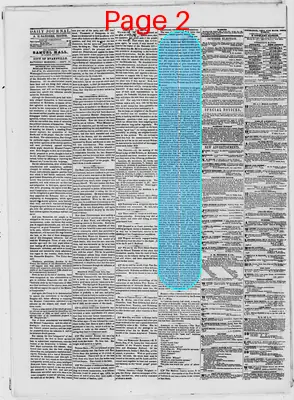
Editorial
September 16, 1854
The Evansville Daily Journal
Evansville, Vanderburgh County, Indiana
What is this article about?
An editorial criticizes the Enquirer's support for Judge Hall and the Kansas-Nebraska Bill, arguing via Dr. Nofsinger's letter that the bill falsely claims to promote self-government while actually imposing federal control and violating the Missouri Compromise to allow slavery in territories.
Clipping

OCR Quality
95%
Excellent
Full Text
The man that votes for Hall Votes that Americans cannot govern themselves.
[Enquirer.]
Thus our remarkable neighbor closes an article on the Miller and Hall discussion--in which there are more absurdities than generally abound in articles from the same source, which is saying a great deal. Judge Hall never has questioned the right of the people to govern themselves, and nobody knows this better than the person who edits the Enquirer. He opposes this Nebraska Bill, and what privilege does it give Americans of governing themselves? Instead of arguing this question as we have done before, we may just as well give an extract from a letter written by Dr. Nofsinger, a good Democrat, and elected by Democrats to the Legislature, Constitutional Convention, and to the Trusteeship of the Wabash and Erie Canal. He says:
It is urged that it is necessary to abrogate the Missouri Compromise line, "in order to carry out the great principle of self-government;" and that those who are not in favor of this abrogation, are not in favor of this great principle of self-government. This assertion has been the most successful of all others in deceiving and proselyting the people. I do not desire to conceal the fact that many honest Democrats have been deceived by this wretched humbug, which I will presently show it to be. Hence you will find every "Nebraskaite" whom you meet, urging this assertion as his first and last argument, to convince you that the Missouri Compromise should be repealed. He will say to you, "are you not in favor of the principle of self-government?" "don't you believe the people are capable of self-government?" "cannot the same men govern themselves as well in a territory as in a State?" Now I answer affirmatively to each one of the propositions. I believe in the doctrine of self-government, just as much or more, than those "Nebraskaites," who propose this document in defense of the Kansas and Nebraska bill. Yet deny emphatically, and can prove positively, that this Kansas and Nebraska bill does not contain or carry out the principle of self-government; and moreover, that it was not the design of Congress that this bill should carry out or establish this doctrine. But on the contrary, that this doctrine is preached to delude the people into the support of a fraudulent, outrageous and dangerous act--an act, which I fear may eventuate in the destruction of our glorious Union. But why do I say that the bill does not carry out the doctrine of self-government? First, because instead of allowing the people of Kansas and Nebraska to form their own governments, Congress institutes governments for them; and secondly, in the institution of these territorial governments, Congress retains in the hands of the General Government two-thirds or more of the power of these territorial governments; that is she retains in the hands of the General Government, not only the judicial and executive departments, but also gives the Governor the power to veto the acts of the territorial legislature; and besides all this, the bill extends all the laws of the United States, which are applicable, over the people of these territories! Yet the people will have no voice or participation whatever, in enacting these laws or repealing, if they don't suit them! What a perfect burlesque upon self-government! The people are not allowed to elect their Judges, their State officers, or their Governor, nor allowed to pass a single law unless approved by the Governor, who is appointed away off at Washington city by the President of the United States, for whom they are not allowed even to vote!!! Now in the name of candor and truth, what was this little stump speech about self-government stuck into this Kansas and Nebraska bill for, unless it was to gull and deceive? And did Congress think she could thus successfully delude the American people with the beautiful name of self-government, and with this name, hide from detection her outrageous violation of the plighted faith of the nation? This sacred and beautiful doctrine of self-government, placed so pompously in the Kansas and Nebraska bill, and which is violated by every principle of the bill, is placed in this bill as a mere Trojan horse, to cheat and delude the people and which I fear will prove as destructive to the Americans, as the ancient Grecian horse did to the Trojans! If Congress was in earnest about establishing the doctrine of self-government, why did she not do it! Why did she not pass a joint resolution, authorizing and recommending the people of these territories to form such governments as she pleased and to elect their own officers. This would have proved the sincerity of Congress. No! Congress never intended to establish any such doctrine. She never intended to let the people of Kansas and Nebraska territories, do as they please on any other subject than that of slavery.
[Enquirer.]
Thus our remarkable neighbor closes an article on the Miller and Hall discussion--in which there are more absurdities than generally abound in articles from the same source, which is saying a great deal. Judge Hall never has questioned the right of the people to govern themselves, and nobody knows this better than the person who edits the Enquirer. He opposes this Nebraska Bill, and what privilege does it give Americans of governing themselves? Instead of arguing this question as we have done before, we may just as well give an extract from a letter written by Dr. Nofsinger, a good Democrat, and elected by Democrats to the Legislature, Constitutional Convention, and to the Trusteeship of the Wabash and Erie Canal. He says:
It is urged that it is necessary to abrogate the Missouri Compromise line, "in order to carry out the great principle of self-government;" and that those who are not in favor of this abrogation, are not in favor of this great principle of self-government. This assertion has been the most successful of all others in deceiving and proselyting the people. I do not desire to conceal the fact that many honest Democrats have been deceived by this wretched humbug, which I will presently show it to be. Hence you will find every "Nebraskaite" whom you meet, urging this assertion as his first and last argument, to convince you that the Missouri Compromise should be repealed. He will say to you, "are you not in favor of the principle of self-government?" "don't you believe the people are capable of self-government?" "cannot the same men govern themselves as well in a territory as in a State?" Now I answer affirmatively to each one of the propositions. I believe in the doctrine of self-government, just as much or more, than those "Nebraskaites," who propose this document in defense of the Kansas and Nebraska bill. Yet deny emphatically, and can prove positively, that this Kansas and Nebraska bill does not contain or carry out the principle of self-government; and moreover, that it was not the design of Congress that this bill should carry out or establish this doctrine. But on the contrary, that this doctrine is preached to delude the people into the support of a fraudulent, outrageous and dangerous act--an act, which I fear may eventuate in the destruction of our glorious Union. But why do I say that the bill does not carry out the doctrine of self-government? First, because instead of allowing the people of Kansas and Nebraska to form their own governments, Congress institutes governments for them; and secondly, in the institution of these territorial governments, Congress retains in the hands of the General Government two-thirds or more of the power of these territorial governments; that is she retains in the hands of the General Government, not only the judicial and executive departments, but also gives the Governor the power to veto the acts of the territorial legislature; and besides all this, the bill extends all the laws of the United States, which are applicable, over the people of these territories! Yet the people will have no voice or participation whatever, in enacting these laws or repealing, if they don't suit them! What a perfect burlesque upon self-government! The people are not allowed to elect their Judges, their State officers, or their Governor, nor allowed to pass a single law unless approved by the Governor, who is appointed away off at Washington city by the President of the United States, for whom they are not allowed even to vote!!! Now in the name of candor and truth, what was this little stump speech about self-government stuck into this Kansas and Nebraska bill for, unless it was to gull and deceive? And did Congress think she could thus successfully delude the American people with the beautiful name of self-government, and with this name, hide from detection her outrageous violation of the plighted faith of the nation? This sacred and beautiful doctrine of self-government, placed so pompously in the Kansas and Nebraska bill, and which is violated by every principle of the bill, is placed in this bill as a mere Trojan horse, to cheat and delude the people and which I fear will prove as destructive to the Americans, as the ancient Grecian horse did to the Trojans! If Congress was in earnest about establishing the doctrine of self-government, why did she not do it! Why did she not pass a joint resolution, authorizing and recommending the people of these territories to form such governments as she pleased and to elect their own officers. This would have proved the sincerity of Congress. No! Congress never intended to establish any such doctrine. She never intended to let the people of Kansas and Nebraska territories, do as they please on any other subject than that of slavery.
What sub-type of article is it?
Slavery Abolition
Constitutional
Partisan Politics
What keywords are associated?
Kansas Nebraska Bill
Self Government
Missouri Compromise
Slavery
Territorial Governments
Congressional Deception
Democrats
What entities or persons were involved?
Judge Hall
Enquirer
Dr. Nofsinger
Congress
Democrats
Nebraskaites
Miller
Editorial Details
Primary Topic
Opposition To Kansas Nebraska Bill As False Self Government
Stance / Tone
Strongly Anti Kansas Nebraska Bill, Accusing It Of Fraud And Deception
Key Figures
Judge Hall
Enquirer
Dr. Nofsinger
Congress
Democrats
Nebraskaites
Miller
Key Arguments
The Kansas Nebraska Bill Does Not Promote Self Government As Congress Institutes Territorial Governments
Congress Retains Most Powers Including Judicial, Executive, And Veto Authority Over Legislatures
The Bill Extends U.S. Laws To Territories Without Local Input
People Cannot Elect Judges, Officers, Or Governor, Who Is Appointed By The President
Self Government Rhetoric Is A Deception To Repeal Missouri Compromise And Allow Slavery
True Self Government Would Allow Territories To Form Their Own Governments Freely
The Bill Endangers The Union By Violating Plighted Faith