Thank you for visiting SNEWPapers!
Sign up free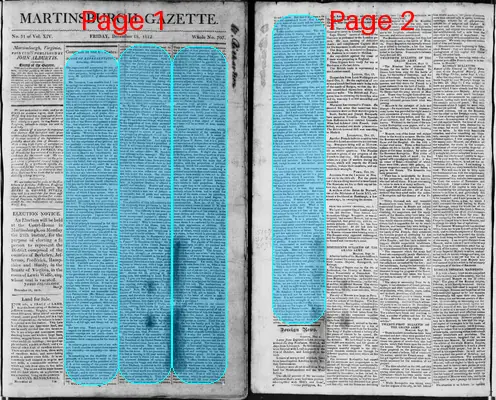
Martinsburgh Gazette
Martinsburg, Berkeley County, West Virginia
What is this article about?
In the U.S. House of Representatives on November 21, Mr. Quincy of Massachusetts protests a bill allowing enlistment of minors over 18, calling it atrocious for seducing youth from guardians, absurd given national prosperity, and unequal as it burdens Northern families while exempting Southern slaves. He urges protecting moral ties and focusing on defensive war measures.
Merged-components note: Merged sequential components across pages 1 and 2 that form a continuous transcript of Mr. Quincy's speech in the House of Representatives. Changed label from 'editorial' for the last component to 'story' as it is a reported political speech fitting the narrative article category.
Clippings
1 of 2
OCR Quality
Full Text
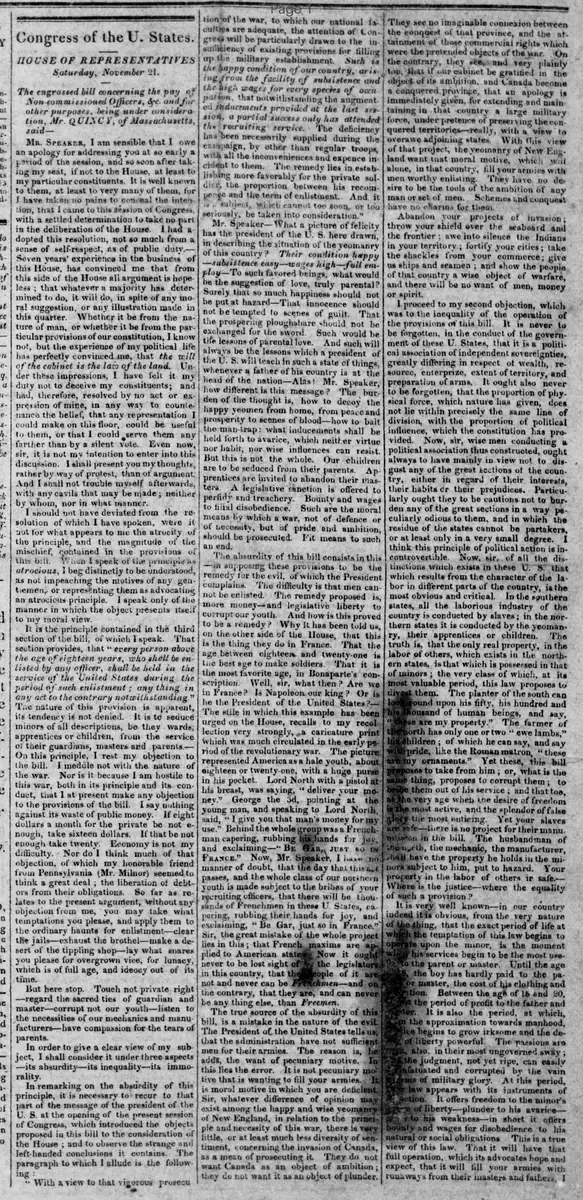
HOUSE OF REPRESENTATIVES
Saturday, November 21.
The engrossed bill concerning the pay of Non-commissioned Officers, &c. and for other purposes, being under consideration, Mr. QUINCY, of Massachusetts, said—
Mr. Speaker. I am sensible that I owe an apology for addressing you at so early a period of the session, and so soon after taking my seat, if not to the House, at least to my particular constituents. It is well known to them, at least to very many of them, for I have taken no pains to conceal the intention, that I came to this session of Congress, with a settled determination to take no part in the deliberation of the House. I had adopted this resolution, not so much from a sense of self-respect, as of public duty.—Seven years' experience in the business of this House, has convinced me that from this side of the House all argument is hopeless; that whatever a majority has determined to do, it will do, in spite of any moral suggestion, or any illustration made in this quarter. Whether it be from the nature of man, or whether it be from the particular provisions of our constitution, I know not, but the experience of my political life has perfectly convinced me, that the will of the cabinet is the law of the land. Under these impressions, I have felt it my duty not to deceive my constituents; and had, therefore, resolved by no act or expression of mine, in any way to countenance the belief, that any representation I could make on this floor, could be useful to them, or that I could serve them any farther than by a silent vote. Even now, sir, it is not my intention to enter into this discussion. I shall present you my thoughts, rather by way of protest, than of argument. And I shall not trouble myself afterwards with any cavils that may be made; neither by whom, nor in what manner.
I should not have deviated from the resolution of which I have spoken, were it not for what appears to me the atrocity of the principle, and the magnitude of the mischief, contained in the provisions of this bill. When I speak of the principle as atrocious, I beg distinctly to be understood, as not impeaching the motives of any gentlemen, or representing them as advocating an atrocious principle. I speak only of the manner in which the object presents itself to my moral view.
It is the principle contained in the third section of the bill, of which I speak. That section provides, that "every person above the age of eighteen years, who shall be enlisted by any officer, shall be held in the service of the United States during the period of such enlistment; any thing in any act to the contrary notwithstanding." The nature of this provision is apparent, its tendency is not denied. It is to seduce minors of all descriptions, be they wards, apprentices or children, from the service of their guardians, masters and parents.—On this principle, I rest my objection to the bill. I meddle not with the nature of the war. Nor is it because I am hostile to this war, both in its principle and its conduct, that I at present make any objection to the provisions of the bill. I say nothing against its waste of public money. If eight dollars a month for the private be not enough, take sixteen dollars. If that be not enough take twenty. Economy is not my difficulty. Nor do I think much of that objection, of which my honorable friend from Pennsylvania (Mr. Milnor) seemed to think a great deal; the liberation of debtors from their obligations. So far as relates to the present argument, without any objection from me, you may take what temptations you please, and apply them to the ordinary haunts for enlistment—clear the jails—exhaust the brothel—make a desert of the tippling shop—lay what snares you please for overgrown vice, for lunacy, which is of full age, and idiocy out of its time.
But here stop. Touch not private right—regard the sacred ties of guardian and master—corrupt not our youth—listen to the necessities of our mechanics and manufacturers—have compassion for the tears of parents.
In order to give a clear view of my subject, I shall consider it under three aspects—its absurdity—its inequality—its immorality.
In remarking on the absurdity of this principle, it is necessary to recur to that part of the message of the president of the U. S. at the opening of the present session of Congress, which introduced the objects proposed in this bill to the consideration of the House; and to observe the strange and left-handed conclusions it contains. The paragraph to which I allude is the following:
"With a view to that vigorous prosecution of the war, to which our national faculties are adequate, the attention of Congress will be particularly drawn to the insufficiency of existing provisions for filling up the military establishment. Such is the happy condition of our country, arising from the facility of subsistence and the high wages for every species of occupation, that notwithstanding the augmented inducements provided at the last session, a partial success only has attended the recruiting service. The deficiency has been necessarily supplied during the campaign, by other than regular troops, with all the inconveniences and expense incident to them. The remedy lies in establishing more favorably for the private soldier, the proportion between his recompense and the term of enlistment. And it is a subject, which cannot too soon, or too seriously, be taken into consideration."
Mr. Speaker—What a picture of felicity has the president of the U. S. here drawn, in describing the situation of the yeomanry of this country? Their condition happy—subsistence easy—wages high—full employment—To such favored beings, what would be the suggestion of love, truly parental? Surely that so much happiness should not be put at hazard—That innocence should not be tempted to scenes of guilt. That the prospering ploughshare should not be exchanged for the sword. Such would be the lessons of parental love. And such will always be the lessons which a president of the U. S. will teach in such a state of things, whenever a father of his country is at the head of the nation—Alas! Mr. Speaker, how different is this message? The burden of the thought is, how to decoy the happy yeomen from home, from peace and prosperity to scenes of blood—how to bait the man-trap: what inducements shall be held forth to avarice, which neither virtue nor habit, nor wise influences can resist. But this is not the whole. Our children are to be seduced from their parents. Apprentices are invited to abandon their masters. A legislative sanction is offered to perfidy and treachery. Bounty and wages to filial disobedience. Such are the moral means by which a war, not of defence or of necessity, but of pride and ambition, should be prosecuted. Fit means to such an end.
The absurdity of this bill consists in this—in supposing these provisions to be the remedy for the evil, of which the President complains. The difficulty is that men cannot be enlisted. The remedy proposed is, more money—and legislative liberty to corrupt our youth. And how is this proved to be a remedy? Why it has been told us, on the other side of the House, that this is the thing they do in France. That the age between eighteen and twenty-one is the best age to make soldiers. That it is the most favorite age, in Bonaparte's conscription. Well, sir, what then? Are we in France? Is Napoleon our king? Or is he the President of the United States?—The stile in which this example has been urged on the House, recalls to my recollection very strongly, a caricature print which was much circulated in the early period of the revolutionary war. The picture represented America as a hale youth, about eighteen or twenty-one, with a huge purse in his pocket. Lord North with a pistol at his breast, was saying, "deliver your money." George the 3d, pointing at the young man, and speaking to Lord North, said, "I give you that man's money for my use." Behind the whole group was a Frenchman capering, rubbing his hands for joy, and exclaiming—"BE GAR, JUST SO IN France." Now, Mr. Speaker, I have no manner of doubt, that the day that this act passes, and the whole class of our northern youth is made subject to the bribes of your recruiting officers, that there will be thousands of Frenchmen in these U. States, capering, rubbing their hands for joy, and exclaiming, "Be Gar, just so in France."
Sir, the great mistake of the whole project lies in this; that French maxims are applied to American state: Now it ought never to be lost sight of by the legislator in this country, that the people of it are not and never can be Frenchmen—and on the contrary, that they are, and can never be any thing else than Freemen.
The true source of the absurdity of this bill, is a mistake in the nature of the evil. The President of the United States tells us, that the administration have not sufficient men for their armies. The reason is, he adds, the want of pecuniary motive. In this lies the error. It is not pecuniary motive that is wanting to fill your armies. It is moral motive in which you are deficient.
Sir, whatever difference of opinion may exist among the happy and wise yeomanry of New England, in relation to the principle and necessity of this war, there is very little, or at least much less diversity of sentiment, concerning the invasion of Canada, as a mean of prosecuting it. They do not want Canada as an object of ambition; they do not want it as an object of plunder.
They see no imaginable connexion between the conquest of that province, and the attainment of those commercial rights which were the pretended objects of the war. On the contrary, they see, and very plainly too, that if our cabinet be gratified in the object of its ambition, and Canada become a conquered province, that an apology is immediately given, for extending and maintaining in that country a large military force, under pretence of preserving the conquered territories—really, with a view to overawe adjoining states. With this view of that project, the yeomanry of New England want that moral motive, which will alone, in that country, fill your armies with men worthy enlisting. They have no desire to be the tools of the ambition of any man or set of men. Schemes and conquest have no charm for them.
Abandon your projects of invasion; throw your shield over the seaboard and the frontier; awe into silence the Indians in your territory; fortify your cities; take the shackles from your commerce; give us ships and seamen; and show the people of that country a wise object of warfare, and there will be no want of men, money or spirit.
I proceed to my second objection, which was to the inequality of the operation of the provisions of this bill. It is never to be forgotten, in the conduct of the government of these U. States, that it is a political association of independent sovereignties, greatly differing in respect of wealth, resource, enterprize, extent of territory, and preparation of arms. It ought also never to be forgotten, that the proportion of physical force, which nature has given, does not lie within precisely the same line of division, with the proportion of political influence, which the constitution has provided. Now, sir, wise men conducting a political association thus constructed, ought always to have mainly in view not to disgust any of the great sections of the country, either in regard of their interests, their habits or their prejudices. Particularly ought they to be cautious not to burden any of the great sections in a way peculiarly odious to them, and in which the residue of the states cannot be partakers, or at least only in a very small degree. I think this principle of political action is incontrovertible. Now, sir, of all the distinctions which exists in these U. S. that which results from the character of the labor in different parts of the country, is the most obvious and critical. In the southern states, all the laborious industry of the country is conducted by slaves; in the northern states it is conducted by the yeomanry, their apprentices or children. The truth is, that the only real property, in the labor of others, which exists in the northern states, is that which is possessed in that of minors; the very class of which, at its most valuable period, this law proposes to divest them. The planter of the south can look round upon his fifty, his hundred and his thousand of human beings, and say, "these are my property." The farmer of the north has only one or two "ewe lambs," children; of which he can say, and say with pride, like the Roman matron, "these are my ornaments." Yet these, this bill proposes to take from him; or, what is the same thing, proposes to corrupt them; to bribe them out of his service; and that too, at the very age when the desire of freedom is most active, and the splendor of false glory the most enticing. Yet your slaves are excepted—there is no project for their enlistment in the bill. The husbandman of the north, the mechanic, the manufacturer, shall have the property he holds in the minors subject to him, put to hazard. Your property in the labor of others is safe.—Where is the justice—where the equality of such a provision?
It is very well known—in our country indeed it is obvious, from the very nature of the thing, that the exact period of life at which the temptation of this law begins to operate upon the minor, is the moment his services begin to be the most useful to the parent or master. Until the age of 18 the boy has hardly paid to the parent or master, the cost of his clothing and education. Between the age of 18 and 20, is the period of profit to the father and master. It is also the period, at which, the approximation towards manhood, discipline begins to grow irksome and the desire of liberty powerful. The passions are also, in their most ungoverned sway; the judgment, not yet ripe, can easily be infatuated and corrupted by the vain promises of military glory. At this period, the law appears with its instruments of seduction. It offers freedom to the minor's love of liberty—plunder to his avarice—glory to his weakness—in short it offers bounty and wages for disobedience to his natural or social obligations. This is a true view of this law. That it will have that full operation, which its advocates hope and expect, that it will fill your armies with runaways from their masters and fathers, I
do not believe. But that it will have a very great operation I know. The temptation to some of our youth will be irresistible. With my consent they shall never be exposed to it.
I offer another consideration. The constitution of the U. States declares, in its seventh amendment—'Private property shall not be taken for public use, without just compensation.' Now of all the property which the laws of the northern states secures to the people of that country that which consists in the labor of the minor, and which, by our laws is sacred to the guardian, master or parent, is perhaps the most valued and most precious to our mechanics, manufacturers and yeomen. Yet when the gentleman from New-York (Mr. Stow) proposed to secure the wages and bounty of the enlisting minor, to those to whom his service belonged, it was rejected.
What is this but a palpable violation of this provision of the constitution? What is it but taking private property for public use without compensation?
But, neither the pecuniary loss, nor yet the violation of the constitution, is the evil which I most deprecate. It is the infringement of our moral rights, and the inroad which the bill makes on the moral habits of our quarter of the country. I know that gentlemen are very apt to sneer, when they hear any thing said about our religious institutions, or moral habits, in the eastern country. But I will explain what I mean.
It is not our religious institutions, our sabbaths, our fasts, our thanksgivings, nor yet our schools, colleges and seminaries of education, to which I refer, when I speak of our moral habits. These are but means and precautions. It is certain established principles of life and conduct which without being noticed in general laws are often the foundation of them, and which always rule and controul our positive institutions.
I do not know for instance, that the extent of the moral tie, which binds the son to the father, or the apprentice to the master is precisely assigned by any of our laws. Yet the principle, upon which all our laws on this subject rests, is this: That this tie is sacred and inviolate. The law regulates, but, except in case of misconduct, never severs it.
I know it is said, that in our country minors are subjected to militia duty. And so they are. But this very service is a proof of the position, which I maintain. Their obligation to service in the militia, is always subject to the paramount authority of the master and the parent.
The law says, it is true, that minors shall be subject to militia duty. But it also permits the father and the master to relieve them from that obligation, at an established price. If either will pay the fine, he may retain the service of the minor, free from the militia duty. What is the consequence of all this? Why that the minor always trains not free of the will, but subject to the will of his natural or legal guardians. The moral tie is sacred. It is never broken. It is a principle, that cases of misconduct out of the question, the minor shall never conceive himself capable of escaping from the wholesome and wise controul of his master or father. The proposed law cuts athwart this wise principle. It preaches infidelity. It makes every recruiting officer in your country an apostle of perfidy. It says to every vain, thoughtless, discontented or ambitious minor:—
'Come hither, here is an asylum from your bonds. Here are wages and bounty for disobedience—Only consent to go to Canada—Forget what you owe to nature and your protectors—Go to Canada, and you shall find freedom and glory.'—Such is the morality of this law.
Take a slave from his master, on any general and novel principle, and there would be an earthquake from the Potomac to the St. Mary's. Bribe an apprentice from his master; seduce a son, worth all the slaves Africa ever produced from his father, we are told it is only a common affair. It will be right when there is a law for it. Such is now the law in France!
Mr. Speaker—I hope what I am now about to say will not be construed into a threat. It is not uttered in that spirit, but only to evince the strength of my convictions concerning the effect of the provisions of this law on the hopes of New-England, particularly of Massachusetts. But pass it, and if the legislatures of the injured states do not come down upon your recruiting officers, with the old laws against kidnapping and manstealing, they are false to themselves, their posterity and their country.
What sub-type of article is it?
What themes does it cover?
What keywords are associated?
What entities or persons were involved?
Where did it happen?
Story Details
Key Persons
Location
House Of Representatives
Event Date
Saturday, November 21
Story Details
Mr. Quincy of Massachusetts delivers a protest speech against a bill provision allowing enlistment of persons over 18, including minors like apprentices and children, without guardian consent, arguing its absurdity in contradicting the President's message on prosperous conditions, its inequality burdening Northern yeomanry while sparing Southern slaves, and its immorality in seducing youth from family ties and promoting disobedience.