Thank you for visiting SNEWPapers!
Sign up free
Literary
December 1, 1892
Pocahontas Times
Marlinton, Huntersville, Pocahontas County, West Virginia
What is this article about?
Anecdotal narrative recounting the true story of the lamb owned by Mary, a farmer's daughter, who rescued and raised it after it was abandoned by its mother. The lamb famously followed her to school, inspiring the nursery rhyme, and lived to old age before being killed by a cow.
Clipping
OCR Quality
98%
Excellent
Full Text
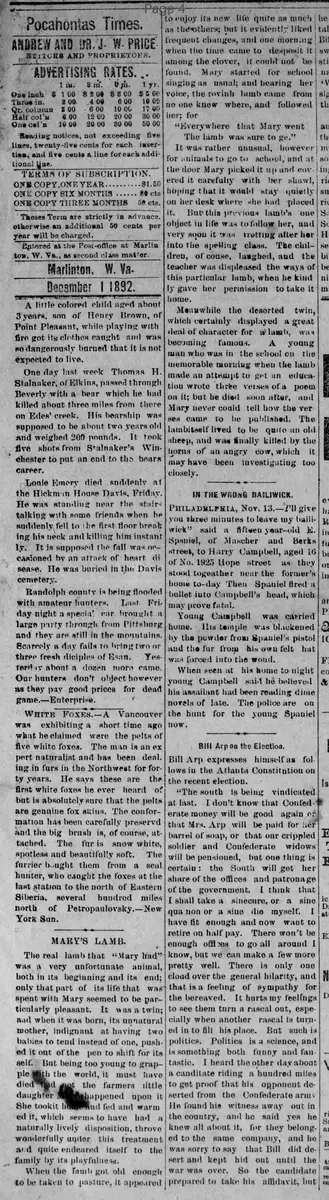
MARY'S LAMB.
The real lamb that "Mary had" was a very unfortunate animal, both in its beginning and its end; only that part of its life that was spent with Mary seemed to be particularly pleasant. It was a twin; and when it was born, its unnatural mother, indignant at having two babies to tend instead of one, pushed it out of the pen to shift for itself. But being too young to grapple with the world, it must have died had not the farmer's little daughter happened upon it. She took it home and fed and warmed it, which seems to have had a naturally lively disposition, throve wonderfully under this treatment and quite endeared itself to the family by its playfulness.
When the lamb got old enough to be taken to pasture, it appeared to enjoy its new life quite as much as the others; but it evidently liked frequent changes, and one morning when the time came to deposit it among the clover, it could not be found. Mary started for school singing as usual; and hearing her voice, the roving lamb came from no one knew where, and followed her; for
"Everywhere that Mary went
The lamb was sure to go."
It was rather unusual, however for animals to go to school, and at the door Mary picked it up and covered it carefully with her shawl, hoping that it would stay quietly on her desk where she had placed it. But this previous lamb's one object in life was to follow her, and very soon it was trotting after her into the spelling class. The children, of course, laughed, and the teacher was displeased the ways of this particular lamb, whom he kindly gave her permission to take it home.
Meanwhile the deserted twin, which certainly displayed a great deal of character for a lamb, was becoming famous. A young man who was in the school on the memorable morning when the lamb made an attempt to get an education wrote three verses of a poem on it: but he died soon after, and Mary never could tell how the verses came to be published. The lamb itself lived to be quite an old sheep, and was finally killed by the horns of an angry cow, which it may have been investigating too closely.
The real lamb that "Mary had" was a very unfortunate animal, both in its beginning and its end; only that part of its life that was spent with Mary seemed to be particularly pleasant. It was a twin; and when it was born, its unnatural mother, indignant at having two babies to tend instead of one, pushed it out of the pen to shift for itself. But being too young to grapple with the world, it must have died had not the farmer's little daughter happened upon it. She took it home and fed and warmed it, which seems to have had a naturally lively disposition, throve wonderfully under this treatment and quite endeared itself to the family by its playfulness.
When the lamb got old enough to be taken to pasture, it appeared to enjoy its new life quite as much as the others; but it evidently liked frequent changes, and one morning when the time came to deposit it among the clover, it could not be found. Mary started for school singing as usual; and hearing her voice, the roving lamb came from no one knew where, and followed her; for
"Everywhere that Mary went
The lamb was sure to go."
It was rather unusual, however for animals to go to school, and at the door Mary picked it up and covered it carefully with her shawl, hoping that it would stay quietly on her desk where she had placed it. But this previous lamb's one object in life was to follow her, and very soon it was trotting after her into the spelling class. The children, of course, laughed, and the teacher was displeased the ways of this particular lamb, whom he kindly gave her permission to take it home.
Meanwhile the deserted twin, which certainly displayed a great deal of character for a lamb, was becoming famous. A young man who was in the school on the memorable morning when the lamb made an attempt to get an education wrote three verses of a poem on it: but he died soon after, and Mary never could tell how the verses came to be published. The lamb itself lived to be quite an old sheep, and was finally killed by the horns of an angry cow, which it may have been investigating too closely.
What sub-type of article is it?
Prose Fiction
What themes does it cover?
Agriculture Rural
Friendship
What keywords are associated?
Mary Lamb
Nursery Rhyme
Abandoned Twin
School Follower
Rural Anecdote
Literary Details
Title
Mary's Lamb.
Key Lines
"Everywhere That Mary Went
The Lamb Was Sure To Go."