Thank you for visiting SNEWPapers!
Sign up free
Alexandria Advertiser And Commercial Intelligencer
Alexandria, Virginia
What is this article about?
European intelligence reports unity in Britain's House of Commons between Ministry and opposition, dismisses Russian mediation as pretext, and condemns First Consul Bonaparte's arrests and property seizures of English subjects in France, including diplomats and women, as violations of international law amid undeclared war captures.
Clipping
OCR Quality
Full Text
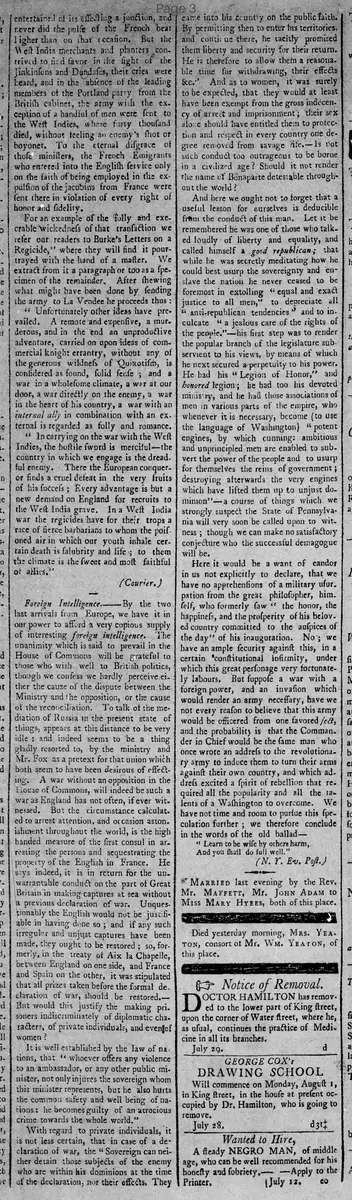
It is well established by the law of nations, that "whoever offers any violence to an ambassador, or any other public minister, not only injures the sovereign whom this minister represents, but he also hurts the common safety and well being of nations: he becomes guilty of an atrocious crime towards the whole world."
With regard to private individuals, it is not less certain, that in case of a declaration of war, the "Sovereign can neither detain those subjects of the enemy who are within his dominions at the time of the declaration, nor their effects. They came into his country on the public faith. By permitting them to enter his territories, and continue there, he tacitly promised them liberty and security for their return. He is therefore to allow them a reasonable time for withdrawing, their effects &c." And as to women, it was surely to be expected, that they would at least have been exempt from the gross indecency of arrest and imprisonment; their sex alone should have entitled them to protection and respect in every country one degree removed from savage life.—Is not such conduct too outrageous to be borne in a civilized age? Should it not render the name of Bonaparte detestable throughout the world?
And here we ought not to forget that a useful lesson for ourselves is deducible from the conduct of this man. Let it be remembered he was one of those who talked loudly of liberty and equality, and called himself a good republican; that while he was secretly meditating how he could best usurp the sovereignty and enslave the nation he never ceased to be foremost in extolling "equal and exact justice to all men," to depreciate all "anti-republican tendencies" and to inculcate "a jealous care of the rights of the people." His first step was to render the popular branch of the legislature subservient to his views, by means of which he next secured a perpetuity to his power. He had his "Legion of Honor," and honored legion; he had too his devoted ministry, and he had those associations of men in various parts of the empire, who whenever it is necessary, become (to use the language of Washington) "potent engines, by which cunning, ambitious and unprincipled men are enabled to subvert the power of the people and to usurp for themselves the reins of government; destroying afterwards the very engines which have lifted them up to unjust dominion"—a course of things which we strongly suspect the State of Pennsylvania will very soon be called upon to witness ; though we can make no satisfactory conjecture who the successful demagogue will be.
Here it would be a want of candor in us not explicitly to declare, that we have no apprehensions of a military usurpation from the great philosopher, himself, who formerly saw "the honor, the happiness, and the prosperity of his beloved country committed to the auspices of the day" of his inauguration. No; we have an ample security against this, in a certain constitutional infirmity, under which this great personage very fortunately labours. But suppose a war with a foreign power, and an invasion which would render an army necessary, have we not every reason to believe that this army would be officered from one favored sect, and the probability is that the Commander in Chief would be the same man who once wrote an address to the revolutionary army to induce them to turn their arms against their own country, and which address excited a spirit of rebellion that required all the popularity and all the talents of a Washington to overcome. We have not time and room to pursue this speculation further ; we therefore conclude in the words of the old ballad—
"Learn to be wise by others harm.
And you shall do full well."
(N. Y. Ev. Post.)
What sub-type of article is it?
What keywords are associated?
What entities or persons were involved?
Where did it happen?
Foreign News Details
Primary Location
France
Key Persons
Outcome
arrests and sequestration of property of english subjects in france, including diplomatic characters, private individuals, and women
Event Details
Reports from Europe detail unity in Britain's House of Commons, dismissed Russian mediation as pretext for reconciliation between Ministry and opposition; condemns First Consul's high-handed arrests of English in France as retaliation for British sea captures without declaration of war, violating law of nations and treaties like Aix la Chapelle; highlights arrests of diplomats, private persons, and women as outrageous