Thank you for visiting SNEWPapers!
Sign up free
Literary
July 13, 1815
Daily National Intelligencer
Washington, District Of Columbia
What is this article about?
Humorous essay from the Analectic Magazine satirizing awkward street conversations among English gentlemen during peacetime, contrasting with lively wartime discussions about Bonaparte and the wars, featuring a banal dialogue example between Adams and Brooks.
Clipping
OCR Quality
98%
Excellent
Full Text
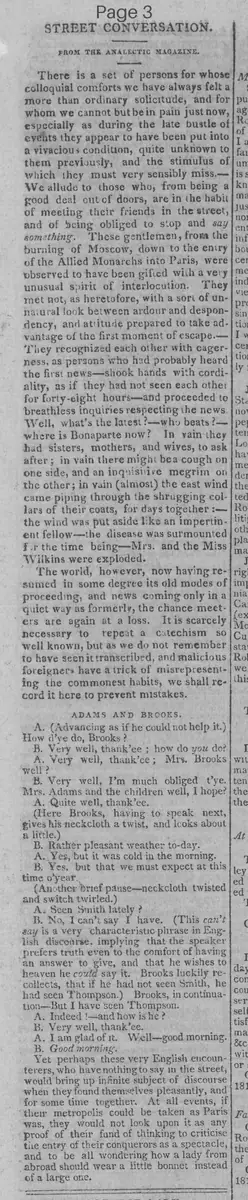
STREET CONVERSATION.
FROM THE ANALECTIC MAGAZINE.
There is a set of persons for whose colloquial comforts we have always felt a more than ordinary solicitude, and for whom we cannot but be in pain just now, especially as during the late bustle of events they appear to have been put into a vivacious condition, quite unknown to them previously, and the stimulus of which they must very sensibly miss.
We allude to those who, from being a good deal cut off doors, are in the habit of meeting their friends in the street, and of being obliged to stop and say something. These gentlemen, from the burning of Moscow, down to the entry of the Allied Monarchs into Paris, were observed to have been gifted with a very unusual spirit of interlocution. They met not, as heretofore, with a sort of unnatural look between ardour and despondency, and attitude prepared to take advantage of the first moment of escape.
They recognized each other with eagerness, as persons who had probably heard the first news—shook hands with cordiality, as if they had not seen each other for forty-eight hours—and proceeded to breathless inquiries respecting the news. Well, what's the latest?—who beats?—where is Bonaparte now? In vain they had sisters, mothers, and wives, to ask after; in vain there might be a cough on one side, and an inquisitive megrim on the other; in vain (almost) the east wind came piping through the shrugging collars of their coats, for days together:—the wind was put aside like an impertinent fellow—the disease was surmounted for the time being—Mrs. and the Miss Wilkins were exploded.
The world, however, now having resumed in some degree its old modes of proceeding, and news coming only in a quiet way as formerly, the chance meet ers are again at a loss. It is scarcely necessary to repeat a Catechism so well known, but as we do not remember to have seen it transcribed, and malicious foreigners have a trick of misrepresenting the commonest habits, we shall record it here to prevent mistakes.
ADAMS AND BROOKS.
A. (Advancing as if he could not help it.) How d'ye do, Brooks?
B. Very well, thank'ee; how do you do?
A. Very well, thank'ee; Mrs. Brooks well?
B. Very well, I'm much obliged t'ye. Mrs. Adams and the children well, I hope?
A. Quite well, thank'ee.
(Here Brooks, having to speak next, gives his neckcloth a twist, and looks about a little.)
B. Rather pleasant weather to-day.
A. Yes, but it was cold in the morning.
B. Yes, but that we must expect at this time o' year.
(Another brief pause—neckcloth twisted and switch twirled.)
A. Seen Smith lately?
B. No, I can't say I have. (This can't say is a very characteristic phrase in English discourse, implying that the speaker prefers truth even to the comfort of having an answer to give, and that he wishes to heaven he could say it. Brooks luckily recollects, that if he had not seen Smith, he had seen Thompson.) Brooks, in continuation—But I have seen Thompson.
A. Indeed! and how is he?
B. Very well, thank'ee.
A. I am glad of it. Well—good morning.
B. Good morning.
Yet perhaps these very English encounterers, who have nothing to say in the street, would bring up infinite subject of discourse when they found themselves pleasantly, and for some time together. At all events, if their metropolis could be taken as Paris was, they would not look upon it as any proof of their fund of thinking to criticise the entry of their conquerors as a spectacle, and to be all wondering how a lady from abroad should wear a little bonnet instead of a large one.
FROM THE ANALECTIC MAGAZINE.
There is a set of persons for whose colloquial comforts we have always felt a more than ordinary solicitude, and for whom we cannot but be in pain just now, especially as during the late bustle of events they appear to have been put into a vivacious condition, quite unknown to them previously, and the stimulus of which they must very sensibly miss.
We allude to those who, from being a good deal cut off doors, are in the habit of meeting their friends in the street, and of being obliged to stop and say something. These gentlemen, from the burning of Moscow, down to the entry of the Allied Monarchs into Paris, were observed to have been gifted with a very unusual spirit of interlocution. They met not, as heretofore, with a sort of unnatural look between ardour and despondency, and attitude prepared to take advantage of the first moment of escape.
They recognized each other with eagerness, as persons who had probably heard the first news—shook hands with cordiality, as if they had not seen each other for forty-eight hours—and proceeded to breathless inquiries respecting the news. Well, what's the latest?—who beats?—where is Bonaparte now? In vain they had sisters, mothers, and wives, to ask after; in vain there might be a cough on one side, and an inquisitive megrim on the other; in vain (almost) the east wind came piping through the shrugging collars of their coats, for days together:—the wind was put aside like an impertinent fellow—the disease was surmounted for the time being—Mrs. and the Miss Wilkins were exploded.
The world, however, now having resumed in some degree its old modes of proceeding, and news coming only in a quiet way as formerly, the chance meet ers are again at a loss. It is scarcely necessary to repeat a Catechism so well known, but as we do not remember to have seen it transcribed, and malicious foreigners have a trick of misrepresenting the commonest habits, we shall record it here to prevent mistakes.
ADAMS AND BROOKS.
A. (Advancing as if he could not help it.) How d'ye do, Brooks?
B. Very well, thank'ee; how do you do?
A. Very well, thank'ee; Mrs. Brooks well?
B. Very well, I'm much obliged t'ye. Mrs. Adams and the children well, I hope?
A. Quite well, thank'ee.
(Here Brooks, having to speak next, gives his neckcloth a twist, and looks about a little.)
B. Rather pleasant weather to-day.
A. Yes, but it was cold in the morning.
B. Yes, but that we must expect at this time o' year.
(Another brief pause—neckcloth twisted and switch twirled.)
A. Seen Smith lately?
B. No, I can't say I have. (This can't say is a very characteristic phrase in English discourse, implying that the speaker prefers truth even to the comfort of having an answer to give, and that he wishes to heaven he could say it. Brooks luckily recollects, that if he had not seen Smith, he had seen Thompson.) Brooks, in continuation—But I have seen Thompson.
A. Indeed! and how is he?
B. Very well, thank'ee.
A. I am glad of it. Well—good morning.
B. Good morning.
Yet perhaps these very English encounterers, who have nothing to say in the street, would bring up infinite subject of discourse when they found themselves pleasantly, and for some time together. At all events, if their metropolis could be taken as Paris was, they would not look upon it as any proof of their fund of thinking to criticise the entry of their conquerors as a spectacle, and to be all wondering how a lady from abroad should wear a little bonnet instead of a large one.
What sub-type of article is it?
Satire
Essay
Dialogue
What themes does it cover?
Social Manners
War Peace
Political
What keywords are associated?
Street Conversation
English Manners
Napoleonic Wars
Social Awkwardness
Wartime News
Peacetime Banalities
What entities or persons were involved?
From The Analectic Magazine.
Literary Details
Title
Street Conversation.
Author
From The Analectic Magazine.
Key Lines
Well, What's The Latest?—Who Beats?—Where Is Bonaparte Now?
A. (Advancing As If He Could Not Help It.) How D'ye Do, Brooks?
B. No, I Can't Say I Have. (This Can't Say Is A Very Characteristic Phrase In English Discourse...)
Yet Perhaps These Very English Encounterers, Who Have Nothing To Say In The Street...