Thank you for visiting SNEWPapers!
Sign up free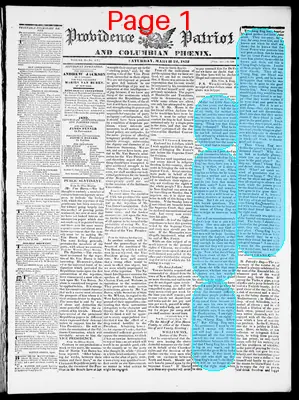
Providence Patriot, Columbian Phenix
Providence, Providence County, Rhode Island
What is this article about?
Chang Eng, one of the Siamese twins, writes from New York on Feb. 1, 1832, to his mother and sister about his homesickness after three years away, irritation with prying questions on family and faith, his simple belief in a protective deity, and critique of somber Western funeral rites.
Clipping
OCR Quality
Full Text
New York Feb. 1, 1832
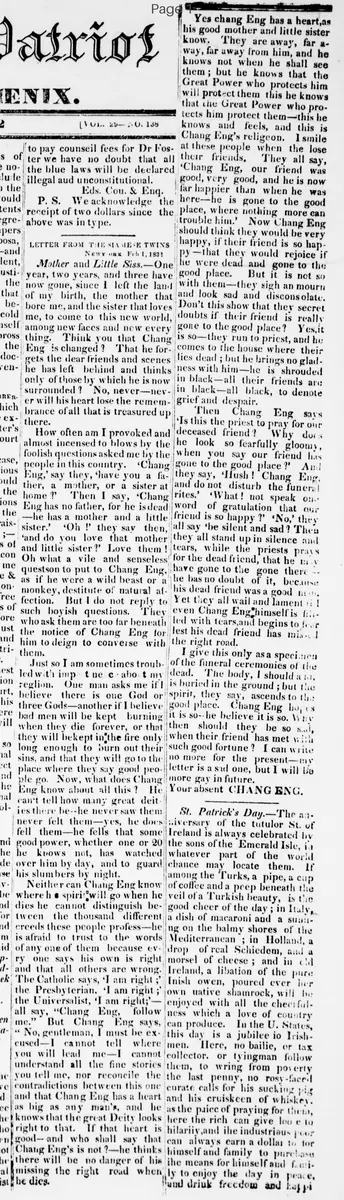
Mother and Little Sis.—One year, two years, and three have now gone, since I left the land of my birth, the mother that bore me, and the sister that loves me, to come to this new world, among new faces and new everything.
Think you that Chang Eng is changed? That he forgets the dear friends and scenes he has left behind and thinks only of those by which he is now surrounded?
No, never—never will his heart lose the remembrance of all that is treasured up there.
How often am I provoked and almost incensed to blows by the foolish questions asked me by the people in this country.
'Chang Eng,' say they, 'have you a father, a mother, or a sister at home?'
Then I say, 'Chang Eng has no father, for he is dead—he has a mother and a little sister.'
'Oh!' they say then, 'and do you love that mother and little sister?' Love them! Oh what a vile and senseless question to put to Chang Eng, as if he were a wild beast or a monkey, destitute of natural affection. But I do not reply to such boyish questions. They who ask them are too far beneath the notice of Chang Eng for him to deign to converse with them.
Just so I am sometimes troubled with impertinent questions about my religion. One man asks me if I believe there is one God or three Gods—another if I believe bad men will be kept burning when they die forever, or that they will be kept in the fire only long enough to burn out their sins, and that they will go to the place where they say good people go.
Now, what does Chang Eng know about all this? He can't tell how many great deities there be—he never saw them—never felt them—yes, he does feel them—he feels that some good power, whether one or twenty he knows not, has watched over him by day, and to guard his slumbers by night.
Neither can Chang Eng know where his spirit will go when he dies—he cannot distinguish between the thousand different creeds these people profess—he is afraid to trust to the words of any one of them because every one says his own is right and that all others are wrong.
The Catholic says, 'I am right;' the Presbyterian, 'I am right;' the Universalist, 'I am right;'—all say, "Chang Eng, follow me."
But Chang Eng says, "No, gentleman, I must be excused—I cannot tell where you will lead me—I cannot understand all the fine stories you tell me, nor reconcile the contradictions between this one and that. Chang Eng has a heart as big as any man's, and he knows that the great Deity looks right to that. If that heart is good—and who shall say that Chang Eng's is not?—he thinks there will be no danger of his missing the right road when he dies."
Yes Chang Eng has a heart, as his good mother and little sister know. They are away, far away from him, and he knows not when he shall see them; but he knows that the Great Power who protects him will protect them—this he knows and feels, and this is Chang Eng's religion. I smile at these people when they lose their friends. They all say, 'Chang Eng, our friend was good, very good, and he is now far happier than when he was here—he is gone to the good place, where nothing more can trouble him.' Now Chang Eng should think they would be very happy, if their friend is so happy—that they would rejoice if he were dead and gone to the good place. But it is not so with them—they sigh and mourn and look sad and disconsolate.
Doesn't this show that their secret doubts if their friend is really gone to the good place? Yes, it is so—they run to priest, and he comes to the house where their friend lies dead; but he brings no gladness with him—he is shrouded in black—all their friends are in black—all black, to denote grief and despair.
Then Chang Eng says 'Is this the priest to pray for our deceased friend? Why does he look so fearfully gloomy when you say our friend has gone to the good place?' And they say, 'Hush! Chang Eng, and do not disturb the funeral rites.' What! not speak one word of gratulation that our friend is so happy?' 'No,' they all say 'be silent and sad.' Then they all stand up in silence and tears, while the priests prays for the dead friend, that he may have gone to the good place—he has no doubt of it, because his dead friend was a good man.
Yet they all wail and lament as if even Chang Eng himself is filled with tears, and begins to fear lest his dead friend has missed the right road.
I give this only as a specimen of the funeral ceremonies of the dead. 'The body, I should add, is buried in the ground; but the spirit, they say, ascends to the good place. Chang Eng hopes it is so—he believes it is so. Why then should they be so sad when their friend has met with such good fortune? I can write no more for the present—my letter is a sad one, but I will be more gay in future.
Your absent CHANG ENG.
What sub-type of article is it?
What themes does it cover?
What keywords are associated?
What entities or persons were involved?
Letter to Editor Details
Author
Chang Eng
Recipient
Mother And Little Sis.
Main Argument
chang eng affirms his deep, unchanging love for his mother and sister despite years away and intrusive questions treating him as affectionless. he rejects complex religious doctrines, trusting instead in a benevolent great power that values a good heart, and questions the inconsistency in westerners' mournful funerals despite believing the dead reach a happy afterlife.
Notable Details