Thank you for visiting SNEWPapers!
Sign up free
The Evening Herald
Klamath Falls, Klamath County, Oregon
What is this article about?
Japan's privy council has established new regulations allowing citizens to directly appeal to the emperor with opinions, grievances, or suggestions via a privy seal office, marking a historic constitutional advance influenced by global democratic trends like the Russian revolution. This replaces risky customs like 'jikiso,' where people threw letters at the emperor's carriage.
Merged-components note: Title and continuing text form a single coherent foreign news story on democracy in Japan.
Clipping
OCR Quality
Full Text
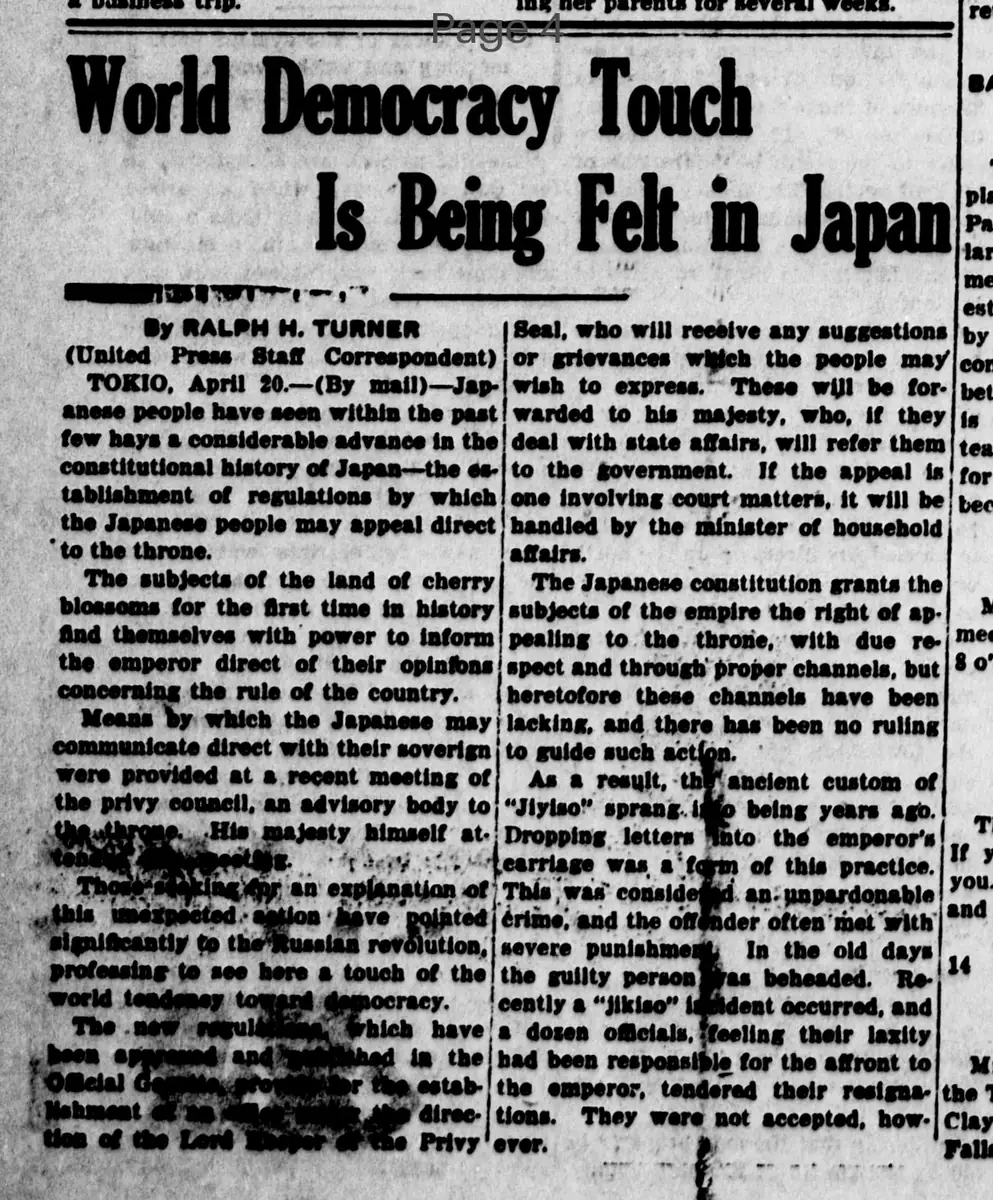
Is
Being
Felt in
Japan
By Ralph H. Turner
(United Press Staff Correspondent)
TOKIO, April 20.—(By mail)—Japanese people have seen within the past few days a considerable advance in the constitutional history of Japan—the establishment of regulations by which the Japanese people may appeal direct to the throne.
The subjects of the land of cherry blossoms for the first time in history find themselves with power to inform the emperor direct of their opinions concerning the rule of the country.
Means by which the Japanese may communicate direct with their sovereign were provided at a recent meeting of the privy council, an advisory body to His majesty himself.
Aha king eprian explanation of this unexpected action have pointed significantly to the Russian revolution, professing to see here a touch of the world tendency toward democracy.
The new rules which have the official designation of establishing direct privy seal, who will receive any suggestions or grievances which the people may wish to express. These will be forwarded to his majesty, who, if they deal with state affairs, will refer them to the government. If the appeal is one involving court matters, it will be handled by the minister of household affairs.
The Japanese constitution grants the subjects of the empire the right of appealing to the throne, with due respect and through proper channels, but heretofore these channels have been lacking, and there has been no ruling to guide such action.
As a result, the ancient custom of "Jikiso!" sprang into being years ago.
Dropping letters into the emperor's carriage was a fad, one of this practice. This was considered an unpardonable crime, and the offender often met with severe punishment.
In the old days the guilty person was beheaded. Recently a "jikiso" incident occurred, and a dozen officials, feeling their laxity had been responsible for the affront to the emperor, tendered their resignations.
They were not accepted, how.
What sub-type of article is it?
What keywords are associated?
Where did it happen?
Foreign News Details
Primary Location
Tokio
Event Date
Within The Past Few Days As Of April 20
Outcome
establishment of new regulations for direct appeals to the throne via privy seal; provides proper channels replacing ancient 'jikiso' custom, which led to severe punishments including beheading.
Event Details
The privy council established regulations allowing Japanese subjects to appeal directly to the emperor with opinions, suggestions, or grievances through a direct privy seal mechanism. Appeals on state affairs go to the government, court matters to the minister of household affairs. This fulfills constitutional rights previously without channels, ending risky practices like 'jikiso' where people dropped letters into the emperor's carriage, often resulting in punishment. The change is attributed to world democratic tendencies, including the Russian revolution.