Thank you for visiting SNEWPapers!
Sign up free
The Corpus Christi Caller
Corpus Christi, Nueces County, Texas
What is this article about?
Mr. Praeger's account of U.S. delegates' achievements at the 7th Universal Postal Congress, including blocking rate hikes, advancing Spanish language use, and securing benefits like lower decimal postage rates for Americas.
Clipping
OCR Quality
Full Text
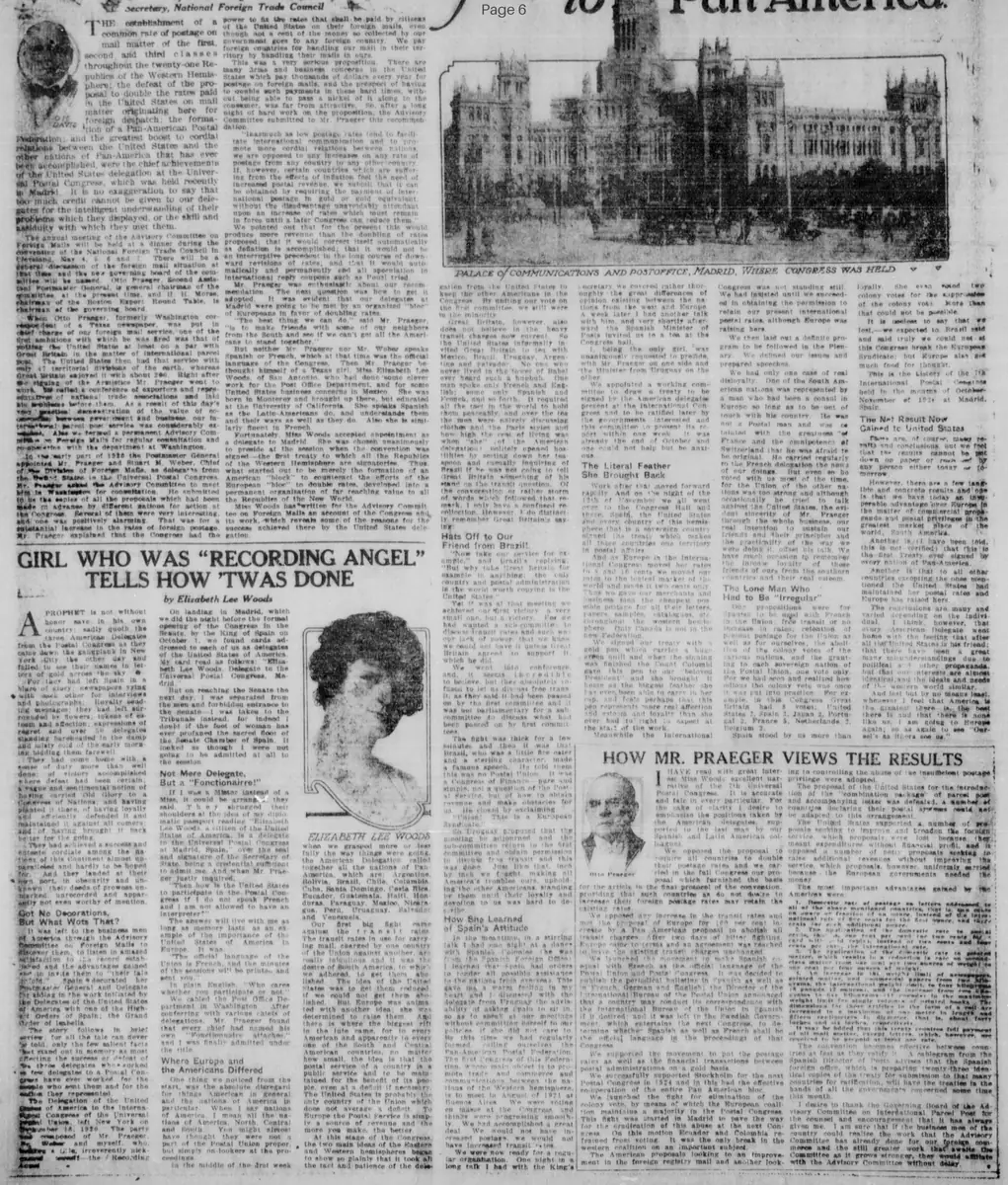
I have read with great interest Miss Woods' excellent narrative of the 7th Universal Postal Congress. It is accurate and fair in every particular. For the sake of clarity I desire to emphasize the positions taken by the American delegates supported to the last man by our Spanish and Latin American colleagues.
We opposed the proposal to require all countries to double their postage rates and we carried in the full Congress our proposal which furnished the basis for the article in the final protocol of the convention, providing that such countries as do not desire to increase their foreign postage rates may retain the existing rates.
We opposed any increase in the transit rates and met the proposal of Europe for 10 per cent increase by a Pan American proposal to abolish all transit charges. After two days of bitter fighting Europe came to terms and an agreement was reached to leave the existing transit charges unchanged.
We launched the movement to make Spanish an equal with French as the official language of the Postal Union and Postal Congress. It was decided to publish the periodical bulletin in Spanish as well as in French, German and English: the Director of the International Bureau of the Postal Union announced that a country may conduct its correspondence with the International Bureau of the Union in Spanish if it desired: and it was left to the Swedish Government which entertains the next Congress, to determine whether Spanish as well as French shall be the official language in the proceedings of that Congress.
We supported the movement to put the postage rates as well as the financial transactions between postal administrations on a gold basis.
We successfully supported Stockholm for the next Postal Congress in 1924 and in this had the effective co-operation of the entire Pan American bloc.
We launched the fight for elimination of the colony vote, by means of which the European coalition maintains a majority in the Postal Congress. This fight was started in Madrid to pave the way for the eradication of this abuse at the next Congress.
On this motion Ecuador and Colombia re- frained from voting. It was the only break in the western coalition on an important subject.
The American proposals looking to an improvement in the foreign registry mail and another looking to controlling the abuse of the insufficient postage privilege were adopted.
The proposal of the United States for the introduction of the "combination package" of parcel post and accompanying letter was defeated, a number of countries declaring their postal systems could not be adapted to this arrangement.
The United States supported a number of proposals seeking to improve and broaden the foreign service, which proposals were lost because they meant expenditures without financial profit, and opposed a number of petty proposals seeking to raise additional revenues without improving the service, which proposals, however, uniformly carried because the European governments needed the money.
The most important advantages gained by the Americas were,
1. Decimal rate of postage on letters addressed to all of the above mentioned countries, that is, five cents for the first ounce, instead of the international rate of 8 cents for the first ounce, and three cents for each additional ounce,
2. The application of the domestic rate to postal and money orders, which results in a reduction in rate on second- class matter from one cent per two ounces of weight to one cent per four ounces of weight, printed matter, and commercial papers from two grams, the international weight limit, to four kilograms (8 pounds 13 ounces), and the increase from two grams to five kilograms in commodities in the medium weight limit for single copies of printed blanks. The dimensions for those articles, in the form of a roll are increased to a maximum of one meter in length and fifteen centimeters in diameter that is, about forty inches and six inches, respectively.
It may be noted that this treaty requires full prepayment of all mail matter, except letters, which, however, are required to be prepaid at least one rate.
The convention becomes effective between countries as fast as they ratify it. A cablegram from the Spanish Director of Posts advises that the Spanish foreign office, which is preparing twenty-three identical copies of the treaty for submission to that many countries for ratification, will have the treaties in the hands of all the governments concerned some time this month.
I desire to thank the Governing Board of the Advisory Committee on International Parcel Post for the counsel and encouragement that it has always given me. I am sure that if the business men of the country could realize the work that the Advisory Committee has already done for our foreign commerce and the still greater work that awaits the Committee as it grows stronger, they would affiliate with the Advisory Committee without delay.
What sub-type of article is it?
What themes does it cover?
What keywords are associated?
What entities or persons were involved?
Where did it happen?
Story Details
Key Persons
Location
Madrid
Story Details
Mr. Praeger provides his perspective on the outcomes of the 7th Universal Postal Congress, highlighting American delegates' successful oppositions to postage and transit rate increases, promotion of Spanish as an official language, support for gold basis, selection of Stockholm for the next congress, fight against colony vote, adoption of improvements in registry mail and insufficient postage controls, defeat of combination package proposal, and key advantages like decimal rates and domestic rates for certain mails.