Thank you for visiting SNEWPapers!
Sign up free
Literary
September 23, 1799
Jenks's Portland Gazette
Portland, Cumberland County, Maine
What is this article about?
Extract from 'American Antiquities' introduces a passage from the eighteenth book of the 'Anarchiad' titled 'The Land of Annihilation.' Critical remarks discuss epic poets' use of infernal regions. The poem depicts a realm of eternal gloom ruled by Annihilation, where demons destroy worlds and plague humanity in disguise.
Clipping
OCR Quality
95%
Excellent
Full Text
EXTRACT
From the Account of American Poets.
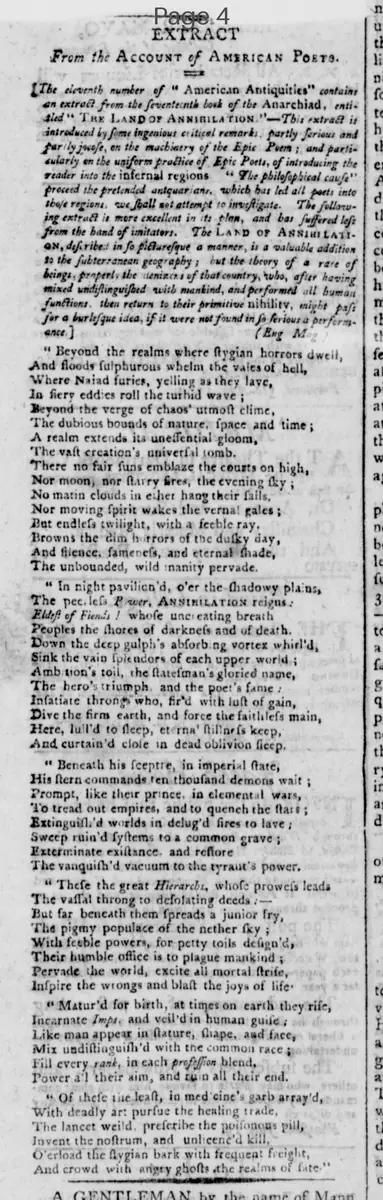
The eleventh number of "American Antiquities" contains an extract from the eighteenth book of the Anarchiad, entitled "The Land of Annihilation." This extract is introduced by some ingenious critical remarks, partly serious and partly jocose, on the machinery of the Epic Poem: and particularly on the uniform practice of Epic Poets, of introducing the reader into the infernal regions.
"The philosophical cause" proceed the pretended antiquarian, which has led all poets into those regions, we shall not attempt to investigate. The following extract is more excellent in its plan, and has suffered less from the hand of imitators. The Land of ANNIHILATION, described in so picturesque a manner, is a valuable addition to the subterranean geography; but the theory of a race of beings, properly the denizens of that country, who, after having mixed undistinguished with mankind, and performed all human functions, then return to their primitive nihility, might pass for a burlesque idea, if it were not found in so serious a performance.]
"Beyond the realms where Stygian horrors dwell,
And floods sulphurous whelm the vales of hell,
Where Naiad furies, yelling as they lave,
In fiery eddies roll the turbid wave:
Beyond the verge of chaos' utmost clime,
The dubious bounds of nature, space and time;
A realm extends its unessential gloom,
The vast creation's universal tomb.
There no fair suns emblaze the courts on high,
Nor moon, nor starry fires, the evening sky;
No matin clouds in ether hang their sails,
Nor moving spirit wakes the vernal gales;
But endless twilight, with a feeble ray,
Browns the dim horrors of the dusky day,
And silence, famine, and eternal shade,
The unbounded, wild vacuity pervade.
"In night pavilion'd, o'er the shadowy plains,
The peerless Power, Annihilation reigns.
Eldest of Fiends! whose uncreating breath
Peoples the shores of darkness and of death.
Down the deep gulph's absorbing vortex whirl'd,
Sink the vain splendors of each upper world;
Ambition's toil, the statesman's gloried name,
The hero's triumph, and the poet's fame:
Insatiate throngs who, fir'd with lust of gain,
Dive the firm earth, and force the faithless main,
Here, lull'd to sleep, eternal Nilness keep,
And curtain'd close in dead oblivion sleep.
"Beneath his sceptre, in imperial state,
His stern commands ten thousand demons wait;
Prompt, like their prince, in elemental wars,
To tread out empires, and to quench the stars;
Extinguish'd worlds in delug'd fires to lave;
Sweep ruin'd systems to a common grave;
Exterminate existence, and restore
The vanquish'd vacuum to the tyrant's power.
"Thee the great Hierarchs, whose prowess leads
The vassal throng to desolating deeds:-
But far beneath them spreads a junior fry,
The pigmy populace of the nether sky;
With feeble powers, for petty toils design'd,
Their humble office is to plague mankind;
Pervade the world, excite all mortal strife,
Inspire the wrongs and blast the joys of life.
"Matur'd for birth, at times on earth they rise,
Incarnate Imps, and veil'd in human guise;
Like man appear in stature, shape, and face,
Mix undistinguish'd with the common race
Fill every rank, in each profession blend,
Power all their aim, and ruin all their end.
"Of thee the least, in med'cine's garb array'd,
With deadly art pursue the healing trade,
The lancet wield, prescribe the poisonous pill,
Invent the nostrum, and unlicens'd kill,
O'erload the Stygian bark with frequent freight,
And crowd with angry ghosts the realms of fate."
From the Account of American Poets.
The eleventh number of "American Antiquities" contains an extract from the eighteenth book of the Anarchiad, entitled "The Land of Annihilation." This extract is introduced by some ingenious critical remarks, partly serious and partly jocose, on the machinery of the Epic Poem: and particularly on the uniform practice of Epic Poets, of introducing the reader into the infernal regions.
"The philosophical cause" proceed the pretended antiquarian, which has led all poets into those regions, we shall not attempt to investigate. The following extract is more excellent in its plan, and has suffered less from the hand of imitators. The Land of ANNIHILATION, described in so picturesque a manner, is a valuable addition to the subterranean geography; but the theory of a race of beings, properly the denizens of that country, who, after having mixed undistinguished with mankind, and performed all human functions, then return to their primitive nihility, might pass for a burlesque idea, if it were not found in so serious a performance.]
"Beyond the realms where Stygian horrors dwell,
And floods sulphurous whelm the vales of hell,
Where Naiad furies, yelling as they lave,
In fiery eddies roll the turbid wave:
Beyond the verge of chaos' utmost clime,
The dubious bounds of nature, space and time;
A realm extends its unessential gloom,
The vast creation's universal tomb.
There no fair suns emblaze the courts on high,
Nor moon, nor starry fires, the evening sky;
No matin clouds in ether hang their sails,
Nor moving spirit wakes the vernal gales;
But endless twilight, with a feeble ray,
Browns the dim horrors of the dusky day,
And silence, famine, and eternal shade,
The unbounded, wild vacuity pervade.
"In night pavilion'd, o'er the shadowy plains,
The peerless Power, Annihilation reigns.
Eldest of Fiends! whose uncreating breath
Peoples the shores of darkness and of death.
Down the deep gulph's absorbing vortex whirl'd,
Sink the vain splendors of each upper world;
Ambition's toil, the statesman's gloried name,
The hero's triumph, and the poet's fame:
Insatiate throngs who, fir'd with lust of gain,
Dive the firm earth, and force the faithless main,
Here, lull'd to sleep, eternal Nilness keep,
And curtain'd close in dead oblivion sleep.
"Beneath his sceptre, in imperial state,
His stern commands ten thousand demons wait;
Prompt, like their prince, in elemental wars,
To tread out empires, and to quench the stars;
Extinguish'd worlds in delug'd fires to lave;
Sweep ruin'd systems to a common grave;
Exterminate existence, and restore
The vanquish'd vacuum to the tyrant's power.
"Thee the great Hierarchs, whose prowess leads
The vassal throng to desolating deeds:-
But far beneath them spreads a junior fry,
The pigmy populace of the nether sky;
With feeble powers, for petty toils design'd,
Their humble office is to plague mankind;
Pervade the world, excite all mortal strife,
Inspire the wrongs and blast the joys of life.
"Matur'd for birth, at times on earth they rise,
Incarnate Imps, and veil'd in human guise;
Like man appear in stature, shape, and face,
Mix undistinguish'd with the common race
Fill every rank, in each profession blend,
Power all their aim, and ruin all their end.
"Of thee the least, in med'cine's garb array'd,
With deadly art pursue the healing trade,
The lancet wield, prescribe the poisonous pill,
Invent the nostrum, and unlicens'd kill,
O'erload the Stygian bark with frequent freight,
And crowd with angry ghosts the realms of fate."
What sub-type of article is it?
Poem
Satire
What themes does it cover?
Death Mortality
Political
What keywords are associated?
Annihilation
Epic Poem
Satire
Demons
Underworld
Human Ruin
Stygian Horrors
Literary Details
Title
The Land Of Annihilation
Key Lines
Beyond The Realms Where Stygian Horrors Dwell,
And Floods Sulphurous Whelm The Vales Of Hell,
Where Naiad Furies, Yelling As They Lave,
In Fiery Eddies Roll The Turbid Wave:
In Night Pavilion'd, O'er The Shadowy Plains,
The Peerless Power, Annihilation Reigns.
Eldest Of Fiends! Whose Uncreating Breath
Peoples The Shores Of Darkness And Of Death.
Matur'd For Birth, At Times On Earth They Rise,
Incarnate Imps, And Veil'd In Human Guise;
Like Man Appear In Stature, Shape, And Face,
Mix Undistinguish'd With The Common Race