Thank you for visiting SNEWPapers!
Sign up free
The Sedalia Weekly Bazoo
Sedalia, Pettis County, Missouri
What is this article about?
Detailed account of the ceremonial opening of the Swedish Diet (Riksdag) by the King, featuring royal procession, uniforms, and the monarch's address in the palace hall, attended by court, military, and diplomatic figures.
Clipping
OCR Quality
Full Text
Opening It With Impressive Royal Ceremonies.
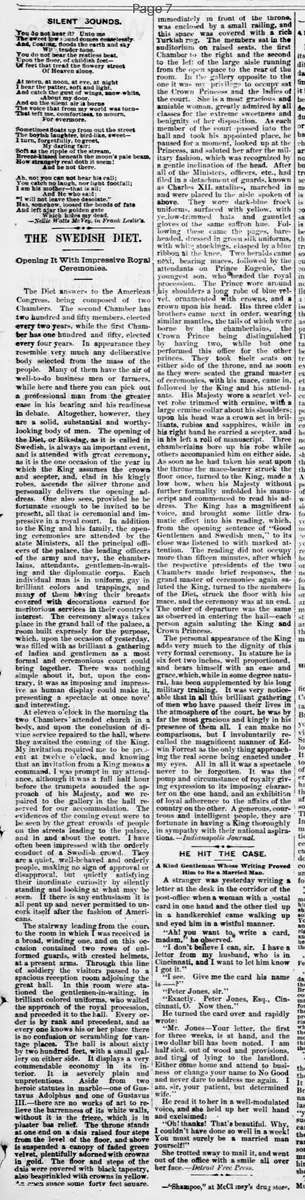
The Diet answers to the American Congress, being composed of two Chambers. The second Chamber has two hundred and fifty members, elected every two years, while the first Chamber has one hundred and fifty, elected every four years. In appearance they resemble very much any deliberative body selected from the mass of the people. Many of them have the air of well-to-do business men or farmers, while here and there you can pick out a professional man from the greater ease in his bearing and his readiness in debate. Altogether, however, they are a solid, substantial and worthy-looking body of men. The opening of the Diet, or Riksdag, as it is called in Swedish, is always an important event, and is attended with great ceremony, as it is the one occasion of the year in which the King assumes the crown and scepter, and, clad in his kingly robes, ascends the silver throne and personally delivers the opening address. One also sees, provided he be fortunate enough to be invited to be present, all that is ceremonial and impressive in a royal court. In addition to the King and his family, the opening ceremonies are attended by the state Ministers, all the principal officers of the palace, the leading officers of the army and navy, the chamberlains, attendants, gentlemen-in-waiting and the diplomatic corps. Each individual man is in uniform, gay in brilliant colors and trappings, and many of them having their breasts covered with decorations earned for meritorious services in their country's interest. The ceremony always takes place in the grand hall of the palace, a room built expressly for the purpose, which, upon the occasion of yesterday, was filled with as brilliant a gathering of ladies and gentlemen as a most formal and ceremonious court could bring together. There was nothing simple about it, but, upon the contrary, it was as imposing and impressive as human display could make it, presenting a spectacle at once novel and interesting.
At eleven o'clock in the morning the two Chambers attended church in a body, and upon the conclusion of divine service repaired to the hall, where they awaited the coming of the King. My invitation required me to be present at twelve o'clock, and knowing that an invitation from a King means a command, I was prompt in my attendance, although it was a full half hour before the trumpets sounded the approach of his Majesty, and we repaired to the gallery in the hall reserved for our accommodation. The evidences of the coming event were to be seen by the great crowds of people on the streets leading to the palace, and in and about the court. I have often been impressed with the orderly conduct of a Swedish crowd. They are a quiet, well-behaved and orderly people, making no sign of approval or disapproval, but quietly satisfying their inordinate curiosity by silently standing and looking at what may be seen. If there is any enthusiasm it is all pent up and never permitted to uncork itself after the fashion of Americans.
The stairway leading from the court to the room in which I was received is a broad, winding one, and on this occasion contained two rows of uniformed guards, with crested helmets, at a present arms. Through this line of soldiery the visitors passed to a spacious reception room adjoining the great hall. In this room were stationed the gentlemen-in-waiting, in brilliant colored uniforms, who waited the approach of the royal procession, and preceded it to the hall. Every order is by rank and precedent, and as every one knows his or her place there is no confusion or scrambling for vantage places. The hall is about sixty by two hundred feet, with a small gallery on either side. It displays a very commendable economy in its interior. It is severely plain and unpretentious. Aside from two heroic statues in marble—one of Gustavus Adolphus and one of Gustavus III.—there are no works of art to relieve the barrenness of its white walls, without it is the frieze, which is in plaster bas relief. The throne stands at one end on a dais raised four steps from the level of the floor, and above is suspended a canopy of faded green velvet, plentifully adorned with crowns in gold. The floor and steps of the dais were covered with black tapestry, also besprinkled with crowns in yellow. A clear space some forty feet square, immediately in front of the throne, was enclosed by a small railing, and this space was covered with a rich Turkish rug. The members sat in the auditorium on raised seats, the first Chamber to the right and the second to the left of the large aisle running from the open space to the rear of the room. In the gallery opposite to the one it was my privilege to occupy sat the Crown Princess and the ladies of the court. She is a most gracious and amiable woman, greatly admired by all classes for the extreme sweetness and benignity of her disposition. As each member of the court passed into the hall and took his appointed place, he paused for a moment, looked up at the Princess, and saluted her after the military fashion, which was recognized by a gentle inclination of the head. After all of the Ministers, officers, etc., had filed in a detachment of guards, known as Charles XII. satellites, marched in and were placed in the aisle spoken of above. They wore dark-blue frock uniforms, surfaced with yellow, with very low-trimmed hats and gauntlet gloves of the same saffron hue. Following these came the pages, bare-headed, dressed in green silk uniforms, with white stockings, clasped by a blue ribbon at the knee. Two heralds came next, bearing maces, followed by the attendants on Prince Eugenie, the youngest son, who headed the royal procession. The Prince wore around his shoulders a long robe of blue velvet, ornamented with crowns, and a crown upon his head. His three elder brothers came next in order, wearing similar mantles, the tails of which were borne by the chamberlains, the Crown Prince being distinguished by having two, while but one performed this office for the other princes. They took their seats on either side of the throne, and as soon as they were seated the grand master of ceremonies, with his mace, came in, followed by the King and his attendants. His Majesty wore a scarlet velvet robe trimmed with ermine, with a large ermine collar about his shoulders; upon his head was a crown set in brilliants, rubies and sapphires, while in his right hand he carried a scepter, and in his left a roll of manuscript. Three chamberlains bore up his robe while others accompanied him on either side. As soon as he had taken his seat upon the throne the mace-bearer struck the floor once, turned to the King, made a low bow, when his Majesty without further formality unfolded his manuscript and commenced to read his address. The King has a magnificent voice, and brought some little dramatic effect into his reading, which, from the opening sentence of "Good Gentlemen and Swedish men," to its close was listened to with marked attention. The reading did not occupy more than fifteen minutes, after which the respective presidents of the two Chambers made brief responses, the grand master of ceremonies again saluted the King, turned to the members of the Diet, struck the floor with his mace, and the ceremony was at an end. The order of departure was the same as observed in entering the hall—each person again saluting the King and Crown Princess.
The personal appearance of the King adds very much to the dignity of this very formal ceremony. In stature he is six feet two inches, well proportioned, and bears himself with an ease and grace, which, while in some degree natural, has been supplemented by his long military training. It was very noticeable that in all this brilliant gathering of men who have passed their lives in the atmosphere of the court, he was by far the most gracious and kingly in his presence of them all. I can make no comparisons, but I involuntarily recalled the magnificent manner of Edwin Forrest as the only thing approaching the real scene being enacted under my eyes. All in all it was a spectacle never to be forgotten. It was the pomp and circumstance of royalty giving expression to its imposing character on the one hand, and an exhibition of loyal adherence to the affairs of the country on the other. A generous, courteous and intelligent people, they are fortunate in having a King thoroughly in sympathy with their national aspirations.—Indianapolis Journal.
What sub-type of article is it?
What keywords are associated?
What entities or persons were involved?
Where did it happen?
Foreign News Details
Primary Location
Sweden
Event Date
Yesterday
Key Persons
Outcome
the king delivered the opening address, followed by brief responses from the presidents of the two chambers, concluding the ceremony.
Event Details
The Swedish Diet (Riksdag) opened with a grand ceremony in the palace hall. The two Chambers attended church at 11 AM, then gathered in the hall. At noon, after a royal procession including guards, pages, heralds, princes, and the King in full regalia, the King ascended the throne, read his address for 15 minutes, and the presidents responded. Attendees included ministers, officers, diplomatic corps, and court ladies. The event featured orderly crowds and precise protocol.