Thank you for visiting SNEWPapers!
Sign up free
Story
October 15, 1930
Willmar Tribune
Willmar, Kandiyohi County, Minnesota
What is this article about?
Mrs. Peter Henderson of Spicer, MN, recounts her 1930 trip to France as a Gold Star Mother to visit her son Walter's grave in Argonne Cemetery. She describes the government's arrangements, journey across the Atlantic, sightseeing in Paris and battlefields, and honors paid to the mothers.
Clipping
OCR Quality
98%
Excellent
Full Text
Wednesday, October 15, 1930
INTERESTING STORY OF GOLD STAR MOTHER'S VISIT TO HER SON'S GRAVE IN FRANCE
TOLD OF TRIP TO EUROPE
Mrs. Peter Henderson Gave Talk on Trip of Gold Star Mothers
Mrs. Peter Henderson of Spicer, one of Kandiyohi county's two Gold Star mothers to visit France during the past summer, gave a most interesting account of the trip, when she spoke to a joint meeting of the Austin F. Hanscom Post of the American Legion and the American Legion Auxiliary Unit Wednesday evening.
Mrs. Henderson and Mrs. A. F. Hanscom, another Gold Star mother, were guests of honor at the meeting.
Mrs. Henderson and Mrs. Mary Saboe were the mothers who visited France. The trip was a most enjoyable one, Mrs. Henderson said. The government provided for every comfort the mothers could desire, and all that the mothers had to do was to pack their grips. The government tended to transporting them, and to looking out for their safety.
Boarding the train at her home town, Mrs. Henderson went to St. Paul, where the mothers were guests of St. Paul Legionaires and where they were given bits of Minnesota earth to lay upon the graves of their sons buried in French soil.
The trip by train took them to Chicago, Detroit, and Hoboken, and from the latter place busses were utilized for sightseeing trip around New York City, one day being spent in this manner before the ship was boarded.
Cross the Ocean.
The trip across the Atlantic was made on board the "George Washington," the first stop being at Plymouth, England, where mail and passengers were taken and left. The trip across was uneventful, each day being filled with some form of entertainment. There were 245 mothers in the party of which Mrs. Henderson and Mrs. Saboe were members. Community singing, motion picture entertainments and various other forms of entertainment made up the program while the ocean was being crossed.
First to Leave Ship.
From Plymouth, the ship went to Cherbourg, where the landing was made on French soil. Mrs. Saboe was the first mother to leave the ship, going on the arm of the ship's first officer, and Mrs. Henderson was the second to leave the boat, on the arm of the second officer.
From Cherbourg, they were taken to Paris aboard compartment trains. Enroute from the sea port to the French capital, Mrs. Henderson stated the fields in many places were a mass of waving red poppies. Also she saw many of the French peasants in their fields harvesting grain, many of them using cradles. It was not until near to Paris that a binder was seen, and one tractor was noticed in a field near the city.
ARGONNE CEMETERY
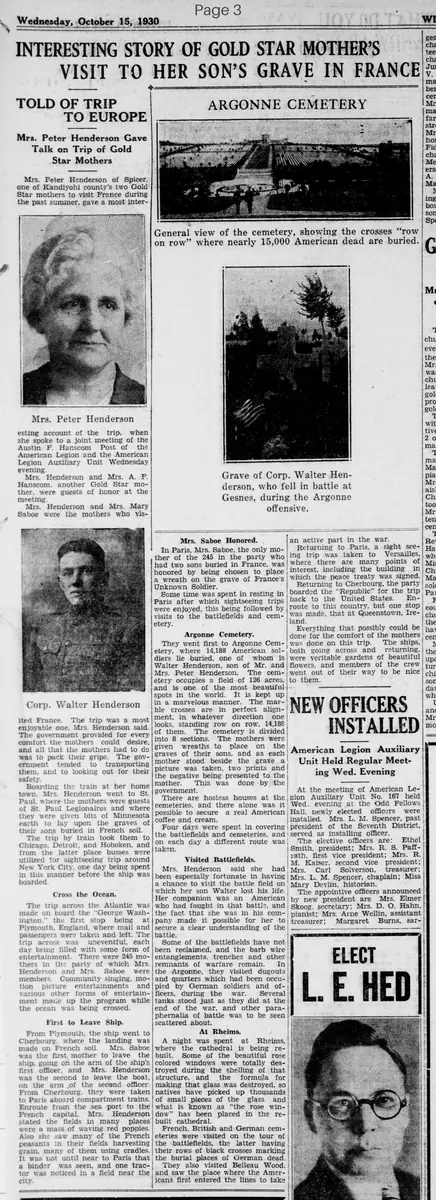
General view of the cemetery, showing the crosses "row on row" where nearly 15,000 American dead are buried.
Grave of Corp. Walter Henderson, who fell in battle at Gesnes, during the Argonne offensive.
In Paris, Mrs. Saboe, the only mother of the 245 in the party who had two sons buried in France, was honored by being chosen to place a wreath on the grave of France's Unknown Soldier.
Some time was spent in resting in Paris after which sightseeing trips were enjoyed, this being followed by visits to the battlefields and cemetery.
Argonne Cemetery.
They went first to Argonne Cemetery, where 14,188 American soldiers lie buried, one of whom is Walter Henderson, son of Mr. and Mrs. Peter Henderson. The cemetery occupies a field of 126 acres, and is one of the most beautiful spots in the world. It is kept up in a marvelous manner. The marble crosses are in perfect alignment, in whatever direction one looks, standing row on row. 14,188 of them. The cemetery is divided into 8 sections. The mothers were given wreaths to place on the graves of their sons, and as each mother stood beside the grave a picture was taken, two prints and the negative being presented to the mother. This was done by the government.
There are hostess houses at the cemeteries, and there alone was it possible to secure a real American coffee and cream.
Four days were spent in covering the battlefields and cemeteries, and on each day a different route was taken.
Visited Battlefields.
Mrs. Henderson said she had been especially fortunate in having a chance to visit the battle field on which her son Walter lost his life. Her companion was an American who had fought in that battle, and the fact that she was in his company made it possible for her to secure a clear understanding of the battle.
Some of the battlefields have not been reclaimed, and the barb wire entanglements, trenches and other remnants of warfare remain. In the Argonne, they visited dugouts and quarters which had been occupied by German soldiers and officers, during the war. Several tanks stood just as they did at the end of the war, and other paraphernalia of battle was to be seen scattered about.
At Rheims.
A night was spent at Rheims, where the cathedral is being rebuilt. Some of the beautiful rose colored windows were totally destroyed during the shelling of that structure, and the formula for making that glass was destroyed, so natives have picked up thousands of small pieces of the glass and what is known as "the rose window" has been placed in the rebuilt cathedral.
French, British and German cemeteries were visited on the tour of the battlefields, the latter having their rows of black crosses marking the burial places of German dead. They also visited Belleau Wood, and saw the place where the Americans first entered the lines to take
Returning to Paris, a sightseeing trip was taken to Versailles, where there are many points of interest, including the building in which the peace treaty was signed.
Returning to Cherbourg, the party boarded the "Republic" for the trip back to the United States. Enroute to this country, but one stop was made, that at Queenstown, Ireland.
Everything that possibly could be done for the comfort of the mothers was done on this trip. The ships, both going across and returning, were veritable gardens of beautiful flowers, and members of the crew went out of their way to be nice to them.
Corp. Walter Henderson
INTERESTING STORY OF GOLD STAR MOTHER'S VISIT TO HER SON'S GRAVE IN FRANCE
TOLD OF TRIP TO EUROPE
Mrs. Peter Henderson Gave Talk on Trip of Gold Star Mothers
Mrs. Peter Henderson of Spicer, one of Kandiyohi county's two Gold Star mothers to visit France during the past summer, gave a most interesting account of the trip, when she spoke to a joint meeting of the Austin F. Hanscom Post of the American Legion and the American Legion Auxiliary Unit Wednesday evening.
Mrs. Henderson and Mrs. A. F. Hanscom, another Gold Star mother, were guests of honor at the meeting.
Mrs. Henderson and Mrs. Mary Saboe were the mothers who visited France. The trip was a most enjoyable one, Mrs. Henderson said. The government provided for every comfort the mothers could desire, and all that the mothers had to do was to pack their grips. The government tended to transporting them, and to looking out for their safety.
Boarding the train at her home town, Mrs. Henderson went to St. Paul, where the mothers were guests of St. Paul Legionaires and where they were given bits of Minnesota earth to lay upon the graves of their sons buried in French soil.
The trip by train took them to Chicago, Detroit, and Hoboken, and from the latter place busses were utilized for sightseeing trip around New York City, one day being spent in this manner before the ship was boarded.
Cross the Ocean.
The trip across the Atlantic was made on board the "George Washington," the first stop being at Plymouth, England, where mail and passengers were taken and left. The trip across was uneventful, each day being filled with some form of entertainment. There were 245 mothers in the party of which Mrs. Henderson and Mrs. Saboe were members. Community singing, motion picture entertainments and various other forms of entertainment made up the program while the ocean was being crossed.
First to Leave Ship.
From Plymouth, the ship went to Cherbourg, where the landing was made on French soil. Mrs. Saboe was the first mother to leave the ship, going on the arm of the ship's first officer, and Mrs. Henderson was the second to leave the boat, on the arm of the second officer.
From Cherbourg, they were taken to Paris aboard compartment trains. Enroute from the sea port to the French capital, Mrs. Henderson stated the fields in many places were a mass of waving red poppies. Also she saw many of the French peasants in their fields harvesting grain, many of them using cradles. It was not until near to Paris that a binder was seen, and one tractor was noticed in a field near the city.
ARGONNE CEMETERY
General view of the cemetery, showing the crosses "row on row" where nearly 15,000 American dead are buried.
Grave of Corp. Walter Henderson, who fell in battle at Gesnes, during the Argonne offensive.
In Paris, Mrs. Saboe, the only mother of the 245 in the party who had two sons buried in France, was honored by being chosen to place a wreath on the grave of France's Unknown Soldier.
Some time was spent in resting in Paris after which sightseeing trips were enjoyed, this being followed by visits to the battlefields and cemetery.
Argonne Cemetery.
They went first to Argonne Cemetery, where 14,188 American soldiers lie buried, one of whom is Walter Henderson, son of Mr. and Mrs. Peter Henderson. The cemetery occupies a field of 126 acres, and is one of the most beautiful spots in the world. It is kept up in a marvelous manner. The marble crosses are in perfect alignment, in whatever direction one looks, standing row on row. 14,188 of them. The cemetery is divided into 8 sections. The mothers were given wreaths to place on the graves of their sons, and as each mother stood beside the grave a picture was taken, two prints and the negative being presented to the mother. This was done by the government.
There are hostess houses at the cemeteries, and there alone was it possible to secure a real American coffee and cream.
Four days were spent in covering the battlefields and cemeteries, and on each day a different route was taken.
Visited Battlefields.
Mrs. Henderson said she had been especially fortunate in having a chance to visit the battle field on which her son Walter lost his life. Her companion was an American who had fought in that battle, and the fact that she was in his company made it possible for her to secure a clear understanding of the battle.
Some of the battlefields have not been reclaimed, and the barb wire entanglements, trenches and other remnants of warfare remain. In the Argonne, they visited dugouts and quarters which had been occupied by German soldiers and officers, during the war. Several tanks stood just as they did at the end of the war, and other paraphernalia of battle was to be seen scattered about.
At Rheims.
A night was spent at Rheims, where the cathedral is being rebuilt. Some of the beautiful rose colored windows were totally destroyed during the shelling of that structure, and the formula for making that glass was destroyed, so natives have picked up thousands of small pieces of the glass and what is known as "the rose window" has been placed in the rebuilt cathedral.
French, British and German cemeteries were visited on the tour of the battlefields, the latter having their rows of black crosses marking the burial places of German dead. They also visited Belleau Wood, and saw the place where the Americans first entered the lines to take
Returning to Paris, a sightseeing trip was taken to Versailles, where there are many points of interest, including the building in which the peace treaty was signed.
Returning to Cherbourg, the party boarded the "Republic" for the trip back to the United States. Enroute to this country, but one stop was made, that at Queenstown, Ireland.
Everything that possibly could be done for the comfort of the mothers was done on this trip. The ships, both going across and returning, were veritable gardens of beautiful flowers, and members of the crew went out of their way to be nice to them.
Corp. Walter Henderson
What sub-type of article is it?
Journey
Historical Event
Biography
What themes does it cover?
Family
Tragedy
Triumph
What keywords are associated?
Gold Star Mother
France Pilgrimage
Argonne Cemetery
Wwi Grave Visit
Battlefield Tour
What entities or persons were involved?
Mrs. Peter Henderson
Walter Henderson
Mrs. Mary Saboe
Mrs. A. F. Hanscom
Where did it happen?
France, Argonne Cemetery, Paris
Story Details
Key Persons
Mrs. Peter Henderson
Walter Henderson
Mrs. Mary Saboe
Mrs. A. F. Hanscom
Location
France, Argonne Cemetery, Paris
Event Date
Summer 1930
Story Details
Mrs. Peter Henderson travels to France with other Gold Star Mothers to visit sons' graves, focusing on Argonne Cemetery where her son Walter is buried; details journey, government care, sightseeing, battlefields, and personal honors.