Thank you for visiting SNEWPapers!
Sign up free
The North Carolina Standard
Raleigh, Wake County, North Carolina
What is this article about?
Account of the Dade Massacre in Florida, December 1835, where Seminole Indians ambushed and killed nearly all of Major Dade's 117-man detachment from Fort Brooke. Survivor Ransom Clark recounts the battle, his wounds, escape, and the fates of two other survivors, Thomas and Sprague.
Clipping
OCR Quality
Full Text
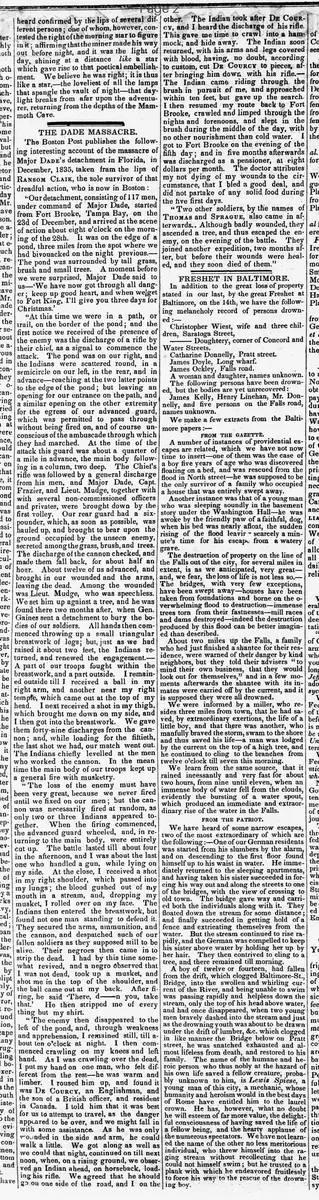
The Boston Post publishes the following interesting account of the massacre of Major Dade's detachment in Florida, in December, 1835, taken from the lips of Ransom Clark, the sole survivor of that dreadful action, who is now in Boston:
"Our detachment, consisting of 117 men, under command of Major Dade, started from Fort Brooke, Tampa Bay, on the 23d of December, and arrived at the scene of action about eight o'clock on the morning of the 28th. It was on the edge of a pond, three miles from the spot where we had bivouacked on the night previous.--The pond was surrounded by tall grass, brush and small trees. A moment before we were surprised, Major Dade said to us--'We have now got through all danger; keep up good heart, and when we get to Fort King, I'll give you three days for Christmas.'
At this time we were in a path, or trail, on the border of the pond; and the first notice we received of the presence of the enemy was the discharge of a rifle by their chief, as a signal to commence the attack. The pond was on our right, and the Indians were scattered round, in a semicircle on our left, in the rear, and in advance--reaching at the two latter points to the edge of the pond; but leaving an opening for our entrance on the path, and a similar opening on the other extremity for the egress of our advanced guard, which was permitted to pass through without being fired on, and of course unconscious of the ambuscade through which they had marched. At the time of the attack this guard was about a quarter of a mile in advance, the main body following in a column, two deep. The Chief's rifle was followed by a general discharge from his men, and Major Dade, Capt. Frazier, and Lieut. Mudge, together with several non-commissioned officers and privates, were brought down by the first volley. Our rear guard had a six-pounder, which, as soon as possible, was hauled up, and brought to bear upon the ground occupied by the unseen enemy, secreted among the grass, brush, and trees. The discharge of the cannon checked, and made them fall back, for about half an hour. About twelve of us advanced, and brought in our wounded and the arms, leaving the dead. Among the wounded was Lieut. Mudge, who was speechless. We set him up against a tree, and he was found there two months after, when Gen. Gaines sent a detachment to bury the bodies of our soldiers. All hands then commenced throwing up a small triangular breastwork of logs; but, just as we had raised it about two feet, the Indians returned, and renewed the engagement. A part of our troops fought within the breastwork, and a part outside. I remained outside till I received a ball in my right arm, and another near my right temple, which came out at the top of my head. I next received a shot in my thigh, which brought me down on my side, and I then got into the breastwork. We gave them forty-nine discharges from the cannon; and, while loading for the fiftieth, the last shot we had, our match went out. The Indians chiefly levelled at the men who worked the cannon. In the meantime the main body of our troops kept up a general fire with musketry.
The loss of the enemy must have been very great, because we never fired until we fixed on our men; but the cannon was necessarily fired at random, as only two or three Indians appeared together. When the firing commenced, the advanced guard wheeled, and, in returning to the main body, were entirely cut up. The battle lasted till about four in the afternoon, and I was about the last one who handled a gun, while lying on my side. At the close, I received a shot in my right shoulder, which passed into my lungs; the blood gushed out of my mouth in a stream, and, dropping my musket, I rolled over on my face. The Indians then entered the breastwork, but found not one man standing to defend it. They secured the arms, ammunition, and the cannon, and despatched such of our fallen soldiers as they supposed still to be alive. Their negroes then came in to strip the dead. I had by this time somewhat revived, and a negro observed that I was not dead, took up a musket, and shot me in the top of the shoulder, and the ball came out at my back. After firing, he said 'There, d--n you, take that.' He then stripped me of everything but my shirt.
The enemy then disappeared to the left of the pond, and, through weakness and apprehension, I remained still, till about ten o'clock at night. I then commenced crawling on my knees and left hand. As I was crawling over the dead, I put my hand on one man, who felt different from the rest--he was warm and limber. I roused him up, and found it was De Courcy, an Englishman, and the son of a British officer, and resident in Canada. I told him that it was best for us to attempt to travel, as the danger appeared to be over, and we might fall in with some assistance. As he was only wounded in the side and arm, he could walk a little. We got along as well as we could that night, continued on till next noon, when, on a rising ground, we observed an Indian ahead, on horseback, loading his rifle. We agreed that he should go on one side of the road, and I on the other. The Indian took after De Courcy, and I heard the discharge of his rifle. This gave me time to crawl into a hammock, and hide away. The Indian soon returned, with his arms and legs covered with blood, having, no doubt, according to custom, cut De Courcy to pieces, after bringing him down with his rifle. The Indian came riding through the brush in pursuit of me, and approached within ten feet, but gave up the search. I then resumed my route back to Fort Brooke, crawled and limped through the nights and forenoons, and slept in the brush during the middle of the day, with no other nourishment than cold water. I got to Fort Brooke on the evening of the fifth day; and in five months afterwards was discharged as a pensioner, at eight dollars per month. The doctor attributes my not dying of my wounds to the circumstance, that I bled a good deal, and did not partake of any solid food during the five first days.
Two other soldiers, by the names of Thomas and Sprague, also came in afterwards. Although badly wounded, they ascended a tree, and thus escaped the enemy, on the evening of the battle. They joined another expedition, two months after, but before their wounds were healed, and they soon died of them."
What sub-type of article is it?
What keywords are associated?
What entities or persons were involved?
Where did it happen?
Domestic News Details
Primary Location
Florida
Event Date
December 23 28, 1835
Key Persons
Outcome
114 of 117 men killed, including major dade, capt. frazier, and lieut. mudge; advanced guard cut up; survivors ransom clark, thomas, and sprague (latter two died later from wounds); indians captured arms, ammunition, and cannon; enemy losses heavy but unspecified.
Event Details
Major Dade's 117-man detachment ambushed by Indians near a pond three miles from bivouac site while marching from Fort Brooke to Fort King. Attack began with chief's rifle signal, followed by volley killing leaders. Troops built breastwork, fired cannon 49 times, fought until afternoon. Indians entered breastwork, killed wounded, stripped dead. Clark wounded multiple times, escaped with De Courcy (later killed), reached Fort Brooke after five days. Thomas and Sprague escaped by climbing tree but died later.