Thank you for visiting SNEWPapers!
Sign up free
The Virginia Gazette
Richmond, Williamsburg, Richmond County, Virginia
What is this article about?
Commodore Esek Hopkins reports the American fleet's successful expedition to New Providence, Bahamas, in March 1776, capturing forts, stores, and prisoners including Governor Montfort Browne. On return, they captured prizes and engaged HMS Glasgow off Long Island on April 6, suffering casualties but securing prizes.
Clipping
OCR Quality
Full Text
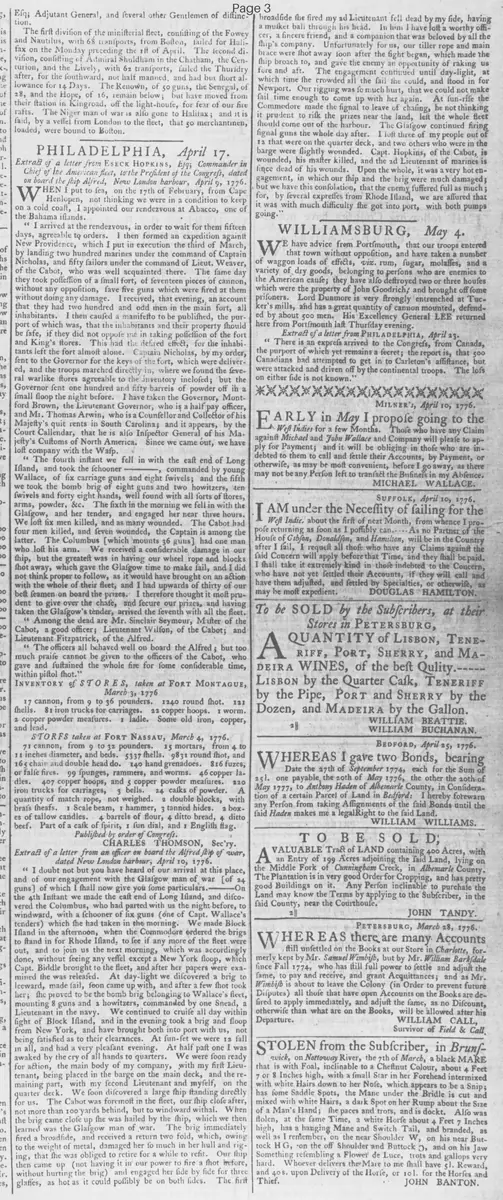
Extract of a letter from Essek Hopkins, Esq; Commander in Chief of the American fleet, to the President of the Congress, dated on board the ship Alfred, New London harbour, April 9, 1776.
When off Henlopen, not thinking we were in a condition to keep on a cold coast, I appointed our rendezvous at Abacco, one of the Bahama islands.
"I arrived at the rendezvous, in order to wait for them fifteen days, agreeable to orders. I then formed an expedition against New Providence, which I put in execution the third of March, by landing two hundred marines under the command of Captain Nicholas, and fifty sailors under the command of Lieut. Weaver, of the Cabot, who was well acquainted there. The same day they took possession of a small fort, of seventeen pieces of cannon, without any opposition, save five guns which were fired at them without doing any damage. I received, that evening, an account that they had two hundred and odd men in the main fort, all inhabitants. I then caused a manifesto to be published, the purport of which was, that the inhabitants and their property should be safe, if they did not oppose me in taking possession of the fort and King's stores. This had the desired effect, for the inhabitants left the fort almost alone. Captain Nicholas, by my order, sent to the Governor for the keys of the fort, which were delivered, and the troops marched directly in, where we found the several warlike stores agreeable to the inventory enclosed; but the Governor sent one hundred and fifty barrels of powder off in a small sloop the night before. I have taken the Governor, Montfort Browne, the Lieutenant Governor, who is a half pay officer, and Mr. Thomas Arwin, who is a Counsellor and Collector of his Majesty's quitrents in South Carolina; and it appears, by the Court Calendar, that he is also Inspector General of his Majesty's Customs of North America. Since we came out, we have lost company with the Wasp."
The fourth instant we fell in with the east end of Long Island, and took the schooner, commanded by young Wallace, of six carriage guns and eight swivels; and the fifth we took the bomb brig of eight guns and two howitzers, ten swivels and forty eight hands, well found with all sorts of stores, arms, powder, &c. The sixth in the morning we fell in with the Glasgow, and her tender, and engaged her near three hours. We lost six men killed, and as many wounded. The Cabot had four men killed, and seven wounded, the Captain is among the latter. The Columbus [which mounts 36 guns] had one man who lost his arm. We received a considerable damage in our ship, but the greatest was in having our wheel rope and blocks shot away, which gave the Glasgow time to make sail, and I did not think proper to follow, as it would have brought on an action with the whole of their fleet, and I had upwards of thirty of our best seamen on board the prizes. I therefore thought it most prudent to give over the chase, and secure our prizes, and having taken the Glasgow's tender, arrived the seventh with all the fleet.
Among the dead are Mr. Sinclair Seymour, Master of the Cabot, a good officer; Lieutenant Wilson, of the Cabot; and Lieutenant Fitzpatrick, of the Alfred.
The officers all behaved well on board the Alfred; but too much praise cannot be given to the officers of the Cabot, who gave and sustained the whole fire for some considerable time, within pistol-shot.
Inventory of STORES, taken at Fort Montague,
March 3, 1776
17 cannon, from 9 to 36 pounders. 1240 round shot. 121 shells. 81 iron trucks for carriages. 22 copper hoops. 1 worm. 2 copper powder measures. 1 ladle. Some old iron, copper, and lead.
STORES taken at FORT NASSAU, March 4, 1776.
71 cannon, from 9 to 32 pounders. 15 mortars, from 4 to 11 inches diameter, and beds. 5337 shells. 9831 round shot, and 165 chain and double head do. 140 hand granadoes. 816 fuzes, or false fires. 99 sponges, rammers, and worms. 46 copper ladles. 407 copper hoops, and 5 copper powder measures. 220 iron trucks for carriages, 3 bells. 24 casks of powder. A quantity of match rope, not weighed. 2 double blocks, with brass sheaves. 1 scale beam, 1 hammer, 3 tanned hides. 2 boxes of tallow candles. 4 barrels of flour, 4 ditto bread, 4 ditto beef. Part of a cask of spirit, 1 sun dial, and 1 English flag.
Published by order of Congress.
CHARLES THOMSON, Sec'ry.
Extract of a letter from an officer on board the Alfred ship of war, dated New London harbour, April 10, 1776.
"I doubt not but you have heard of our arrival at this place, and of our engagement with the Glasgow man of war [of 24 guns] of which I shall now give you some particulars."
On the 4th Instant we made the east end of Long Island, and discovered the Columbus, who had parted with us the night before, to windward, with a schooner of six guns (one of Capt. Wallace's tenders) which she had taken in the morning. We made Block Island in the afternoon, when the Commodore ordered the brigs to stand in for Rhode Island, to see if any more of the fleet were out, and to join us the next morning, which was accordingly done, without seeing any vessel except a New York sloop, which Capt. Biddle brought to the fleet, and after her papers were examined she was released. At day-light we discovered a brig to leeward, made sail, soon came up with, and after a few shot took her; she proved to be the bomb brig belonging to Wallace's fleet, mounting 8 guns and 2 howitzers, commanded by one Snead, a Lieutenant in the navy. We continued to cruise all day within sight of Block Island, and in the evening took a brig and sloop from New York, and have brought both into port with us, not being satisfied as to their clearances. At sun-set we were 12 sail in all, and had a very pleasant evening. At half past one I was awaked by the cry of all hands to quarters. We were soon ready for action, the main body of my company, with my first Lieutenant, being placed in the barge on the main deck, and the remaining part, with my second Lieutenant and myself, on the quarter deck. We soon discovered a large ship standing directly for us. The Cabot was foremost in the fleet, our ship close after, not more than 100 yards behind, but to windward withal. When the brig came close up she was hailed by the ship, which we then learned was the Glasgow man of war. The brig immediately fired a broadside, and received a return two fold, which, owing to the weight of metal, damaged her so much in her hull and rigging, that she was obliged to retire for a while to refit. Our ship then came up (not having it in our power to fire a shot before, without hurting the brig) and engaged her side by side for three glasses, as hot as it could possibly be on both sides. The first broadside she fired my 2d Lieutenant fell dead by my side, having a musket ball through his head. In him I have lost a worthy officer, a sincere friend, and a companion that was beloved by all the ship's company. Unfortunately for us, our tiller rope and main brace were shot away soon after the fight began, which made the ship broach to, and gave the enemy an opportunity of raking us fore and aft. The engagement continued until day-light, at which time she crowded all the sail she could, and stood in for Newport. Our rigging was so much hurt, that we could not make sail time enough to come up with her again. At sun-rise the Commodore made the signal to leave off chasing, he not thinking it prudent to risk the prizes near the land, lest the whole fleet should come out of the harbour. The Glasgow continued firing signal guns the whole day after. I lost three of my people out of 12 that were on the quarter deck, and two others who were in the barge were slightly wounded. Capt. Hopkins, of the Cabot, is wounded, his master killed, and the 2d Lieutenant of marines is since dead of his wounds. Upon the whole, it was a very hot engagement, in which our ship and the brig were much damaged; but we have this consolation, that the enemy suffered full as much; for, by several expresses from Rhode Island, we are assured that it was with much difficulty he got into port, with both pumps going."
What sub-type of article is it?
What keywords are associated?
What entities or persons were involved?
Where did it happen?
Domestic News Details
Primary Location
New Providence, Bahamas
Event Date
March 3 To April 6, 1776
Key Persons
Outcome
captured fort montague and fort nassau with extensive stores; took governor montfort browne and others prisoner; captured schooner, bomb brig, and other vessels; engaged hms glasgow for three hours, losing 6 killed and 6 wounded on alfred, 4 killed and 7 wounded on cabot, 1 injured on columbus; secured prizes and returned to new london.
Event Details
American fleet under Commodore Hopkins landed marines and sailors at New Providence on March 3, 1776, capturing forts without opposition after publishing a manifesto; seized warlike stores but 150 barrels of powder escaped; prisoners included the governor and officials. On return voyage in April, captured British tenders and engaged HMS Glasgow off Long Island on April 6, damaging her but unable to pursue due to own damage.