Thank you for visiting SNEWPapers!
Sign up free
Story
July 23, 1865
New York Dispatch
New York, New York County, New York
What is this article about?
Trial of Miss Mary Harris in Washington ends on the 19th inst. with a not guilty verdict after ten days. Dramatic closing arguments feature clashes between District Attorney Carrington and defense counsel over evidence and character attacks, culminating in jury's quick acquittal amid applause.
Clipping
OCR Quality
95%
Excellent
Full Text
The Dark Side of Life.
Closing Scene of the Trial of Miss Mary Harris She is Declared "Not Guilty"
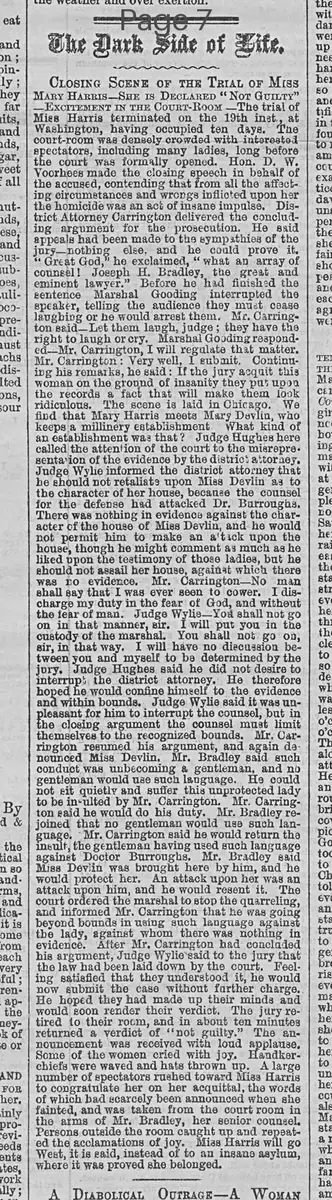
Excitement in the Court-Room.—The trial of Miss Harris terminated on the 19th inst., at Washington, having occupied ten days. The court-room was densely crowded with interested spectators, including many ladies, long before the court was formally opened. Hon. D. W. Voorhees made the closing speech in behalf of the accused, contending that from all the affecting circumstances and wrongs inflicted upon her the homicide was an act of insane impulse. District Attorney Carrington delivered the concluding argument for the prosecution. He said appeals had been made to the sympathies of the jury nothing else, and he could prove it. Great God, he exclaimed, "what an array of counsel! Joseph H. Bradley, the great and eminent lawyer." Before he had finished the sentence Marshal Gooding interrupted the speaker, telling the audience they must cease laughing or he would arrest them. Mr. Carrington said Let them laugh, judge; they have the right to laugh or cry. Marshal Gooding responded _Mr. Carrington, I will regulate that matter_ Mr Carrington: Very well, I submit. Continuing his remarks, he said: If the jury acquit this woman on the ground of insanity they put upon the records a fact that will make them look ridiculous. The scene is laid in Chicago. We find that Mary Harris meets Mary Devlin, who keeps a millinery establishment What kind of an establishment was that? Judge Hughes here called the attention of the court to the misrepresentation of the evidence by the district attorney. Judge Wylie informed the district attorney that he should not retaliate upon Miss Devlin as to the character of her house, because the counsel for the defense had attacked Dr. Burroughs. There was nothing in evidence against the character of the house of Miss Devlin, and he would not permit him to make an attack upon the house, though he might comment as much as he liked upon the testimony of those ladies, but he should not assail her house, against which there was no evidence. Mr. Carrington—No man shall say that I was ever seen to cower. I discharge my duty in the fear of God, and without the fear of man. Judge Wylie You shall not go on in that manner, sir. I will put you in the custody of the marshal. You shall not go on, sir, in that way. I will have no discussion between you and myself to be determined by the jury. Judge Hughes said he did not desire to interrupt the district attorney. He therefore hoped he would confine himself to the evidence and within bounds. Judge Wylie said it was unpleasant for him to interrupt the counsel, but in the closing argument the counsel must limit themselves to the recognized bounds. Mr. Carrington resumed his argument, and again denounced Miss Devlin. Mr. Bradley said such conduct was unbecoming a gentleman, and no gentleman would use such language. He could not sit quietly and suffer this unprotected lady to be insulted by Mr. Carrington. Mr. Carrington said he would do his duty. Mr. Bradley rejoined that no gentleman would use such language. Mr. Carrington said he would return the insult, the gentleman having used such language against Doctor Burroughs. Mr. Bradley said Miss Devlin was brought here by him, and he would protect her. An attack upon her was an attack upon him, and he would resent it. The court ordered the marshal to stop the quarreling, and informed Mr. Carrington that he was going beyond bounds in using such language against the lady, against whom there was nothing in evidence. After Mr. Carrington had concluded his argument, Judge Wylie said to the jury that the law had been laid down by the court. Feeling satisfied that they understood it, he would now submit the case without further charge He hoped they had made up their minds and would soon render their verdict. The jury retired to their room, and in about ten minutes returned a verdict of "not guilty." The announcement was received with loud applause. Some of the women cried with joy. Handkerchiefs were waved and hats thrown up. A large number of spectators rushed toward Miss Harris to congratulate her on her acquittal, the words of which had scarcely been announced when she fainted, and was taken from the court room in the arms of Mr. Bradley, her senior counsel. Persons outside the room caught up and repeated the acclamations of joy. Miss Harris will go West, it is said, instead of to an insane asylum where it was proved she belonged.
Closing Scene of the Trial of Miss Mary Harris She is Declared "Not Guilty"
Excitement in the Court-Room.—The trial of Miss Harris terminated on the 19th inst., at Washington, having occupied ten days. The court-room was densely crowded with interested spectators, including many ladies, long before the court was formally opened. Hon. D. W. Voorhees made the closing speech in behalf of the accused, contending that from all the affecting circumstances and wrongs inflicted upon her the homicide was an act of insane impulse. District Attorney Carrington delivered the concluding argument for the prosecution. He said appeals had been made to the sympathies of the jury nothing else, and he could prove it. Great God, he exclaimed, "what an array of counsel! Joseph H. Bradley, the great and eminent lawyer." Before he had finished the sentence Marshal Gooding interrupted the speaker, telling the audience they must cease laughing or he would arrest them. Mr. Carrington said Let them laugh, judge; they have the right to laugh or cry. Marshal Gooding responded _Mr. Carrington, I will regulate that matter_ Mr Carrington: Very well, I submit. Continuing his remarks, he said: If the jury acquit this woman on the ground of insanity they put upon the records a fact that will make them look ridiculous. The scene is laid in Chicago. We find that Mary Harris meets Mary Devlin, who keeps a millinery establishment What kind of an establishment was that? Judge Hughes here called the attention of the court to the misrepresentation of the evidence by the district attorney. Judge Wylie informed the district attorney that he should not retaliate upon Miss Devlin as to the character of her house, because the counsel for the defense had attacked Dr. Burroughs. There was nothing in evidence against the character of the house of Miss Devlin, and he would not permit him to make an attack upon the house, though he might comment as much as he liked upon the testimony of those ladies, but he should not assail her house, against which there was no evidence. Mr. Carrington—No man shall say that I was ever seen to cower. I discharge my duty in the fear of God, and without the fear of man. Judge Wylie You shall not go on in that manner, sir. I will put you in the custody of the marshal. You shall not go on, sir, in that way. I will have no discussion between you and myself to be determined by the jury. Judge Hughes said he did not desire to interrupt the district attorney. He therefore hoped he would confine himself to the evidence and within bounds. Judge Wylie said it was unpleasant for him to interrupt the counsel, but in the closing argument the counsel must limit themselves to the recognized bounds. Mr. Carrington resumed his argument, and again denounced Miss Devlin. Mr. Bradley said such conduct was unbecoming a gentleman, and no gentleman would use such language. He could not sit quietly and suffer this unprotected lady to be insulted by Mr. Carrington. Mr. Carrington said he would do his duty. Mr. Bradley rejoined that no gentleman would use such language. Mr. Carrington said he would return the insult, the gentleman having used such language against Doctor Burroughs. Mr. Bradley said Miss Devlin was brought here by him, and he would protect her. An attack upon her was an attack upon him, and he would resent it. The court ordered the marshal to stop the quarreling, and informed Mr. Carrington that he was going beyond bounds in using such language against the lady, against whom there was nothing in evidence. After Mr. Carrington had concluded his argument, Judge Wylie said to the jury that the law had been laid down by the court. Feeling satisfied that they understood it, he would now submit the case without further charge He hoped they had made up their minds and would soon render their verdict. The jury retired to their room, and in about ten minutes returned a verdict of "not guilty." The announcement was received with loud applause. Some of the women cried with joy. Handkerchiefs were waved and hats thrown up. A large number of spectators rushed toward Miss Harris to congratulate her on her acquittal, the words of which had scarcely been announced when she fainted, and was taken from the court room in the arms of Mr. Bradley, her senior counsel. Persons outside the room caught up and repeated the acclamations of joy. Miss Harris will go West, it is said, instead of to an insane asylum where it was proved she belonged.
What sub-type of article is it?
Crime Story
Historical Event
What themes does it cover?
Crime Punishment
Justice
What keywords are associated?
Trial Acquittal
Courtroom Drama
Insanity Defense
Homicide Case
Legal Arguments
What entities or persons were involved?
Miss Mary Harris
Hon. D. W. Voorhees
District Attorney Carrington
Marshal Gooding
Judge Hughes
Judge Wylie
Joseph H. Bradley
Mary Devlin
Dr. Burroughs
Where did it happen?
Washington
Story Details
Key Persons
Miss Mary Harris
Hon. D. W. Voorhees
District Attorney Carrington
Marshal Gooding
Judge Hughes
Judge Wylie
Joseph H. Bradley
Mary Devlin
Dr. Burroughs
Location
Washington
Event Date
19th Inst.
Story Details
The trial of Miss Mary Harris for homicide ends with a not guilty verdict after ten days. Courtroom drama ensues with heated arguments between counsel, interruptions by the judge, and defenses of character. The jury acquits her quickly, leading to applause and her fainting.