Thank you for visiting SNEWPapers!
Sign up free
Douglas Daily Dispatch
Douglas, Cochise County, Arizona
What is this article about?
The Roosevelts, part of the Kelly-Roosevelt-Field Museum Expedition, hunt and jointly kill a rare giant panda in Lolo, China on April 13. Amid challenges like bamboo jungles, rain, snow, and wary locals, they navigate trails, befriend Lolo villagers with gifts and Benedictine, and celebrate the success with native rituals including sheep sacrifice.
Clipping
OCR Quality
Full Text
Event
Was Celebrated by Sacrifice of Sheep Prepared by the Headman's Wife
In the wilds of China with the
Kelly-Roosevelt-Field Museum Ex-
pedition.--Organizing a hunt for
rare game in the Lolo country,
which few white men have pene-
trated.--Difficulties of penetrating
the bamboo jungle in rain and
snow.--How the natives "make med-
icine" to propitiate the gods of the
hunt.--On the trail of the giant
panda at last.--A fortunate double
shot at the animal which has been
one of the main objects of the sci-
ntific quest.--Natives celebrate the
success of the hunt.--A ceremony
of purification to counteract any
evil that may follow the killing of
an animal that is held sacred.
We gathered 11 villagers to serve
as porters. Unaccustomed to the
work, they could only carry very
light loads, and even so would only
go a short distance before sitting
down for a rest and a smoke. All
the Lolos were inveterate smokers.
They hollowed pipes out of stones;
some were white, others green, and
many were made from a red stone
which closely resembled the red
pipestone used by the American In-
dian.
The distance from Kooing Ma to
Kooing Hai is short as the crow
flies, but the trail wound round
and about, and there were rivers to
cross and steep ravines to negoti-
ate so that it was not until two in
the afternoon that we came to the
first of the group of houses that
go to make up Kooing Hai. We had
taken four soldiers, leaving the
others with the mules. We also
had Mooka and the son of a neigh-
boring headman.
At moments it did not look as if
we would meet with a friendly re-
ception. As we reached the hamlet
farthest up the valley, designated
as our halting place, the inhabitants
took to the mountain side, and one
man was very visibly leveling a rifle
at us. Our conductors succeeding
in smoothing things out, but only
with a good deal of difficulty, and
it was not a friendly appearing del-
egation that dropped down to talk
things over with us. Probably the
Chinese soldiers were largely re-
sponsible for the distrust.
Throughout the expedition we
found that it was impossible to tell
what sort of gift would prove a
success. The knives and axes which
had been a flat failure in Muping
were now of the greatest service,
and went a great way to clear the
horizon. On the other hand the
cheap field glasses from which we
had expected much, were firmly
rejected. The ceremony of a glass
of Benedictine stood us in good
stead. The headman of the village
was won over, but his tall, hand-
some old father did not appear to
yield quite so readily to our at-
tempted blandishments. It was evi-
dent that, except in defense of their
property, they did not care to at-
tract attention to themselves. The
old man was particularly sus-
picious, and it was only after sev-
eral glasses of Benedictine that he
became at all friendly. He was a
fine old fellow, with a patriarchal
beard, and he seemed to be the
real head of the village. The young-
er men deferred to him in every-
thing, and it was he who finally
decided that we might stay. We
then bought some native wine which we
poured into bowls that circulated
among the headmen and their de-
pendents. They were a fine, stal-
wart lot, and very friendly. We had
heard that the Lolos were heavy
drinkers, but we saw no indica-
tions of their being so. Their wine
is usually made from corn. It
varied greatly in quality, though
none of it could really be called
an agreeable beverage.
We burrowed our way through a
bamboo jungle along a ridge. The
dogs separated and presumably
hunted the valleys on either side.
We came on panda sign, but from
our observations we were very cer-
tain that there were very few of
the animals about, far less than in
Muping.
At noon we built a fire
and from the folds of their cloaks
the Lolos drew forth round lumps
of bread liberally studded with
beans.
Once or twice the dogs picked up
the trail of some animal, but they
never held it for long. Aside from
panda signs of questionable age, all
we saw were some musk deer
tracks, and a number of places
where wild hogs had been rooting.
The result of the evening confer-
ence was a determination to put
in a final hunt on the following
morning, and if nothing came of it
to move further on to where we
had been told takin were to be
found. We paid our Lolo hunters
from 15 to 30 cents a day, offering
a large reward to any others who
should really have had a part in
the successful hunt.
Our next morning's hunt was a
repetition of those of the two pre-
vious days. Again we climbed a
ridge. This time instead of rain
and sleet, we had snow, but the ef-
fect was much the same. We found
no panda sign. We had sent Hsuen
ahead with our kit to Kooing Ma,
telling him to gather the mules and
go on to Litzaping, a village near
which he had been told that takin
were to be found. We followed at
the termination of our hunt, and
reached Litzaping just before dark.
Four headmen gathered to greet
us. We first gave each a liqueur
glass of Benedictine.
Our friends were unanimous in
saying that there were very few
takin about. We had heard there
were many near a mountain named
Tseunei Kwa. This they denied.
one and all advising us to go on to
Yehli, where they said there were
many takin, and an occasional
giant panda. It was decided that
we should send back the Chinese
soldiers and take with us a son of
each of the headmen. The Lolos
said that with the soldiers accom-
panying us we might find ourselves
in difficulties, but that without
them we would be safe. Hsuen was
by now thoroughly sick of the
"brother man" to whom he referred
sarcastically as "our dear brother,"
but he was afraid he might do us
harm if sent back, and for several
days more we gave way to Hsuen's
judgment. All of us were heartily
glad when we eventually arbitrarily
forced him to turn back.
On the twelfth of April we set
out for Yehli. A persistent rain
was falling, which added to the dif-
fficulties of the trail. Our pack ani-
mals consisted of four mules and
two ponies. One of the latter riss-
ed his footing and started down the
mountain side. A muleteer pluck-
ily grabbed his head stall and went
rolling over and over among the
boulders, until long after it had
seemed impossible to us to hold on
further. A most convenient clump
of sturdy bushes prevented pony
and pack from taking the final
plunge.
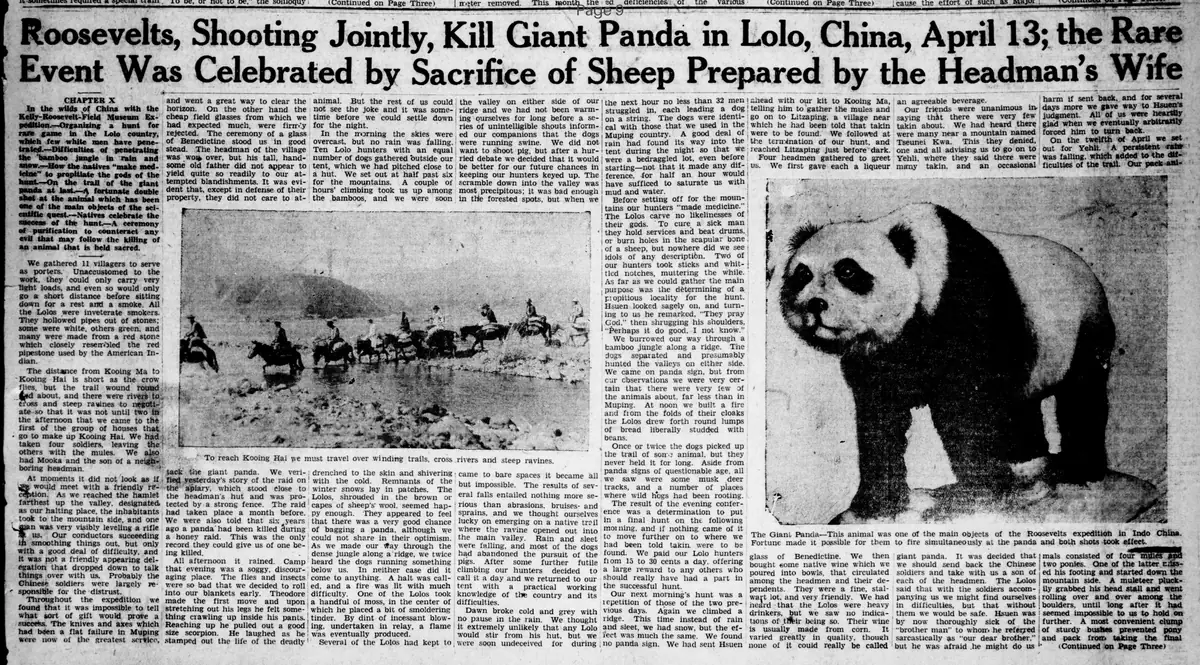
To reach Kooing Hai we must travel over winding
trails, cross rivers and steep ravines.
The Giant Panda--This animal was one of the main objects of the Roosevelts expedition in Indo China
Fortune made it possible for them to fire simultaneously at the panda and both shots took effect.
What sub-type of article is it?
What themes does it cover?
What keywords are associated?
What entities or persons were involved?
Where did it happen?
Story Details
Key Persons
Location
Lolo Country, China
Event Date
April 13
Story Details
The expedition organizes a hunt in remote Lolo country, faces travel difficulties through bamboo jungles in harsh weather, interacts with suspicious Lolo villagers using gifts and liquor, tracks the giant panda, achieves a simultaneous double shot to kill it, and participates in native celebrations and purification rituals.