Thank you for visiting SNEWPapers!
Sign up free
Story
September 20, 1894
The Advance
Jamesburg, Middlesex County, New Jersey
What is this article about?
The author recounts experiences in Ceylon, debunking childhood myths about elephants from storybooks, describing their true cruel and intelligent nature, uses in labor and war, and a fatal attack by a trained elephant on a woman in Debra.
Clipping
OCR Quality
98%
Excellent
Full Text
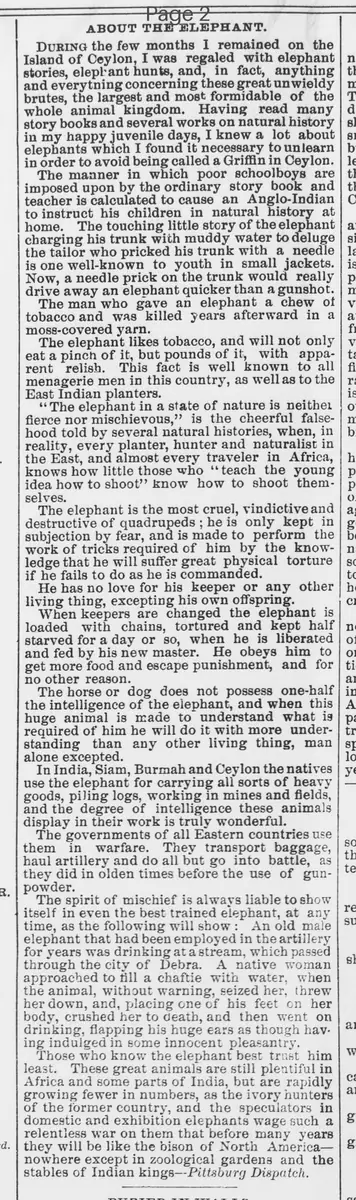
ABOUT THE ELEPHANT.
During the few months I remained on the Island of Ceylon, I was regaled with elephant stories, elephant hunts, and, in fact, anything and everything concerning these great unwieldy brutes, the largest and most formidable of the whole animal kingdom. Having read many story books and several works on natural history in my happy juvenile days, I knew a lot about elephants which I found it necessary to unlearn in order to avoid being called a Griffin in Ceylon.
The manner in which poor schoolboys are imposed upon by the ordinary story book and teacher is calculated to cause an Anglo-Indian to instruct his children in natural history at home. The touching little story of the elephant charging his trunk with muddy water to deluge the tailor who pricked his trunk with a needle is one well-known to youth in small jackets.
Now, a needle prick on the trunk would really drive away an elephant quicker than a gunshot. The man who gave an elephant a chew of tobacco and was killed years afterward in a moss-covered yarn.
The elephant likes tobacco, and will not only eat a pinch of it, but pounds of it, with apparent relish. This fact is well known to all menagerie men in this country, as well as to the East Indian planters.
"The elephant in a state of nature is neither fierce nor mischievous," is the cheerful falsehood told by several natural histories, when, in reality, every planter, hunter and naturalist in the East, and almost every traveler in Africa, knows how little those who "teach the young idea how to shoot" know how to shoot them-selves.
The elephant is the most cruel, vindictive and destructive of quadrupeds; he is only kept in subjection by fear, and is made to perform the work of tricks required of him by the knowledge that he will suffer great physical torture if he fails to do as he is commanded.
He has no love for his keeper or any other living thing, excepting his own offspring. When keepers are changed the elephant is loaded with chains, tortured and kept half starved for a day or so, when he is liberated and fed by his new master. He obeys him to get more food and escape punishment, and for no other reason.
The horse or dog does not possess one-half the intelligence of the elephant, and when this huge animal is made to understand what is required of him he will do it with more understanding than any other living thing, man alone excepted.
In India, Siam, Burmah and Ceylon the natives use the elephant for carrying all sorts of heavy goods, piling logs, working in mines and fields, and the degree of intelligence these animals display in their work is truly wonderful.
The governments of all Eastern countries use them in warfare. They transport baggage, haul artillery and do all but go into battle, as they did in olden times before the use of gunpowder.
The spirit of mischief is always liable to show itself in even the best trained elephant, at any time, as the following will show: An old male elephant that had been employed in the artillery for years was drinking at a stream, which passed through the city of Debra. A native woman approached to fill a chattie with water, when the animal, without warning, seized her, threw her down, and, placing one of his feet on her body, crushed her to death, and then went on drinking, flapping his huge ears as though having indulged in some innocent pleasantry.
Those who know the elephant best trust him least. These great animals are still plentiful in Africa and some parts of India, but are rapidly growing fewer in numbers, as the ivory hunters of the former country, and the speculators in domestic and exhibition elephants wage such a relentless war on them that before many years they will be like the bison of North America—nowhere except in zoological gardens and the stables of Indian kings.—Pittsburg Dispatch.
During the few months I remained on the Island of Ceylon, I was regaled with elephant stories, elephant hunts, and, in fact, anything and everything concerning these great unwieldy brutes, the largest and most formidable of the whole animal kingdom. Having read many story books and several works on natural history in my happy juvenile days, I knew a lot about elephants which I found it necessary to unlearn in order to avoid being called a Griffin in Ceylon.
The manner in which poor schoolboys are imposed upon by the ordinary story book and teacher is calculated to cause an Anglo-Indian to instruct his children in natural history at home. The touching little story of the elephant charging his trunk with muddy water to deluge the tailor who pricked his trunk with a needle is one well-known to youth in small jackets.
Now, a needle prick on the trunk would really drive away an elephant quicker than a gunshot. The man who gave an elephant a chew of tobacco and was killed years afterward in a moss-covered yarn.
The elephant likes tobacco, and will not only eat a pinch of it, but pounds of it, with apparent relish. This fact is well known to all menagerie men in this country, as well as to the East Indian planters.
"The elephant in a state of nature is neither fierce nor mischievous," is the cheerful falsehood told by several natural histories, when, in reality, every planter, hunter and naturalist in the East, and almost every traveler in Africa, knows how little those who "teach the young idea how to shoot" know how to shoot them-selves.
The elephant is the most cruel, vindictive and destructive of quadrupeds; he is only kept in subjection by fear, and is made to perform the work of tricks required of him by the knowledge that he will suffer great physical torture if he fails to do as he is commanded.
He has no love for his keeper or any other living thing, excepting his own offspring. When keepers are changed the elephant is loaded with chains, tortured and kept half starved for a day or so, when he is liberated and fed by his new master. He obeys him to get more food and escape punishment, and for no other reason.
The horse or dog does not possess one-half the intelligence of the elephant, and when this huge animal is made to understand what is required of him he will do it with more understanding than any other living thing, man alone excepted.
In India, Siam, Burmah and Ceylon the natives use the elephant for carrying all sorts of heavy goods, piling logs, working in mines and fields, and the degree of intelligence these animals display in their work is truly wonderful.
The governments of all Eastern countries use them in warfare. They transport baggage, haul artillery and do all but go into battle, as they did in olden times before the use of gunpowder.
The spirit of mischief is always liable to show itself in even the best trained elephant, at any time, as the following will show: An old male elephant that had been employed in the artillery for years was drinking at a stream, which passed through the city of Debra. A native woman approached to fill a chattie with water, when the animal, without warning, seized her, threw her down, and, placing one of his feet on her body, crushed her to death, and then went on drinking, flapping his huge ears as though having indulged in some innocent pleasantry.
Those who know the elephant best trust him least. These great animals are still plentiful in Africa and some parts of India, but are rapidly growing fewer in numbers, as the ivory hunters of the former country, and the speculators in domestic and exhibition elephants wage such a relentless war on them that before many years they will be like the bison of North America—nowhere except in zoological gardens and the stables of Indian kings.—Pittsburg Dispatch.
What sub-type of article is it?
Animal Story
Curiosity
Biography
What themes does it cover?
Deception
Nature
Misfortune
What keywords are associated?
Elephant Myths
Ceylon Elephants
Animal Intelligence
Elephant Cruelty
Fatal Elephant Attack
What entities or persons were involved?
Native Woman
Old Male Elephant
Where did it happen?
Island Of Ceylon
Story Details
Key Persons
Native Woman
Old Male Elephant
Location
Island Of Ceylon
Story Details
Author debunks elephant myths from storybooks, describes their cruelty, intelligence, uses in labor and war, and recounts a trained elephant killing a woman in Debra.