Thank you for visiting SNEWPapers!
Sign up free
Story
February 25, 1840
Rutland Herald
Rutland, Rutland County, Vermont
What is this article about?
The New York Express criticizes further issuance of Treasury notes as deceptive means to hide government bankruptcy, engines of corruption, and harmful to merchants by absorbing bank funds. It recalls banks prioritizing Treasury notes in July last and calls for exposing profligate spending through loans or taxes instead of paper money.
Clipping
OCR Quality
98%
Excellent
Full Text
TREASURY NOTES.
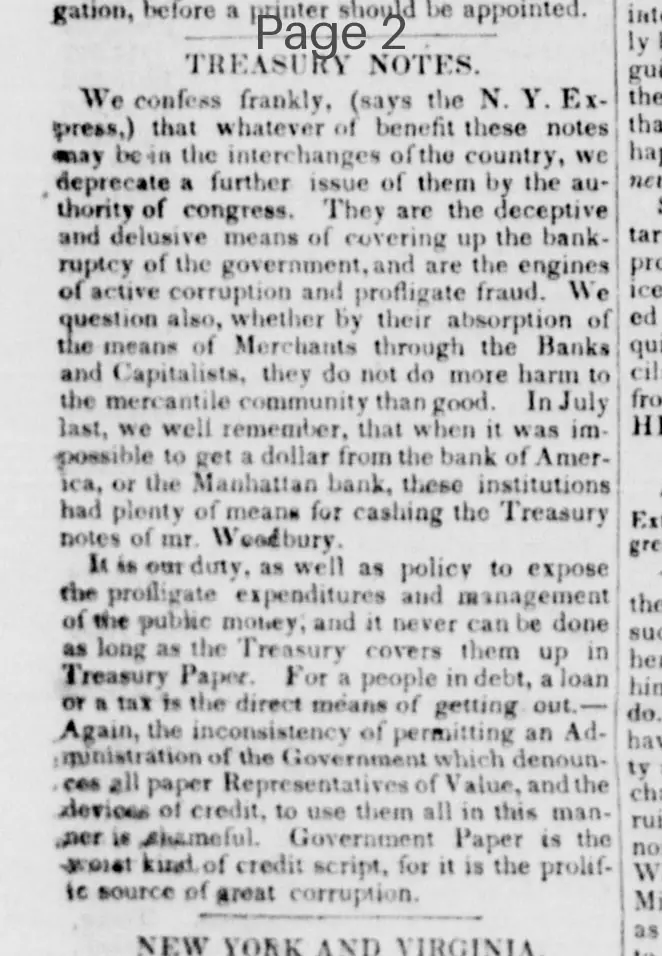
We confess frankly. (says the N. Y. Express.) that whatever of benefit these notes may be in the interchanges ofthe country, we deprecate a further issue of them by the authority of congress. They are the deceptive and delusive means of covering up the bankruptcy of the government,and are the engines of active corruption and profligate fraud. We question also, whether by their absorption of the means of Merchants through the Banks and Capitalists, they do not do more harm to the mercantile community than good. In July last, we well remember. that when it was impossible to get a dollar from the bank of America, or the Manhattan bank, these institutions had plenty of means for cashing the Treasury notes of mr. Woodbury.
It is our duty. as well as policy to expose the profligate expenditures and management of the public money, and it never can be done as long as the Treasury covers them up in Treasury Paper. For a people in debt, a loan or a tax is the direct means of getting out.— Again, the inconsistency of permitting an Administration of the Government which denounces all paper Representatives of Value, and the deviees of credit, to use them all in this manner is shameful. Government Paper is the worst kind of credit script. for it is the prolific source of great corruption.
We confess frankly. (says the N. Y. Express.) that whatever of benefit these notes may be in the interchanges ofthe country, we deprecate a further issue of them by the authority of congress. They are the deceptive and delusive means of covering up the bankruptcy of the government,and are the engines of active corruption and profligate fraud. We question also, whether by their absorption of the means of Merchants through the Banks and Capitalists, they do not do more harm to the mercantile community than good. In July last, we well remember. that when it was impossible to get a dollar from the bank of America, or the Manhattan bank, these institutions had plenty of means for cashing the Treasury notes of mr. Woodbury.
It is our duty. as well as policy to expose the profligate expenditures and management of the public money, and it never can be done as long as the Treasury covers them up in Treasury Paper. For a people in debt, a loan or a tax is the direct means of getting out.— Again, the inconsistency of permitting an Administration of the Government which denounces all paper Representatives of Value, and the deviees of credit, to use them all in this manner is shameful. Government Paper is the worst kind of credit script. for it is the prolific source of great corruption.
What sub-type of article is it?
Deception Fraud
What themes does it cover?
Deception
Moral Virtue
What keywords are associated?
Treasury Notes
Government Corruption
Financial Deception
Bank Prioritization
Profligate Spending
What entities or persons were involved?
N. Y. Express
Mr. Woodbury
Story Details
Key Persons
N. Y. Express
Mr. Woodbury
Event Date
July Last
Story Details
Criticism of Treasury notes as deceptive covers for government bankruptcy and sources of corruption, harming merchants and contradicting anti-paper money policies, with examples from banks prioritizing them.