Thank you for visiting SNEWPapers!
Sign up free
Editorial
May 21, 1833
Phenix Gazette
Alexandria, Virginia
What is this article about?
Editorial criticizes Dr. Webster's proposed Bible edition for using euphemisms to soften language, omitting obsolete terms, and correcting grammar, arguing it would undermine the Bible's divine simplicity, purity, and truthfulness.
Clipping
OCR Quality
98%
Excellent
Full Text
DR. WEBSTER'S PROPOSED EDITION
OF THE BIBLE.
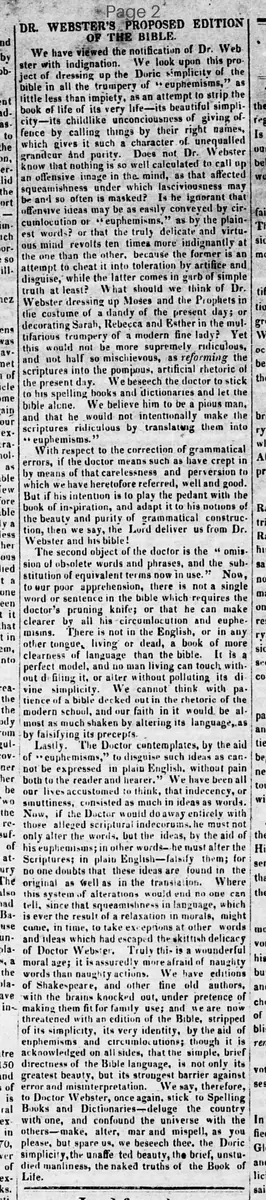
We have viewed the notification of Dr. Webster with indignation. We look upon this project of dressing up the Doric simplicity of the bible in all the trumpery of "euphemisms," as little less than impiety, as an attempt to strip the book of life of its very life—its beautiful simplicity—its childlike unconsciousness of giving offence by calling things by their right names, which gives it such a character of unequalled grandeur and purity. Does not Dr. Webster know that nothing is so well calculated to call up an offensive image in the mind, as that affected squeamishness under which lasciviousness may be and so often is masked? Is he ignorant that offensive ideas may be as easily conveyed by circumlocution or "euphemisms." as by the plainest words? or that the truly delicate and virtuous mind revolts ten times more indignantly at the one than the other, because the former is an attempt to cheat it into toleration by artifice and disguise, while the latter comes in garb of simple truth at least? What should we think of Dr. Webster dressing up Moses and the Prophets in the costume of a dandy of the present day; or decorating Sarah, Rebecca and Esther in the multifarious trumpery of a modern fine lady? Yet this would not be more supremely ridiculous, and not half so mischievous, as reforming the scriptures into the pompous, artificial rhetoric of the present day. We beseech the doctor to stick to his spelling books and dictionaries and let the bible alone. We believe him to be a pious man, and that he would not intentionally make the scriptures ridiculous by translating them into "euphemisms."
With respect to the correction of grammatical errors, if the doctor means such as have crept in by means of that carelessness and perversion to which we have heretofore referred, well and good. But if his intention is to play the pedant with the book of inspiration, and adapt it to his notions of the beauty and purity of grammatical construction, then we say, the Lord deliver us from Dr. Webster and his bible!
The second object of the doctor is the "omission of obsolete words and phrases, and the substitution of equivalent terms now in use.": Now, to our poor apprehension, there is not a single word or sentence in the bible which requires the doctor's pruning knife; or that he can make clearer by all his circumlocution and euphemisms. There is not in the English, or in any other tongue, living or dead, a book of more clearness of language than the bible. It is a perfect model, and no man living can touch without defiling it, or alter without polluting its divine simplicity. We cannot think with patience of a bible decked out in the rhetoric of the modern school, and our faith in it would be almost as much shaken by altering its language, as by falsifying its precepts.
Lastly. The Doctor contemplates, by the aid of "euphemisms," to disguise such ideas as cannot be expressed in plain English, without pain both to the reader and hearer. We have been all our lives accustomed to think, that indecency, or smuttiness, consisted as much in ideas as words. Now, if the Doctor would do away entirely with those alleged scriptural indecencies, he must not only alter the words, but the ideas, by the aid of his euphemisms; in other words—he must alter the Scriptures; in plain English—falsify them; for no one doubts that these ideas are found in the original as well as in the translation. Where this system of alterations would end no one can tell, since that squeamishness in language, which is ever the result of a relaxation in morals, might come, in time, to take exceptions at other words and ideas which had escaped the skittish delicacy of Doctor Webster. Truly this is a wonderful moral age; it is assuredly more afraid of naughty words than naughty actions. We have editions of Shakspeare, and other fine old authors, with the brains knocked out, under pretence of making them fit for family use; and we are now threatened with an edition of the Bible, stripped of its simplicity, its very identity, by the aid of euphemisms and circumlocutions; though it is acknowledged on all sides, that the simple, brief directness of the Bible language, is not only its greatest beauty, but its strongest barrier against error and misinterpretation. We say, therefore, to Doctor Webster, once again, stick to Spelling Books and Dictionaries—deluge the country with one, and confound the universe with the others—make, alter, mar and misspell, as you please, but spare us, we beseech thee, the Doric simplicity, the unaffected beauty, the brief, unstudied manliness, the naked truths of the Book of Life.
OF THE BIBLE.
We have viewed the notification of Dr. Webster with indignation. We look upon this project of dressing up the Doric simplicity of the bible in all the trumpery of "euphemisms," as little less than impiety, as an attempt to strip the book of life of its very life—its beautiful simplicity—its childlike unconsciousness of giving offence by calling things by their right names, which gives it such a character of unequalled grandeur and purity. Does not Dr. Webster know that nothing is so well calculated to call up an offensive image in the mind, as that affected squeamishness under which lasciviousness may be and so often is masked? Is he ignorant that offensive ideas may be as easily conveyed by circumlocution or "euphemisms." as by the plainest words? or that the truly delicate and virtuous mind revolts ten times more indignantly at the one than the other, because the former is an attempt to cheat it into toleration by artifice and disguise, while the latter comes in garb of simple truth at least? What should we think of Dr. Webster dressing up Moses and the Prophets in the costume of a dandy of the present day; or decorating Sarah, Rebecca and Esther in the multifarious trumpery of a modern fine lady? Yet this would not be more supremely ridiculous, and not half so mischievous, as reforming the scriptures into the pompous, artificial rhetoric of the present day. We beseech the doctor to stick to his spelling books and dictionaries and let the bible alone. We believe him to be a pious man, and that he would not intentionally make the scriptures ridiculous by translating them into "euphemisms."
With respect to the correction of grammatical errors, if the doctor means such as have crept in by means of that carelessness and perversion to which we have heretofore referred, well and good. But if his intention is to play the pedant with the book of inspiration, and adapt it to his notions of the beauty and purity of grammatical construction, then we say, the Lord deliver us from Dr. Webster and his bible!
The second object of the doctor is the "omission of obsolete words and phrases, and the substitution of equivalent terms now in use.": Now, to our poor apprehension, there is not a single word or sentence in the bible which requires the doctor's pruning knife; or that he can make clearer by all his circumlocution and euphemisms. There is not in the English, or in any other tongue, living or dead, a book of more clearness of language than the bible. It is a perfect model, and no man living can touch without defiling it, or alter without polluting its divine simplicity. We cannot think with patience of a bible decked out in the rhetoric of the modern school, and our faith in it would be almost as much shaken by altering its language, as by falsifying its precepts.
Lastly. The Doctor contemplates, by the aid of "euphemisms," to disguise such ideas as cannot be expressed in plain English, without pain both to the reader and hearer. We have been all our lives accustomed to think, that indecency, or smuttiness, consisted as much in ideas as words. Now, if the Doctor would do away entirely with those alleged scriptural indecencies, he must not only alter the words, but the ideas, by the aid of his euphemisms; in other words—he must alter the Scriptures; in plain English—falsify them; for no one doubts that these ideas are found in the original as well as in the translation. Where this system of alterations would end no one can tell, since that squeamishness in language, which is ever the result of a relaxation in morals, might come, in time, to take exceptions at other words and ideas which had escaped the skittish delicacy of Doctor Webster. Truly this is a wonderful moral age; it is assuredly more afraid of naughty words than naughty actions. We have editions of Shakspeare, and other fine old authors, with the brains knocked out, under pretence of making them fit for family use; and we are now threatened with an edition of the Bible, stripped of its simplicity, its very identity, by the aid of euphemisms and circumlocutions; though it is acknowledged on all sides, that the simple, brief directness of the Bible language, is not only its greatest beauty, but its strongest barrier against error and misinterpretation. We say, therefore, to Doctor Webster, once again, stick to Spelling Books and Dictionaries—deluge the country with one, and confound the universe with the others—make, alter, mar and misspell, as you please, but spare us, we beseech thee, the Doric simplicity, the unaffected beauty, the brief, unstudied manliness, the naked truths of the Book of Life.
What sub-type of article is it?
Moral Or Religious
What keywords are associated?
Bible Edition
Euphemisms
Scriptural Simplicity
Dr Webster
Moral Squeamishness
Divine Purity
Language Alteration
What entities or persons were involved?
Dr. Webster
Moses
The Prophets
Sarah
Rebecca
Esther
Shakspeare
Editorial Details
Primary Topic
Opposition To Dr. Webster's Proposed Bible Edition Using Euphemisms
Stance / Tone
Indignant Opposition
Key Figures
Dr. Webster
Moses
The Prophets
Sarah
Rebecca
Esther
Shakspeare
Key Arguments
Using Euphemisms Strips The Bible Of Its Beautiful Simplicity And Purity
Euphemisms Mask Lasciviousness And Provoke More Indignation Than Plain Words
Altering Grammar Or Language Defiles The Divine Inspiration
The Bible's Language Is Already Perfectly Clear And Needs No Changes
Changing Words And Ideas Would Falsify The Scriptures
Modern Squeamishness Prioritizes Avoiding Naughty Words Over Actions