Thank you for visiting SNEWPapers!
Sign up free
The Enquirer
Richmond, Henrico County, Virginia
What is this article about?
In January 1794, the US House of Representatives debates James Madison's resolutions proposing additional duties on foreign manufactures and tonnage for nations without commercial treaties, aiming to promote American commerce and navigation against unequal British restrictions.
Clipping
OCR Quality
Full Text
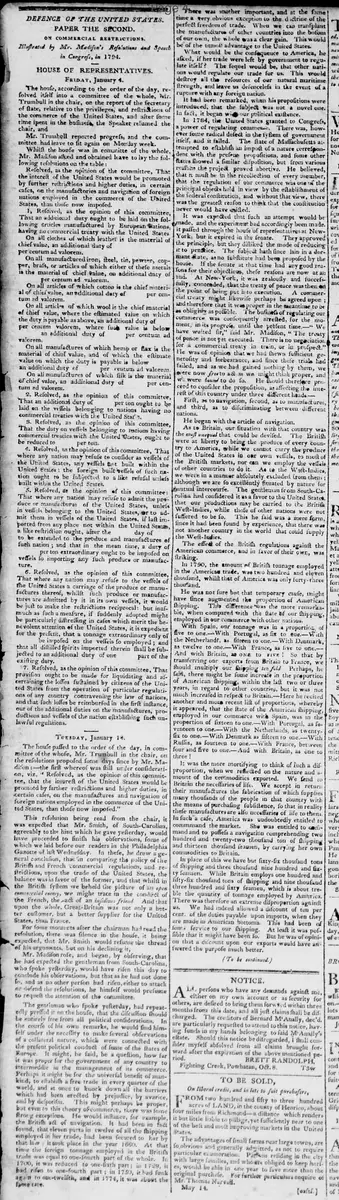
PAPER THE SECOND.
ON COMMERCIAL RESTRICTIONS.
Illustrated by Mr. Madison's Resolutions and Speech
in Congress, in 1794.
HOUSE OF REPRESENTATIVES.
Friday, January 4.
The house, according to the order of the day, resolved itself into a committee of the whole, Mr. Trumbull in the chair, on the report of the secretary of state, relative to the privileges, and restrictions of the commerce of the United States, and after some time spent in the business, the Speaker resumed the chair, and Mr. Trumbull reported progress, and the committee had leave to sit again on Monday week.
Whilst the house was in committee of the whole, Mr. Madison asked and obtained leave to lay the following resolutions on the table:
Resolved, as the opinion of the committee, That the interest of the United States would be promoted by further restrictions and higher duties, in certain cases, on the manufactures and navigation of foreign nations employed in the commerce of the United States, than those now imposed.
1. Resolved, as the opinion of this committee, That an additional duty ought to be laid on the following articles manufactured by European nations having no commercial treaty with the United States.
On all clothes of which leather is the material of chief value, an additional duty of [blank] per centum ad valorem.
On all manufactured iron, steel, tin, pewter, copper, brass, or articles of which either of these metals is the material of chief value, an additional duty of [blank] per centum ad valorem.
On all articles of which cotton is the chief material of chief value, an additional duty of [blank] per centum ad valorem.
On all articles of which wool is the chief material of chief value, where the estimated value on which the duty is payable as above, an additional duty of [blank] per centum ad valorem, where such value is below [blank], an additional duty of [blank] per centum ad valorem.
On all manufactures of which hemp or flax is the material of chief value, and of which the estimated value on which the duty is payable is below [blank], an additional duty of [blank] per centum ad valorem.
On all manufactures of which silk is the material of chief value, an additional duty of [blank] per centum ad valorem.
2. Resolved, as the opinion of this committee, That an additional duty of [blank] per ton ought to be laid on the vessels belonging to nations having no commercial treaties with the United States.
3. Resolved, as the opinion of this committee, That the duty on vessels belonging to nations having commercial treaties with the United States, ought to be reduced to [blank] per ton.
4. Resolved, as the opinion of this committee, That where any nation may refuse to consider as vessels of the United States, any vessels built within the United States: the foreign built vessels of such nation ought to be subjected to a like refusal unless built within the United States.
5. Resolved, as the opinion of this committee: That where any nation may refuse to admit the produce or manufactures of the United States, unless in vessels belonging to the United States, or to admit them in vessels of the United States, if last imported from any place not within the United States, alike restriction ought, after the [blank] day of [blank], to be extended to the produce and manufactures of such nation; and that in the mean time, a duty of [blank] per ton extraordinary ought to be imposed on vessels importing any such produce or manufacture.
6. Resolved, as the opinion of this committee, That where any nation may refuse to the vessels of the United States a carriage of the produce or manufactures thereof, whilst such produce or manufactures are admitted by it in its own vessels, it would be just to make the restrictions reciprocal: but inasmuch as such a measure, if suddenly adopted might be particularly distressing in cases which merit the benevolent attention of the United States, it is expedient for the present, that a tonnage extraordinary only of [blank] be imposed on the vessels so employed; and that all distilled spirits imported therein shall be subjected to an additional duty of one part of the existing duty.
7. Resolved, as the opinion of this committee, That provision ought to be made for liquidating and ascertaining the loss sustained by citizens of the United States from the operation of particular regulations of any country contravening the law of nations, and that such loss be reimbursed in the first instance, out of the additional duties on the manufactures, productions and vessels of the nation establishing such unlawful regulations.
Tuesday, January 14.
The house passed to the order of the day, in committee of the whole, Mr. Trumbull in the chair, on the resolutions proposed one day since by Mr. Madison:--the first whereof was still under consideration, viz, "Resolved, as the opinion of this committee, that the interest of the United States would be promoted by further restrictions and higher duties, in certain cases, on the manufactures and navigation of foreign nations employed in the commerce of the United States, than those now imposed."
This resolution being read from the chair, it was expected that Mr. Smith, of South-Carolina, agreeably to the hint which he gave yesterday, would have proceeded to finish his observations, some of which we laid before our readers in the Philadelphia Gazette of last Wednesday. In these, he drew a general conclusion, that in comparing the British and French commercial regulations, and restrictions, upon the trade of the United States, the balance was in favor of the former, and that whilst in the British system we beheld the picture of an open commercial enemy, we might trace in the conduct of the French, the act of an insidious friend. And that upon the whole, Great-Britain was not only a better customer, but a better supplier for the United States, than France.
For some moments after the chairman had read the resolution, there was silence in the house, it being expected, that Mr. Smith would resume the thread of his arguments, but on his declining it, Mr. Madison rose, and began, by observing, that he had expected the gentleman from South-Carolina, who spoke yesterday, would have risen this day to conclude his observations, but that as he had not done so, and as no other person had risen, either to attack or defend the resolutions, he himself would presume to request the attention of the committee.
The gentleman who spoke yesterday, had repeatedly pressed it on the house, that the discussion should be entirely free from all political considerations. In the course of his own remarks, he would find himself under the necessity to make several observations of a collateral nature, which were connected with the present political conduct of some of the states of Europe. It might, he said, be a question, how far it was proper for the government of any country to intermeddle in the management of its commerce. Perhaps it might be for the universal benefit of mankind, to establish a free trade in every quarter of the world, and at once to knock down all the barriers which had been erected by prejudice, by avarice, and by despotism. This might perhaps be proper, but even to this theory of commerce, there was some strong exceptions. He would instance, for example, the British act of navigation. It had been in fact found, that eleven parts in twelve of all the shipping employed in her trade, had been secured to her by that law: it took place in the year 1650. At that time the foreign tonnage employed in the British trade was equal to one-fourth part of the whole. In 1700, it was reduced to one-sixth part; in 1729, it had risen to one-eighth part; in 1750, it had sunk again to one-twelfth, and in 1774, it was about the same rate.
There was another important, and at the same time a very obvious exception to the doctrine of the perfect freedom of trade. When we can transplant the manufactures of other countries into the bosom of our own, the whole is a clear gain. This would be of the utmost advantage to the United States. What would be the consequence to America, he asked, if her trade were left by government to regulate itself? The result would be, that other nations would regulate our trade for us. This would destroy all the resources of our natural maritime strength, and leave us defenceless in the event of a rupture with any foreign nation.
It had been remarked, when his propositions were introduced, that the subject was not a novel one. In fact, it began with our political existence. In 1784, the United States granted to Congress, a power of regulating commerce. There was, however some radical defect in the system of government itself, and it failed. The state of Massachusetts attempted to establish an impost of a nature correspondent with the present propositions, and some other states showed a similar disposition, but from various reasons the project proved abortive. He believed, that it must be in the recollection of every member, that the regulation of our commerce was one of the principal objects held in view by the establishment of the federal constitution, and without that view, there was the greatest reason to think that the constitution never would have existed.
It was expected that such an attempt would be made, and the experiment had accordingly been made. It passed through the house of representatives at New-York, but it expired in the senate. They approved the principle, but they disliked the mode of reducing it to practice. The subject hath since lain in a dormant state, as no substitute had been proposed by the house. If the senate at that time had any good reasons for their objection, those reasons are now at an end. At New-York, it was zealously and successfully, contended, that the treaty of peace was then on the point of being put into execution. A commercial treaty might likewise perhaps be agreed upon; and therefore that it was proper in the meantime to be as obliging as possible. The business of regulating our commerce was consequently arrested, for the moment, in its progress, until the present time.-- "We have waited long," said Mr. Madison, "The treaty of peace is not yet executed. There is no negotiation for a commercial treaty in train, or in prospect."
He was of opinion that we had shown sufficient generosity and forbearance, and since these trials had failed, and as we had gained nothing by them, we were now free to act as we might think proper, and were bound to do so. He should therefore proceed to consider the proposition, as affecting the interest of this country under three different heads.--
First, as to navigation, second, as to manufactures, and third, as to discriminating between different nations.
He began with the article of navigation.
As to Britain, our situation with that country was the most unequal that could be devised. The British were at liberty to bring the produce of every country to America, while we cannot carry the produce of the United States in our own vessels, to most of the British markets, nor can we employ the vessels of other countries to do it. As to the West-Indies, we were in a manner absolutely excluded from them; although we are so excellently situated by nature for mutual intercourse. The gentleman from South-Carolina had considered it as a favor to the United States, that our productions may be carried to the British West-Indies, while those of other nations were not suffered to be so. This he said was a mere form, since it had been found by experience, that there was not another country in the world that could supply the West-Indies.
The effect of the British regulations against the American commerce, and in favor of their own, was striking.
In 1790, the amount of British tonnage employed in the American trade, was two hundred and eleven thousand, whilst that of America was only forty-three thousand.
He was not sure but that temporary causes, might have since augmented the proportion of American shipping.
This difference was the more remarkable, when compared with the state of our shipping, employed in our commerce with other nations.
With Spain, our tonnage was in a proportion, of five to one.--With Portugal, as six to one.--With the Netherlands, as fifteen to one.--With Denmark, as twelve to one.--With France, as five to one.-- And with Britain, as one to five! So that by transferring our exports from Britain to France, we should multiply our shipping tenfold. Perhaps, he said, there might be some increase in the proportion of American shipping, within the last two or three years, in regard to other countries, but it was not much increased in respect to Britain.--Here he recited another and more recent list of proportions, whereby it appeared, that the state of the American shipping, employed in our commerce with Spain, was in the proportion of sixteen to one.--With Portugal, as seventeen to one.--With the Netherlands, as twenty-six to one.--With Denmark as fifteen to one.--With Russia, as fourteen to one.--With France, between four and five to one.--And with Britain, as one to three!
It was the more mortifying to think of such a disproportion, when we reflected on the nature and amount of the commodities exported. We send to Britain the necessaries of life. We accept in return their manufactures the fabrication of which supplies many thousands of the people in that country with the means of purchasing subsistence, so that in reality these manufactures are also necessaries of life to them.
In such a case, America was undoubtedly entitled to command the market. She was entitled to command and to possess a navigation comprehending two hundred and twenty-two thousand tons of shipping and thirteen thousand seamen, by carrying her own commodities to Britain.
In place of this we have but sixty-six thousand tons of shipping and three thousand nine hundred and sixty seamen. While Britain employs one hundred and fifty-six thousand tons of shipping and nine thousand three hundred and sixty seamen, which is about treble the quantity of tonnage employed by America.
There was therefore an extreme disproportion against us. We had indeed allowed a discount of ten per cent. of the duties payable upon imports, when they are made in American bottoms. This had been of some service to our shipping. At least it was possible that it might have been so. But he was of opinion that a discount upon our exports would have answered the purpose much better.
(To be continued.)
What sub-type of article is it?
What themes does it cover?
What keywords are associated?
What entities or persons were involved?
Where did it happen?
Story Details
Key Persons
Location
House Of Representatives
Event Date
January 4, 1794 And January 14, 1794
Story Details
James Madison introduces resolutions in the US House for additional duties on foreign manufactures and vessels without treaties to protect American commerce; he argues against free trade theory citing British Navigation Acts and unequal trade proportions, advocating reciprocal restrictions.