Thank you for visiting SNEWPapers!
Sign up free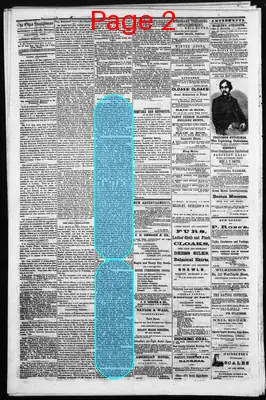
Daily Ohio Statesman
Columbus, Franklin County, Ohio
What is this article about?
The Toledo Union Democratic Club reports its formation and adopts resolutions denouncing the Lincoln Administration's shift from non-interference with slavery, imposition of martial law in loyal states, suppression of civil liberties, and the Emancipation Proclamation as unconstitutional, urging return to original principles to end the war and restore the Union. (248 characters)
Merged-components note: Merging sequential components that form a single continuous letter to the editor from the Toledo Union Democratic Club, including resolutions, based on reading order and coherent topic flow.
Clipping

OCR Quality
Full Text
The Toledo Union Democratic Club.
Toledo, Feb. 10th, 1863.
Editors Statesman—Gents:—On the 19th of January last the Democrats of the city of Toledo met, pursuant to notice, and formed a Club of the name and style of 'The Toledo Union Democratic Club,' the object and business of which (as declared by its Constitution) is the reading of such governmental, national, political and historical books and papers as treat of past and present events relating to our country; and also the discussion of any suggestions that may be made for the restoration of law and order, union and peace, loyalty and patriotism, where now exist tyranny and confusion, disunion and war, secession and treason.
The officers of our Club are—W. W. Jones President; John E. Hart, Vice-President; A. T. Stebbins, Recording Secretary and Treasurer; and Andrew Young, Corresponding Secretary.
On Thursday last (the first stated meeting of the Club) the following resolutions were reported by a committee, discussed, and enthusiastically adopted without a dissenting voice:
Whereas, The present Administration, in accepting the functions of the Government, declared to the country, through the President, in substance as follows: 'I have no purpose, directly or indirectly, to interfere with the institution of slavery in the States where it exists, and I believe I have no lawful right to do so;' and the thirty-sixth Congress of the United States, by a unanimous vote, declared that neither it nor the people of the non-slaveholding States have the Constitutional right to legislate upon or interfere with slavery in any of the slaveholding States of the Union; and the people of the loyal States, relying in good faith upon the honest fulfillment of the trust, and the carrying out of the will of the nation, as expressed by these declarations, were united as one man against disunion and secession, and every part of the country vied with its neighbor in contributing men and money for the support of the nation, threatened with destruction by armed traitors; and while reposing in that faith, the cause of the country prospered, its armies were successful, and the hopes of all true patriots brightened—believing they could see the end coming, when the Union would be restored and peace and harmony again prevail over the whole land—but, suddenly, the Administration alarmed the whole country by its intolerance in declaring martial law over the loyal States—placing the military, in violation of the Constitution, superior to the civil authority—denying a hearing to the parties whom it held under arrest; suppressing the presses which it could not subsidize; encouraged the formation of secret political societies of oath-bound members to spy out and hunt up 'subjects to fill its prisons;' employed detectives to dog the footsteps of those it hoped to entrap, stealing upon them in the dead hours of the night, instead of arresting them in the open day; and, when in prison, with cowardly fear, denied them all access to friends, and communication with dear ones at home—following which, the President issued his celebrated threat that he would abolish slavery on the first day of January, 1863, and which he is now attempting to do under the plea of military necessity—the only effect of which would be to liberate the slaves of loyal masters (if it could be enforced), the confiscation act having already declared the freedom of the slaves of those in rebellion. As a consequence of such departure from the principles with which it set out, the Administration has involved the country in confusion, depreciated its credit far below that of any of the loyal States—so that the national six per cents will not bring as much as many of the railroad bonds of the country; set an example of violation of the Constitution and laws, which encourages anarchy, corrupts the people, and demoralizes the army; therefore,
Resolved, 1st. That it is the first duty of all true patriots to unite their efforts to bring back the Administration to the principles upon which it started out, that the efforts of the country may be united in crushing the rebellion and restoring the Union.
2d. That the military is subordinate to the civil law, where the civil law can be enforced; and no sophistry on the part of the Administration, will justify the War Department in violating the Constitution and laws of the country by illegal arrests (notoriously partisan in their enforcement), and no ex post facto law enacted by Congress ought to indemnify the perpetrators of such outrages, with the people's money, or shield them from the penalties which justly attach to the violators of individual rights.
3d. That we look upon the proclamation of emancipation as unconstitutional, uncalled for and issued under a misconception of the effect it was calculated to produce. That proclamations, in order to be effective and binding, must have the authority of law; and, we regard the scheme of compensated emancipation which proposes to tax the people of the free States, to liberate the slaves of the slave States, as an act of executive usurpation; and we object to the encumbering of our posterity with a debt for this purpose, and the exciting of external hatred against us on the part of loyal persons in slaveholding States, as the emancipation proclamation will do and is now doing.
4th. That the present Administration, by its action and war policy, has given an artificial and extraordinary force to the Abolition faction in place of the delegated will of the nation and made itself the instrument of ill-concerted and incongruous projects; rather than the organ of consistent and wholesome plans, digested by wise counsels and modified by mutual interests. And that this faction has, for years, by their noisy, inconsiderate and pharisaical action, disturbed the harmony of the people of the States; treated the Constitution and the laws with contempt, whenever they came in conflict with their peculiar ideas of 'higher law,' and which has finally culminated in maddening the South into rebellion.
5th. That while we will yield implicit obedience to law and constituted authority as a sacred obligation and duty enjoined by the fundamental maxims of the republic, we protest against the innovations upon the spirit and letter of our Constitution, which are manifested by an artful, overreaching and unscrupulous minority Administration, to centralize power in the hands of the General Government, trample upon the rights of the States, destroy individual liberty, and change the whole fabric of our Government.
6th. That virtue or morality is a necessary spring of free government seems to have been forgotten by the Administration—peculation is winked at in high places, and official misconduct is whitewashed.
7th, That the Administration seems to have lost sight of the fact that government is instituted for the people, and is practicing upon the assumption that the people are subordinate to the Administration.
8th. That the so-called 'Union Club' (having a State and national organization and a lodge in this city), a secret political society of oath-bound members, for the avowed purpose of reporting disloyal persons to the War Department, is, like its prototype of the 'Golden Circle,' detestable, and should receive the condemnation of every right-minded citizen, and is worthy only of the days of the Spanish inquisition.
On motion of Judge Dunlap, each resolution was separately read, discussed and adopted without one dissenting voice.
On motion of J. C. Klots, the Corresponding Secretary, was requested to furnish the following papers with copies of the resolutions for publication, viz: The Ohio Statesman, The Crisis, the Cincinnati Enquirer, Defiance Democrat and Napoleon North West.
[Signed]
W. W. JONES, President.
A. T. STEBBINS, Secretary.
What sub-type of article is it?
What themes does it cover?
What keywords are associated?
What entities or persons were involved?
Letter to Editor Details
Author
W. W. Jones, President; A. T. Stebbins, Secretary
Recipient
Editors Statesman
Main Argument
the administration has deviated from its initial pledges not to interfere with slavery, imposed unconstitutional martial law, suppressed freedoms, and issued the emancipation proclamation under false pretenses, leading to national confusion; patriots must unite to restore it to original principles for crushing rebellion and reuniting the country.
Notable Details