Thank you for visiting SNEWPapers!
Sign up free
Literary
September 7, 1802
The New Hampshire Gazette
Portsmouth, Rockingham County, New Hampshire
What is this article about?
In 'The Rural Loiterer—No. III.', the author praises the industry and simplicity of ancient women, quoting Exodus on wise-hearted women spinning fabrics, and urges modern American women to reject luxury and dissipation for virtuous domestic duties, moral education of children, and family happiness.
Clipping
OCR Quality
95%
Excellent
Full Text
For the N.H. GAZETTE.
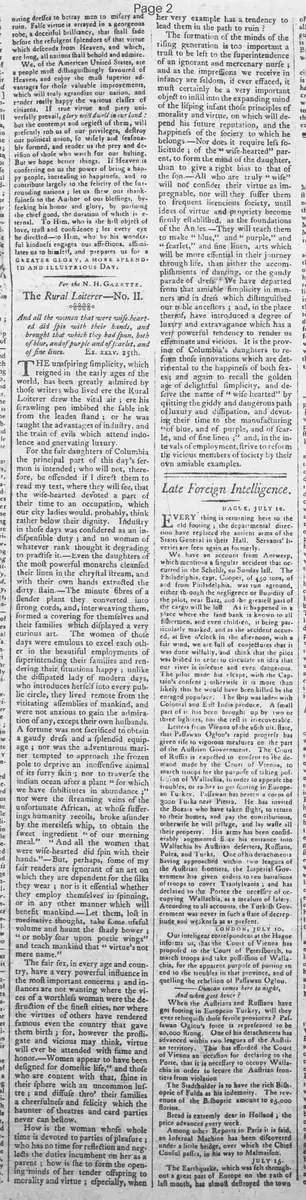
The Rural Loiterer—No. III.
And all the women that were wise-hearted did spin with their hands, and brought that which they had spun both of blue, and of purple, and of scarlet, and of fine linen.
Ex. xxxv. 25th.
The unsparing simplicity, which distinguished the female world, has been greatly admired by those writers who lived ere the Rural Loiterer drew the vital air; ere his crawling pen imbibed the sable ink from the leaden stand; or he was taught the advantages of industry, and the train of evils which attend indolence and enervating luxury.
For the fair daughters of Columbia the principal part of this essay is intended; who will not, therefore, be offended if I direct them to read my text, where they will see, that the wise-hearted devoted a part of their time to an occupation, which our city ladies would, probably, think rather below their dignity. Industry in those days was considered as an indispensable duty; and no woman of whatever rank thought it degrading to practice it.—Even the daughters of the most powerful monarchs cleansed their linen in the crystal stream, and with their own hands extracted the dirty stain.—The minute fibres of a slender plant they converted into strong cords, and, interweaving them, formed a covering for themselves and their families which displayed a very curious art. The women of those days were emulous to excel each other in the beautiful employments of superintending their families and rendering their situations happy; unlike the dissipated lady of modern days, who introduces herself into every public circle, they lived remote from the vititating assemblies of mankind, and were not anxious to gain the admiration of any, except their own husbands. A fortune was not sacrificed to obtain a gaudy dress and a splendid equipage; nor was the adventurous mariner tempted to approach the frozen pole to deprive an inoffensive animal of its furry skin; nor to traverse the Indian ocean after a plant “for which we have substitutes in abundance;” nor were the streaming veins of the unfortunate African, at whose sufferings humanity recoils, broke asunder by the merciless whip, to obtain the sweet ingredient “of our morning meal.” “And all the women that were wise-hearted did spin with their hands.”—But, perhaps, some of my fair readers are ignorant of an art on which they are dependent for the silks they wear; nor is it essential whether they employ themselves in spinning, or in any other manner which will benefit mankind. Let them, lost in meditative thought, take some useful volume and haunt the shady bower; “or nobly soar upon poetic wings” and teach mankind that “virtue's not mere name.”
The fair sex, in every age and country, have a very powerful influence in the most important concerns; and instances are not wanting where the vices of a worthless woman were the destruction of the finest cities, nor where the virtues of others have rendered famous even the country that gave them birth; for, however the profligate and vicious may think, virtue will ever be attended with fame and honor.—Women appear to have been designed for domestic life,” and those who are content with that, shine in their sphere with an uncommon lustre; and diffuse thro' their families a cheerfulness and felicity which the haunter of theatres and card parties never can bestow.
How is the woman whose whole time is devoted to parties of pleasure; who has no time for reflection and neglects the duties incumbent on her as a parent; how is she to form the opening minds of her tender offspring to morality and virtue; especially, when her very example has a tendency to lead them in the path to ruin?
The formation of the minds of the rising generation is too important a trust to be left to the superintendence of an ignorant and mercenary nurse; and as the impressions we receive in infancy are seldom, if ever effaced, it must certainly be a very important object to instil into the expanding mind of the lisping infant those principles of morality and virtue, on which will depend his future reputation, and the happiness of the society to which he belongs.—Nor does it require less solicitude; of the “wise-hearted” parent, to form the mind of the daughter, than to give a right bias to that of the son.—All who are truly “wise” will not consider their virtue as impregnable, nor will they suffer them to frequent licentious society, until ideas of virtue and propriety become firmly established, as the foundations of the Andes.—They will teach them to make “blue,” and “purple,” and “scarlet,” and fine linen, arts which will be more essential in their journey through life, than either the accomplishments of dancing, or the gaudy parade of dress.* We have departed from that amiable simplicity in manners and in dress which distinguished our noble ancestors; and, in the place thereof, have introduced a degree of luxury and extravagance which has a very powerful tendency to render us effeminate and vicious. It is the province of Columbia's daughters to reform those innovations which are detrimental to the happiness of both sexes; and again to recall the golden age of delightful simplicity, and deserve the name of “wise hearted” by quitting the giddy and dangerous path of luxury and dissipation, and devoting their time to the manufacturing “of blue, and of purple, and of scarlet, and of fine linen;” and, in the intervals of employment, strive to reform the vicious members of society by their own amiable examples.
The Rural Loiterer—No. III.
And all the women that were wise-hearted did spin with their hands, and brought that which they had spun both of blue, and of purple, and of scarlet, and of fine linen.
Ex. xxxv. 25th.
The unsparing simplicity, which distinguished the female world, has been greatly admired by those writers who lived ere the Rural Loiterer drew the vital air; ere his crawling pen imbibed the sable ink from the leaden stand; or he was taught the advantages of industry, and the train of evils which attend indolence and enervating luxury.
For the fair daughters of Columbia the principal part of this essay is intended; who will not, therefore, be offended if I direct them to read my text, where they will see, that the wise-hearted devoted a part of their time to an occupation, which our city ladies would, probably, think rather below their dignity. Industry in those days was considered as an indispensable duty; and no woman of whatever rank thought it degrading to practice it.—Even the daughters of the most powerful monarchs cleansed their linen in the crystal stream, and with their own hands extracted the dirty stain.—The minute fibres of a slender plant they converted into strong cords, and, interweaving them, formed a covering for themselves and their families which displayed a very curious art. The women of those days were emulous to excel each other in the beautiful employments of superintending their families and rendering their situations happy; unlike the dissipated lady of modern days, who introduces herself into every public circle, they lived remote from the vititating assemblies of mankind, and were not anxious to gain the admiration of any, except their own husbands. A fortune was not sacrificed to obtain a gaudy dress and a splendid equipage; nor was the adventurous mariner tempted to approach the frozen pole to deprive an inoffensive animal of its furry skin; nor to traverse the Indian ocean after a plant “for which we have substitutes in abundance;” nor were the streaming veins of the unfortunate African, at whose sufferings humanity recoils, broke asunder by the merciless whip, to obtain the sweet ingredient “of our morning meal.” “And all the women that were wise-hearted did spin with their hands.”—But, perhaps, some of my fair readers are ignorant of an art on which they are dependent for the silks they wear; nor is it essential whether they employ themselves in spinning, or in any other manner which will benefit mankind. Let them, lost in meditative thought, take some useful volume and haunt the shady bower; “or nobly soar upon poetic wings” and teach mankind that “virtue's not mere name.”
The fair sex, in every age and country, have a very powerful influence in the most important concerns; and instances are not wanting where the vices of a worthless woman were the destruction of the finest cities, nor where the virtues of others have rendered famous even the country that gave them birth; for, however the profligate and vicious may think, virtue will ever be attended with fame and honor.—Women appear to have been designed for domestic life,” and those who are content with that, shine in their sphere with an uncommon lustre; and diffuse thro' their families a cheerfulness and felicity which the haunter of theatres and card parties never can bestow.
How is the woman whose whole time is devoted to parties of pleasure; who has no time for reflection and neglects the duties incumbent on her as a parent; how is she to form the opening minds of her tender offspring to morality and virtue; especially, when her very example has a tendency to lead them in the path to ruin?
The formation of the minds of the rising generation is too important a trust to be left to the superintendence of an ignorant and mercenary nurse; and as the impressions we receive in infancy are seldom, if ever effaced, it must certainly be a very important object to instil into the expanding mind of the lisping infant those principles of morality and virtue, on which will depend his future reputation, and the happiness of the society to which he belongs.—Nor does it require less solicitude; of the “wise-hearted” parent, to form the mind of the daughter, than to give a right bias to that of the son.—All who are truly “wise” will not consider their virtue as impregnable, nor will they suffer them to frequent licentious society, until ideas of virtue and propriety become firmly established, as the foundations of the Andes.—They will teach them to make “blue,” and “purple,” and “scarlet,” and fine linen, arts which will be more essential in their journey through life, than either the accomplishments of dancing, or the gaudy parade of dress.* We have departed from that amiable simplicity in manners and in dress which distinguished our noble ancestors; and, in the place thereof, have introduced a degree of luxury and extravagance which has a very powerful tendency to render us effeminate and vicious. It is the province of Columbia's daughters to reform those innovations which are detrimental to the happiness of both sexes; and again to recall the golden age of delightful simplicity, and deserve the name of “wise hearted” by quitting the giddy and dangerous path of luxury and dissipation, and devoting their time to the manufacturing “of blue, and of purple, and of scarlet, and of fine linen;” and, in the intervals of employment, strive to reform the vicious members of society by their own amiable examples.
What sub-type of article is it?
Essay
Satire
What themes does it cover?
Moral Virtue
Social Manners
Temperance
What keywords are associated?
Rural Loiterer
Female Industry
Moral Virtue
Simplicity
Luxury Criticism
Domestic Duties
Women's Education
Biblical Spinning
Literary Details
Title
The Rural Loiterer—No. Iii.
Subject
Promoting Industry And Virtue Among The Daughters Of Columbia
Key Lines
And All The Women That Were Wise Hearted Did Spin With Their Hands, And Brought That Which They Had Spun Both Of Blue, And Of Purple, And Of Scarlet, And Of Fine Linen.
Industry In Those Days Was Considered As An Indispensable Duty; And No Woman Of Whatever Rank Thought It Degrading To Practice It.
Women Appear To Have Been Designed For Domestic Life,” And Those Who Are Content With That, Shine In Their Sphere With An Uncommon Lustre;
The Formation Of The Minds Of The Rising Generation Is Too Important A Trust To Be Left To The Superintendence Of An Ignorant And Mercenary Nurse;
It Is The Province Of Columbia's Daughters To Reform Those Innovations Which Are Detrimental To The Happiness Of Both Sexes;