Thank you for visiting SNEWPapers!
Sign up free
Marshall County Democrat
Plymouth, Marshall County, Indiana
What is this article about?
A political defense of the Kansas-Nebraska Act against Northern opposition from infidels, clergy, prohibitionists, Know-Nothings, and abolitionists, who formed a coalition leading to strife in Kansas but peace in Nebraska. Democracy held in Illinois amid 1854 events and later Kansas conflicts.
Clipping
OCR Quality
Full Text
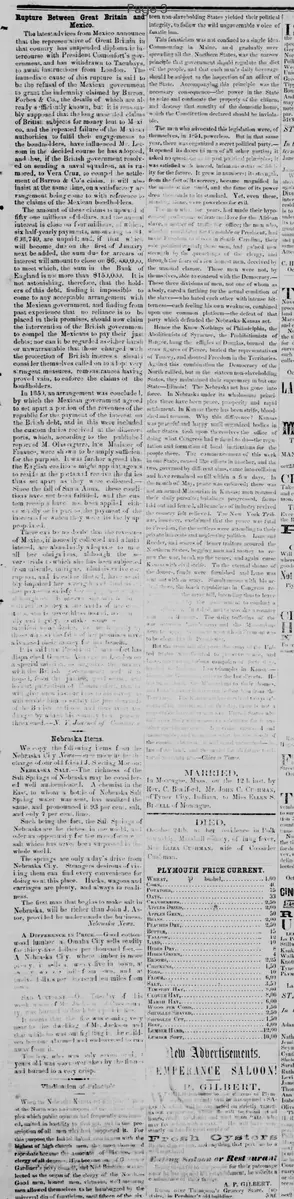
When the Nebraska-Kansas act at the North who had so doggedly clung to principles which public opinion had frequently condemned, united in hostility to that act, and in the proscription of all men who had supported it. For this purpose the Infidel linked arm in arm with the highest of high church men, the most abandoned reprobate became the associate of Bishops, and clergy of all degrees; Huss became one of General Gardiner's privy council, and Ned Bantine was elected as the organ of the clergy of the North.
Good men, honest men, virtuous, well meaning men allowed themselves to be humbugged by the universal din of fanaticism, until fifteen of the non-slaveholding States yielded their political integrity, to follow the wild ungovernable voice of fanaticism.
This fanaticism was not confined to a single idea. Commencing in Maine, and gradually overspreading all the Northern States, was the narrow principle that government should regulate the diet of the people, and that each man's daily beverage should be subject to the inspection of an officer of the State. Accompanying this principle was the necessary consequence-the power in the State to seize and confiscate the property of the citizen, and destroy that sanctity of the domestic home, which the Constitution declared should be inviolable.
The men who advocated this legislation were, of themselves, in 1854, powerless. But in that same year, there was organized a secret political party. It opened its doors to men of all other parties; it asked no questions as to past political principles; it was satisfied with horrid, infamous oaths of fidelity for the future. It grew in numbers; its strength, from the fact of its secrecy, became magnified in the minds of the timid, and the fame of its power drew thousands to its standard. Yet, even these, standing alone, were powerless for evil.
The men who for years, had made their hypocritical words of fraternal love for the African slave, a matter of traffic for office; the men who, when candidates for Constable or President, had made Free Soil speeches in South Carolina, their sole political capital; by such men, had gained new strength by the preachings of the clergy, and through the ears of a few honest men, deceived by the unusual clamor. These men were not, by themselves, able to contend with the Democracy.
These three divisions of men, not one of whom as a body, cared a farthing for the actual condition of the slaves--who hated each other with intense bitterness-each feeling his own weakness, combined upon one common platform--the defeat of that party which defended the Nebraska-Kansas act.
Hence the Know-Nothings of Philadelphia, the Abolitionists of Syracuse, the Prohibitionists of Bangor, hung the effigies of Douglas, burned the straw figures of Pierce, buried the representatives of Pierce, and shouted Freedom in the Territories.
Against this combination the Democracy of the North rallied, but in the sixteen non-slaveholding States, they maintained their supremacy in but one State--Illinois! The Nebraska act has gone into force. In Nebraska under its wholesome principles there have been peace, prosperity and rapid settlement. In Kansas there has been strife, bloodshed and treason. Why this difference? Kansas was peaceful and happy until organized bodies in other States took upon themselves the office of doing what Congress had refused to do-the regulation and formation of local institutions for the people there. The commencement of this work in one State, caused like efforts in another, and the two, governed by different aims, came into collision and have remained so till within a few days. In the month of May, peace was enforced; there was not an armed Missourian in Kansas: men resumed their daily pursuits; buildings progressed, farms had oat and fence, all branches of industry revived the country felt relieved. The New York Tribune, however, exclaimed that the peace was fatal to Freedom, for the settlers were attending to their private interests and neglecting politics. Lane and Reeder, and scores of lesser traitors scoured the Northern States, begging men and money to renew the war, break up the peace, and again curse Kansas with civil strife. To the eternal shame of the donors, funds were furnished and Lane was sent out with an army. Simultaneous with his arrival, the black Republicans in Congress re-the army bill, intending thus to leave the common to conduct a war. The daily bulletins of the war yet its my a the Miu don't. But they sri aall de jees she ry thU'ni- ted Ste wPectd to reve ae. ahd Lt, enrots campai,ni fntd. heI I s teiumphs in Kamsa- s he laa lr ets. H sthWims tothiphoms. Teriap Iksha'tawr thttaeisnt I'nit.isatwh , te Co it sn th :ii (..ln MHo 4:i!; 4ir be asof the come law fehan, ad th ak shratup t ei trais uta i—Chieqo Tunes
What sub-type of article is it?
What themes does it cover?
What keywords are associated?
What entities or persons were involved?
Where did it happen?
Story Details
Key Persons
Location
Northern States, Nebraska, Kansas, Philadelphia, Syracuse, Bangor, Illinois
Event Date
1854
Story Details
Opposition to the Kansas-Nebraska Act united diverse Northern factions including infidels, clergy, prohibitionists, Know-Nothings, and abolitionists in fanaticism and secrecy, leading to political defeat for Democrats except in Illinois. Nebraska prospered peacefully, while Kansas suffered strife from external interference by groups like Lane's forces, disrupting local institutions.