Thank you for visiting SNEWPapers!
Sign up free
The Massachusetts Spy, And Worcester County Advertiser
Worcester, Worcester County, Massachusetts
What is this article about?
A missionary from New England, residing in Beirut, Syria, writes a letter contrasting Syrian customs with those of America, highlighting differences in writing direction, gender roles, social norms, infrastructure, communication, marriage practices, truthfulness, and moral boundaries, expressing longing for American family virtues.
Clipping
OCR Quality
Full Text
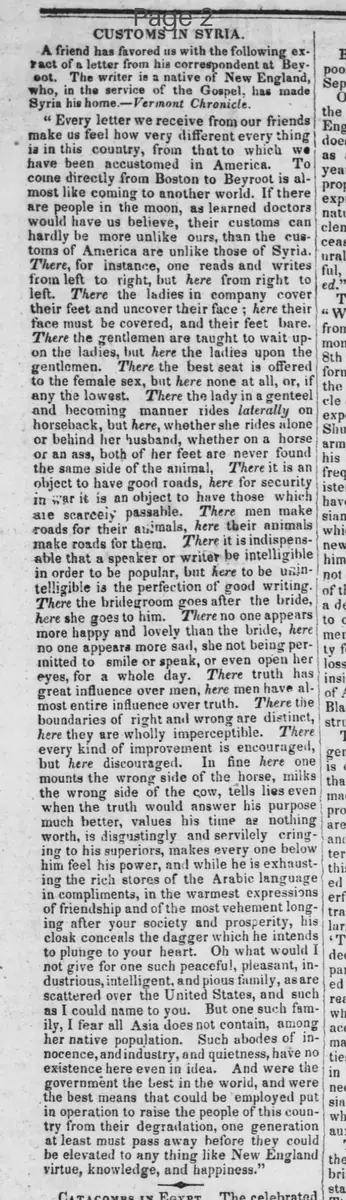
A friend has favored us with the following extract of a letter from his correspondent at Beirut. The writer is a native of New England, who, in the service of the Gospel, has made Syria his home.—Vermont Chronicle.
"Every letter we receive from our friends make us feel how very different every thing is in this country, from that to which we have been accustomed in America. To come directly from Boston to Beirut is almost like coming to another world. If there are people in the moon, as learned doctors would have us believe, their customs can hardly be more unlike ours, than the customs of America are unlike those of Syria. There, for instance, one reads and writes from left to right, but here from right to left. There the ladies in company cover their feet and uncover their face: here their face must be covered, and their feet bare. There the gentlemen are taught to wait upon the ladies, but here the ladies upon the gentlemen. There the best seat is offered to the female sex, but here none at all, or, if any, the lowest. There the lady in a genteel and becoming manner rides laterally on horseback, but here, whether she rides alone or behind her husband, whether on a horse or an ass, both of her feet are never found on the same side of the animal. There it is an object to have good roads, here for security in war it is an object to have those which are scarcely passable. There men make roads for their animals, here their animals make roads for them. There it is indispensable that a speaker or writer be intelligible in order to be popular, but here to be unintelligible is the perfection of good writing. There the bridegroom goes after the bride, here she goes to him. There no one appears more happy and lovely than the bride, here no one appears more sad, she not being permitted to smile or speak, or even open her eyes, for a whole day. There truth has great influence over men, here men have almost entire influence over truth. There the boundaries of right and wrong are distinct, here they are wholly imperceptible. There every kind of improvement is encouraged, but here discouraged. In fine here one mounts the wrong side of the horse, milks the wrong side of the cow, tells lies even when the truth would answer his purpose much better, values his time as nothing worth, is disgustingly and servilely cringing to his superiors, makes every one below him feel his power, and while he is exhausting the rich stores of the Arabic language in compliments, in the warmest expressions of friendship and of the most vehement longing after your society and prosperity, his cloak conceals the dagger which he intends to plunge to your heart. Oh what would I not give for one such peaceful, pleasant, industrious, intelligent, and pious family, as are scattered over the United States, and such as I could name to you. But one such family, I fear all Asia does not contain, among her native population. Such abodes of innocence, and industry, and quietness, have no existence here even in idea. And were the government the best in the world, and were the best means that could be employed put in operation to raise the people of this country from their degradation, one generation at least must pass away before they could be elevated to any thing like New England virtue, knowledge, and happiness.'"
What sub-type of article is it?
What keywords are associated?
Where did it happen?
Foreign News Details
Primary Location
Beirut, Syria
Event Details
Extract of a letter from a New England missionary in Beirut describing stark cultural differences between Syrian and American customs, including writing direction, veiling practices, gender roles, seating, riding styles, road conditions, communication styles, marriage customs, truthfulness, moral boundaries, and social interactions, while lamenting the absence of virtuous families like those in the United States and the challenges of elevating the local population.