Thank you for visiting SNEWPapers!
Sign up free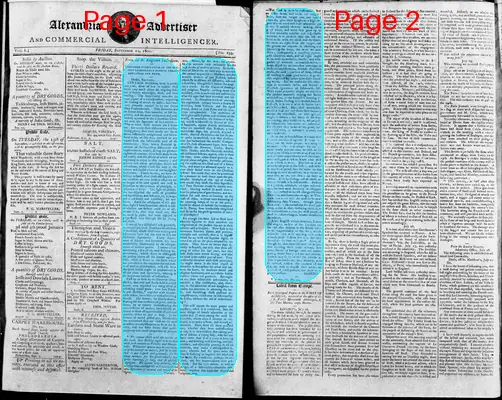
Editorial
September 11, 1801
Alexandria Advertiser And Commercial Intelligencer
Alexandria, Virginia
What is this article about?
Satirical editorial vindicating fashionable female education emphasizing external accomplishments like music, dancing, and embroidery over moral and intellectual development, while praising revealing dress as rational and proper, mocking Enlightenment philosophers and contrasting with ancestors' values.
Merged-components note: Continuation of the satirical editorial on female education and fashion from page 1 to page 2.
Clippings
1 of 2
OCR Quality
98%
Excellent
Full Text
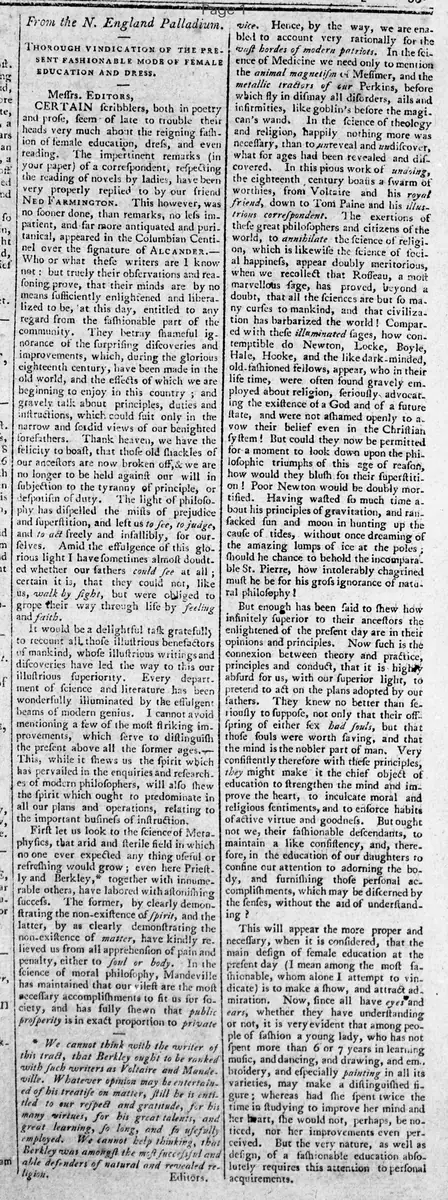
From the N. England Palladium.
Thorough Vindication of the present Fashionable Mode of Female Education and Dress.
Messrs. Editors,
CERTAIN scribblers, both in poetry and prose, seem of late to trouble their heads very much about the reigning fashion of female education, dress, and even reading. The impertinent remarks (in your paper) of a correspondent, respecting the reading of novels by ladies, have been very properly replied to by our friend Ned Farmington. This however, was no sooner done, than remarks, no less impertinent, and far more antiquated and puritanical, appeared in the Columbian Centinel over the Signature of ALEXANDER.-- Who or what these writers are I know not : but truly their observations and reasoning prove, that their minds are by no means sufficiently enlightened and liberalized to be, 'at this day, entitled to any regard from the fashionable part of the community. They betray shameful ignorance of the surprising discoveries and improvements, which, during the glorious eighteenth century, have been made in the old world, and the effects of which we are beginning to enjoy in this country ; and gravely talk about principles, duties and instructions, which could suit only in the narrow and sordid views of our benighted forefathers. Thank heaven, we have the felicity to boast, that those old shackles of our ancestors are now broken off.& we are no longer to be held against our will in subjection to the tyranny of principle, or despotism of duty. The light of philosophy has dispelled the mists of prejudice and superstition, and left us to see, to judge, and to act freely and infallibly, for ourselves. Amid the effulgence of this glorious light I have sometimes almost doubted whether our fathers could see at all : certain it is, that they could not, like us, walk by sight, but were obliged to grope their way through life by feeling and faith.
It would be a delightful task gratefully to recount all those illustrious benefactors of mankind, whose illustrious writings and discoveries have led the way to this our illustrious superiority. Every department of science and literature has been wonderfully illuminated by the effulgent beams of modern genius. I cannot avoid mentioning a few of the most striking improvements, which serve to distinguish the present above all the former ages.--- This, while it shews us the spirit which has prevailed in the enquiries and researches of modern philosophers, will also shew the spirit which ought to predominate in all our plans and operations, relating to the important business of instruction.
First let us look to the science of Metaphysics, that arid and sterile field in which no one ever expected any thing useful or refreshing would grow ; even here Priestley and Berkley,* together with innumerable others, have labored with astonishing success. The former, by clearly demonstrating the non-existence of spirit, and the latter, by as clearly demonstrating the non-existence of matter, have kindly relieved us from all apprehension of pain and penalty, either to Soul or body. In the science of moral philosophy, Mandeville has maintained that our vilest are the most necessary accomplishments to fit us for society, and has fully shewn that public prosperity is in exact proportion to private vice. Hence, by the way, we are enabled to account very rationally for the vast hordes of modern patriots. In the science of Medicine we need only to mention the animal magnetism of Mesmer, and the metallic tractors of our Perkins, before which all in ordinary all disorders, ails and infirmities, like goblins before the magician's wand. In the science of theology and religion, happily nothing more was necessary, than to unreveal and undiscover, what for ages had been revealed and discovered. In this pious work of undoing, the eighteenth century boasts a swarm of worthies, from Voltaire and his royal friend, down to Tom Paine and his illustrious correspondent. The exertions of these great philosophers and citizens of the world, to annihilate the science of religion, which is likewise the science of social happiness, appear doubly meritorious, when we recollect that Rousseau, a most marvellous sage, has proved, beyond a doubt. that all the sciences are but so many curses to mankind, and that civilization has barbarized the world! Compared with these illuminated sages, how contemptible do Newton, Locke, Boyle, Hale, Hooke, and the like dark-minded. old-fashioned fellows, appear, who in their life time, were often found gravely employed about religion, seriously advocating the existence of a God and of a future state, and were not ashamed openly to avow their belief even in the Christian system! But could they now be permitted for a moment to look down upon the philosophic triumphs of this age of reason, how would they blush for their superstition ! Poor Newton would be doubly mortified. Having wasted so much time about his principles of gravitation, and ransacked sun and moon in hunting up the cause of tides, without once dreaming of the amazing lumps of ice at the poles ; should he chance to behold the incomparable St. Pierre, how intolerably chagrined must he be for his gross ignorance of natural philosophy !
But enough has been said to shew how infinitely superior' to their ancestors the enlightened of the present day are in their opinions and principles. Now such is the connexion between theory and practice. principles and conduct, that it is highly absurd for us, with our superior light, to pretend to act on the plans adopted by out fathers. They knew no better than to seriously suppose, not only that their offspring of either sex had souls, but that those souls were worth saving, and that the mind is the nobler part of man. Very consistently therefore with these principles, they might make it the chief object of education to strengthen the mind and improve the heart, to inculcate moral and religious sentiments, and to enforce habits of active virtue and goodness. But ought not we, their fashionable descendants, to maintain a like consistency, and, therefore, in the education of our daughters to confine our attention to adorning the body, and furnishing those personal accomplishments, which may be discerned by the senses, without the aid of understanding ?
This will appear the more proper and necessary, when it is considered, that the main design of female education at the present day (I mean among the most fashionable, whom alone I attempt to vindicate) is to make a show, and attract admiration. Now, since all have eyes and ears, whether they have understanding or not, it is very evident that among people of fashion a young lady, who has not spent more than 6 or 7 years in learning music, and dancing, and drawing, and embroidery, and especially painting in all its varieties, may make a distinguished figure; whereas had she spent twice the time in studying to improve her mind and her heart, she would not, perhaps, be noticed, nor her improvements even perceived. But the very nature, as well as design, of a fashionable education absolutely requires this attention to personal acquirements.
Editors.
For what is it to be fashionable, but so differ from, and outdo the vulgar?
Now, since the vulgar can, and indeed often do, give their daughters a high degree of mind and heart education (as it may be called) thereby making them good wives, and when they grow up to be sure tolerably amiable and respectable women: it is evident that the less we have to do with the mind and the heart, the more we differ from the vulgar, and the greater our expense in adorning and improving the body, the more we outdo them; consequently a completely fashionable education must, and of right ought to be made up entirely, totally, and altogether of external accomplishments.
Some object to an exclusive attention to these accomplishments, because that even music, the most important of them, instead of tending to make good wives, is generally neglected by ladies upon their becoming wives. But the reason for this objection is extremely futile, and betrays a clownish ignorance of fashionable life. With equal propriety might we object to the prudent matron's stringing her butter with saffron, or the butcher's bloating his meat, before sending it to market, because forsooth, it is not a whit the better for it after being sold. Had these accomplishments a tendency to prevent their becoming wives, the objection, on that ground, might be serious; but since, so far from preventing, they facilitate it, all purposes of fashionable education are answered; for whether they make wives, good, bad, or indifferent, is nobody's concern but their husbands.
As to the present fashion of female dress so much declaimed against, I think nothing can be more proper, becoming or rational. That it is proper for our climate clearly appears from the dress of the aborigines of this country, who, from long and intimate acquaintance with the climate may be supposed best to know what dress is most suitable to it. This custom is admirably adapted to the season, and although it may be objected that the ladies by thus seeking to cool themselves, may chance to over-heat others, yet this is no fault of theirs. It is becoming, and of course rational, because it is fashionable. Fashion is a goddess, which, in all ages and nations, has been most devoutly worshipped. She may indeed be no less changeable than Proteus, and sometimes as ugly as Vulcan, yet never will she cease to be more fascinating than Venus.
Though Joel Barlow, in his enthusiasm for hair powdering, declared, that, forsaking his God, he should substitute a cow, yet most people, it must be acknowledged, betake themselves to fashion.
A late English writer, however, I mean the elegant author of the Looker-On, imputes this fashion in the British ladies to the magnanimity of the sex; which, while the men were exposing their necks abroad, made it seem but fair, that they should do the same at home. Now, although no American citizens are at present exposing their necks abroad, how many over of foreign ones are endangering theirs here; yet our fair country-women may so far exceed the British ladies in patriotism and magnanimity, as to be induced, without the example of our sex, not only to expose their necks, regardless of consequences, but their transparent persons.
ALBEDO.
Looker-On, No. 53.
Thorough Vindication of the present Fashionable Mode of Female Education and Dress.
Messrs. Editors,
CERTAIN scribblers, both in poetry and prose, seem of late to trouble their heads very much about the reigning fashion of female education, dress, and even reading. The impertinent remarks (in your paper) of a correspondent, respecting the reading of novels by ladies, have been very properly replied to by our friend Ned Farmington. This however, was no sooner done, than remarks, no less impertinent, and far more antiquated and puritanical, appeared in the Columbian Centinel over the Signature of ALEXANDER.-- Who or what these writers are I know not : but truly their observations and reasoning prove, that their minds are by no means sufficiently enlightened and liberalized to be, 'at this day, entitled to any regard from the fashionable part of the community. They betray shameful ignorance of the surprising discoveries and improvements, which, during the glorious eighteenth century, have been made in the old world, and the effects of which we are beginning to enjoy in this country ; and gravely talk about principles, duties and instructions, which could suit only in the narrow and sordid views of our benighted forefathers. Thank heaven, we have the felicity to boast, that those old shackles of our ancestors are now broken off.& we are no longer to be held against our will in subjection to the tyranny of principle, or despotism of duty. The light of philosophy has dispelled the mists of prejudice and superstition, and left us to see, to judge, and to act freely and infallibly, for ourselves. Amid the effulgence of this glorious light I have sometimes almost doubted whether our fathers could see at all : certain it is, that they could not, like us, walk by sight, but were obliged to grope their way through life by feeling and faith.
It would be a delightful task gratefully to recount all those illustrious benefactors of mankind, whose illustrious writings and discoveries have led the way to this our illustrious superiority. Every department of science and literature has been wonderfully illuminated by the effulgent beams of modern genius. I cannot avoid mentioning a few of the most striking improvements, which serve to distinguish the present above all the former ages.--- This, while it shews us the spirit which has prevailed in the enquiries and researches of modern philosophers, will also shew the spirit which ought to predominate in all our plans and operations, relating to the important business of instruction.
First let us look to the science of Metaphysics, that arid and sterile field in which no one ever expected any thing useful or refreshing would grow ; even here Priestley and Berkley,* together with innumerable others, have labored with astonishing success. The former, by clearly demonstrating the non-existence of spirit, and the latter, by as clearly demonstrating the non-existence of matter, have kindly relieved us from all apprehension of pain and penalty, either to Soul or body. In the science of moral philosophy, Mandeville has maintained that our vilest are the most necessary accomplishments to fit us for society, and has fully shewn that public prosperity is in exact proportion to private vice. Hence, by the way, we are enabled to account very rationally for the vast hordes of modern patriots. In the science of Medicine we need only to mention the animal magnetism of Mesmer, and the metallic tractors of our Perkins, before which all in ordinary all disorders, ails and infirmities, like goblins before the magician's wand. In the science of theology and religion, happily nothing more was necessary, than to unreveal and undiscover, what for ages had been revealed and discovered. In this pious work of undoing, the eighteenth century boasts a swarm of worthies, from Voltaire and his royal friend, down to Tom Paine and his illustrious correspondent. The exertions of these great philosophers and citizens of the world, to annihilate the science of religion, which is likewise the science of social happiness, appear doubly meritorious, when we recollect that Rousseau, a most marvellous sage, has proved, beyond a doubt. that all the sciences are but so many curses to mankind, and that civilization has barbarized the world! Compared with these illuminated sages, how contemptible do Newton, Locke, Boyle, Hale, Hooke, and the like dark-minded. old-fashioned fellows, appear, who in their life time, were often found gravely employed about religion, seriously advocating the existence of a God and of a future state, and were not ashamed openly to avow their belief even in the Christian system! But could they now be permitted for a moment to look down upon the philosophic triumphs of this age of reason, how would they blush for their superstition ! Poor Newton would be doubly mortified. Having wasted so much time about his principles of gravitation, and ransacked sun and moon in hunting up the cause of tides, without once dreaming of the amazing lumps of ice at the poles ; should he chance to behold the incomparable St. Pierre, how intolerably chagrined must he be for his gross ignorance of natural philosophy !
But enough has been said to shew how infinitely superior' to their ancestors the enlightened of the present day are in their opinions and principles. Now such is the connexion between theory and practice. principles and conduct, that it is highly absurd for us, with our superior light, to pretend to act on the plans adopted by out fathers. They knew no better than to seriously suppose, not only that their offspring of either sex had souls, but that those souls were worth saving, and that the mind is the nobler part of man. Very consistently therefore with these principles, they might make it the chief object of education to strengthen the mind and improve the heart, to inculcate moral and religious sentiments, and to enforce habits of active virtue and goodness. But ought not we, their fashionable descendants, to maintain a like consistency, and, therefore, in the education of our daughters to confine our attention to adorning the body, and furnishing those personal accomplishments, which may be discerned by the senses, without the aid of understanding ?
This will appear the more proper and necessary, when it is considered, that the main design of female education at the present day (I mean among the most fashionable, whom alone I attempt to vindicate) is to make a show, and attract admiration. Now, since all have eyes and ears, whether they have understanding or not, it is very evident that among people of fashion a young lady, who has not spent more than 6 or 7 years in learning music, and dancing, and drawing, and embroidery, and especially painting in all its varieties, may make a distinguished figure; whereas had she spent twice the time in studying to improve her mind and her heart, she would not, perhaps, be noticed, nor her improvements even perceived. But the very nature, as well as design, of a fashionable education absolutely requires this attention to personal acquirements.
Editors.
For what is it to be fashionable, but so differ from, and outdo the vulgar?
Now, since the vulgar can, and indeed often do, give their daughters a high degree of mind and heart education (as it may be called) thereby making them good wives, and when they grow up to be sure tolerably amiable and respectable women: it is evident that the less we have to do with the mind and the heart, the more we differ from the vulgar, and the greater our expense in adorning and improving the body, the more we outdo them; consequently a completely fashionable education must, and of right ought to be made up entirely, totally, and altogether of external accomplishments.
Some object to an exclusive attention to these accomplishments, because that even music, the most important of them, instead of tending to make good wives, is generally neglected by ladies upon their becoming wives. But the reason for this objection is extremely futile, and betrays a clownish ignorance of fashionable life. With equal propriety might we object to the prudent matron's stringing her butter with saffron, or the butcher's bloating his meat, before sending it to market, because forsooth, it is not a whit the better for it after being sold. Had these accomplishments a tendency to prevent their becoming wives, the objection, on that ground, might be serious; but since, so far from preventing, they facilitate it, all purposes of fashionable education are answered; for whether they make wives, good, bad, or indifferent, is nobody's concern but their husbands.
As to the present fashion of female dress so much declaimed against, I think nothing can be more proper, becoming or rational. That it is proper for our climate clearly appears from the dress of the aborigines of this country, who, from long and intimate acquaintance with the climate may be supposed best to know what dress is most suitable to it. This custom is admirably adapted to the season, and although it may be objected that the ladies by thus seeking to cool themselves, may chance to over-heat others, yet this is no fault of theirs. It is becoming, and of course rational, because it is fashionable. Fashion is a goddess, which, in all ages and nations, has been most devoutly worshipped. She may indeed be no less changeable than Proteus, and sometimes as ugly as Vulcan, yet never will she cease to be more fascinating than Venus.
Though Joel Barlow, in his enthusiasm for hair powdering, declared, that, forsaking his God, he should substitute a cow, yet most people, it must be acknowledged, betake themselves to fashion.
A late English writer, however, I mean the elegant author of the Looker-On, imputes this fashion in the British ladies to the magnanimity of the sex; which, while the men were exposing their necks abroad, made it seem but fair, that they should do the same at home. Now, although no American citizens are at present exposing their necks abroad, how many over of foreign ones are endangering theirs here; yet our fair country-women may so far exceed the British ladies in patriotism and magnanimity, as to be induced, without the example of our sex, not only to expose their necks, regardless of consequences, but their transparent persons.
ALBEDO.
Looker-On, No. 53.
What sub-type of article is it?
Satire
Education
Moral Or Religious
What keywords are associated?
Female Education
Fashionable Dress
Enlightenment Satire
Moral Philosophy
External Accomplishments
Fashion Worship
What entities or persons were involved?
Albedo
Ned Farmington
Alexander
Priestley
Berkley
Mandeville
Mesmer
Perkins
Voltaire
Tom Paine
Rousseau
Newton
Locke
Joel Barlow
Editorial Details
Primary Topic
Vindication Of Fashionable Female Education And Dress
Stance / Tone
Satirical Defense Of Superficial Accomplishments And Revealing Fashion
Key Figures
Albedo
Ned Farmington
Alexander
Priestley
Berkley
Mandeville
Mesmer
Perkins
Voltaire
Tom Paine
Rousseau
Newton
Locke
Joel Barlow
Key Arguments
Modern Philosophy Has Liberated From Ancestral Principles And Duties
Enlightenment Discoveries Prove Superiority Over Past Ages
Female Education Should Focus On External Accomplishments To Attract Admiration And Differ From The Vulgar
Fashionable Dress Is Proper, Becoming, And Rational, Emulating Aborigines And Surpassing British Patriotism
Accomplishments Facilitate Marriage, Regardless Of Making Good Wives