Thank you for visiting SNEWPapers!
Sign up free
Story
May 4, 1955
The Key West Citizen
Key West, Monroe County, Florida
What is this article about?
Post-AFL-CIO merger, U.S. labor leaders like George Meany vow independence from political parties, rejecting a British-style labor party, while planning increased nonpartisan action favoring Democrats in 1956 elections. (187 chars)
Clipping
OCR Quality
98%
Excellent
Full Text
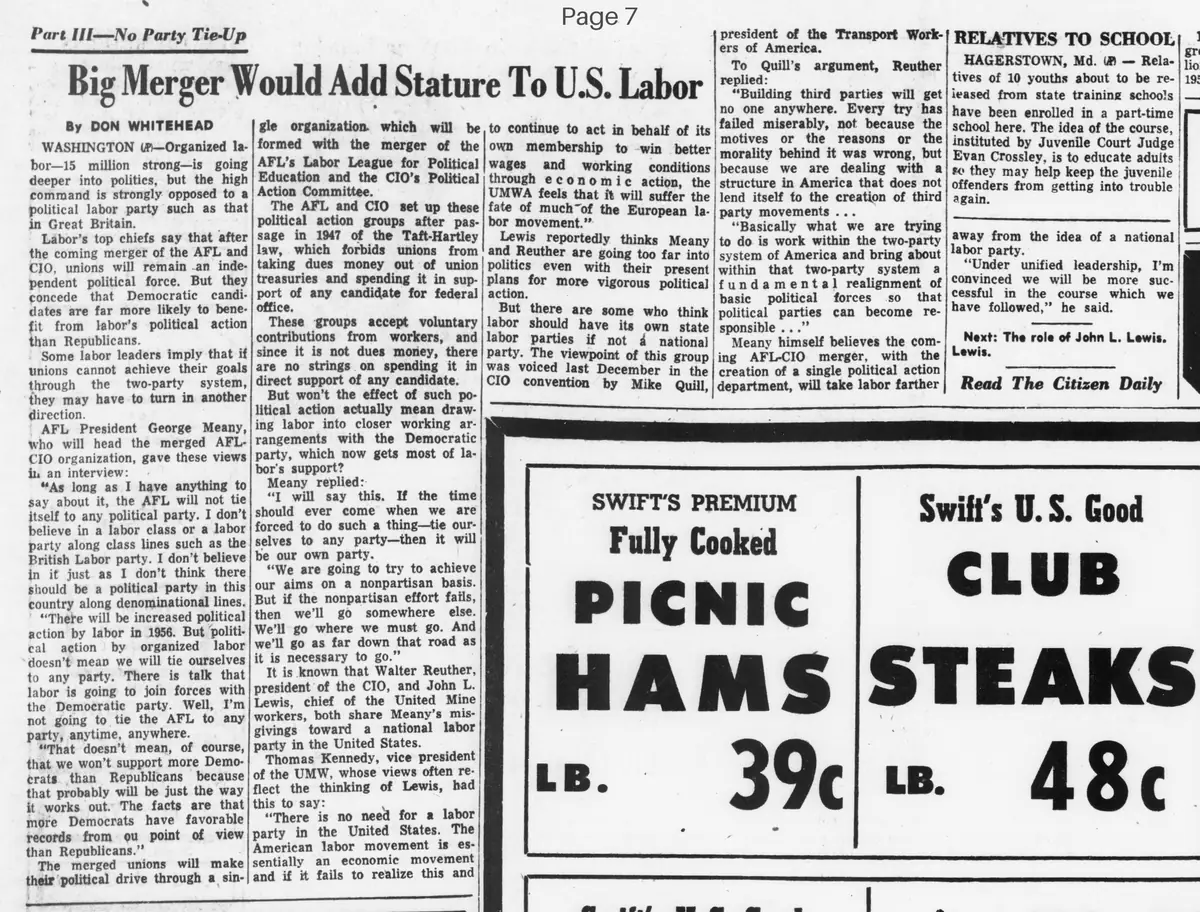
Part III—No Party Tie-Up
Big Merger Would Add Stature To U.S. Labor
By Don Whitehead
WASHINGTON (P) Organized labor—15 million strong—is going deeper into politics, but the high command is strongly opposed to a political labor party such as that in Great Britain.
Labor's top chiefs say that after the coming merger of the AFL and CIO, unions will remain an independent political force. But they concede that Democratic candidates are far more likely to benefit from labor's political action than Republicans.
Some labor leaders imply that if unions cannot achieve their goals through the two-party system, they may have to turn in another direction.
AFL President George Meany, who will head the merged AFL-CIO organization, gave these views in an interview:
"As long as I have anything to say about it, the AFL will not tie itself to any political party. I don't believe in a labor class or a labor party along class lines such as the British Labor party. I don't believe in it just as I don't think there should be a political party in this country along denominational lines.
"There will be increased political action by labor in 1956. But political action by organized labor doesn't mean we will tie ourselves to any party. There is talk that labor is going to join forces with the Democratic party. Well, I'm not going to tie the AFL to any party, anytime, anywhere.
"That doesn't mean, of course, that we won't support more Democrats than Republicans because that probably will be just the way it works out. The facts are that more Democrats have favorable records from our point of view than Republicans."
The merged unions will make their political drive through a single organization, which will be formed with the merger of the AFL's Labor League for Political Education and the CIO's Political Action Committee.
The AFL and CIO set up these political action groups after passage in 1947 of the Taft-Hartley law, which forbids unions from taking dues money out of union treasuries and spending it in support of any candidate for federal office.
These groups accept voluntary contributions from workers, and since it is not dues money, there are no strings on spending it in direct support of any candidate.
But won't the effect of such political action actually mean drawing labor into closer working arrangements with the Democratic party, which now gets most of labor's support?
Meany replied:
"I will say this. If the time should ever come when we are forced to do such a thing—tie ourselves to any party—then it will be our own party.
"We are going to try to achieve our aims on a nonpartisan basis. But if the nonpartisan effort fails, then we'll go somewhere else. We'll go where we must go. And we'll go as far down that road as it is necessary to go."
It is known that Walter Reuther, president of the CIO, and John L. Lewis, chief of the United Mine Workers, both share Meany's misgivings toward a national labor party in the United States.
Thomas Kennedy, vice president of the UMW, whose views often reflect the thinking of Lewis, had this to say:
"There is no need for a labor party in the United States. The American labor movement is essentially an economic movement and if it fails to realize this and to continue to act in behalf of its own membership to win better wages and working conditions through economic action, the UMWA feels that it will suffer the fate of much of the European labor movement."
Lewis reportedly thinks Meany and Reuther are going too far into politics even with their present plans for more vigorous political action.
But there are some who think labor should have its own state labor parties if not a national party. The viewpoint of this group was voiced last December in the CIO convention by Mike Quill, president of the Transport Workers of America.
To Quill's argument, Reuther replied:
"Building third parties will get no one anywhere. Every try has failed miserably, not because the motives or the reasons or the morality behind it was wrong, but because we are dealing with a structure in America that does not lend itself to the creation of third party movements.
"Basically what we are trying to do is work within the two-party system of America and bring about within that two-party system a fundamental realignment of basic political forces so that political parties can become responsible.
Meany himself believes the coming AFL-CIO merger, with the creation of a single political action department, will take labor farther away from the idea of a national labor party.
"Under unified leadership, I'm convinced we will be more successful in the course which we have followed," he said.
Next: The role of John L. Lewis.
Lewis.
Big Merger Would Add Stature To U.S. Labor
By Don Whitehead
WASHINGTON (P) Organized labor—15 million strong—is going deeper into politics, but the high command is strongly opposed to a political labor party such as that in Great Britain.
Labor's top chiefs say that after the coming merger of the AFL and CIO, unions will remain an independent political force. But they concede that Democratic candidates are far more likely to benefit from labor's political action than Republicans.
Some labor leaders imply that if unions cannot achieve their goals through the two-party system, they may have to turn in another direction.
AFL President George Meany, who will head the merged AFL-CIO organization, gave these views in an interview:
"As long as I have anything to say about it, the AFL will not tie itself to any political party. I don't believe in a labor class or a labor party along class lines such as the British Labor party. I don't believe in it just as I don't think there should be a political party in this country along denominational lines.
"There will be increased political action by labor in 1956. But political action by organized labor doesn't mean we will tie ourselves to any party. There is talk that labor is going to join forces with the Democratic party. Well, I'm not going to tie the AFL to any party, anytime, anywhere.
"That doesn't mean, of course, that we won't support more Democrats than Republicans because that probably will be just the way it works out. The facts are that more Democrats have favorable records from our point of view than Republicans."
The merged unions will make their political drive through a single organization, which will be formed with the merger of the AFL's Labor League for Political Education and the CIO's Political Action Committee.
The AFL and CIO set up these political action groups after passage in 1947 of the Taft-Hartley law, which forbids unions from taking dues money out of union treasuries and spending it in support of any candidate for federal office.
These groups accept voluntary contributions from workers, and since it is not dues money, there are no strings on spending it in direct support of any candidate.
But won't the effect of such political action actually mean drawing labor into closer working arrangements with the Democratic party, which now gets most of labor's support?
Meany replied:
"I will say this. If the time should ever come when we are forced to do such a thing—tie ourselves to any party—then it will be our own party.
"We are going to try to achieve our aims on a nonpartisan basis. But if the nonpartisan effort fails, then we'll go somewhere else. We'll go where we must go. And we'll go as far down that road as it is necessary to go."
It is known that Walter Reuther, president of the CIO, and John L. Lewis, chief of the United Mine Workers, both share Meany's misgivings toward a national labor party in the United States.
Thomas Kennedy, vice president of the UMW, whose views often reflect the thinking of Lewis, had this to say:
"There is no need for a labor party in the United States. The American labor movement is essentially an economic movement and if it fails to realize this and to continue to act in behalf of its own membership to win better wages and working conditions through economic action, the UMWA feels that it will suffer the fate of much of the European labor movement."
Lewis reportedly thinks Meany and Reuther are going too far into politics even with their present plans for more vigorous political action.
But there are some who think labor should have its own state labor parties if not a national party. The viewpoint of this group was voiced last December in the CIO convention by Mike Quill, president of the Transport Workers of America.
To Quill's argument, Reuther replied:
"Building third parties will get no one anywhere. Every try has failed miserably, not because the motives or the reasons or the morality behind it was wrong, but because we are dealing with a structure in America that does not lend itself to the creation of third party movements.
"Basically what we are trying to do is work within the two-party system of America and bring about within that two-party system a fundamental realignment of basic political forces so that political parties can become responsible.
Meany himself believes the coming AFL-CIO merger, with the creation of a single political action department, will take labor farther away from the idea of a national labor party.
"Under unified leadership, I'm convinced we will be more successful in the course which we have followed," he said.
Next: The role of John L. Lewis.
Lewis.
What sub-type of article is it?
Historical Event
What themes does it cover?
Justice
Social Manners
What keywords are associated?
Afl Cio Merger
Labor Politics
Political Action
Labor Party Opposition
Democratic Support
What entities or persons were involved?
George Meany
Walter Reuther
John L. Lewis
Thomas Kennedy
Mike Quill
Where did it happen?
Washington
Story Details
Key Persons
George Meany
Walter Reuther
John L. Lewis
Thomas Kennedy
Mike Quill
Location
Washington
Story Details
Organized labor opposes forming a U.S. labor party, favoring independent political action within the two-party system after AFL-CIO merger, with leaders like Meany, Reuther, and Lewis emphasizing nonpartisan support likely benefiting Democrats.