Thank you for visiting SNEWPapers!
Sign up free
The Bismarck Tribune
Bismarck, Mandan, Burleigh County, Morton County, North Dakota
What is this article about?
Political columnist Rodney Dutcher speculates that Senator Simeon D. Fess's appointment as Republican National Convention keynoter is a calculated effort by Calvin Coolidge supporters to boost his renomination chances and weaken Herbert Hoover's delegate support, despite Fess's lack of oratorical prestige and his public admission of lying to aid Coolidge.
Clipping
OCR Quality
Full Text
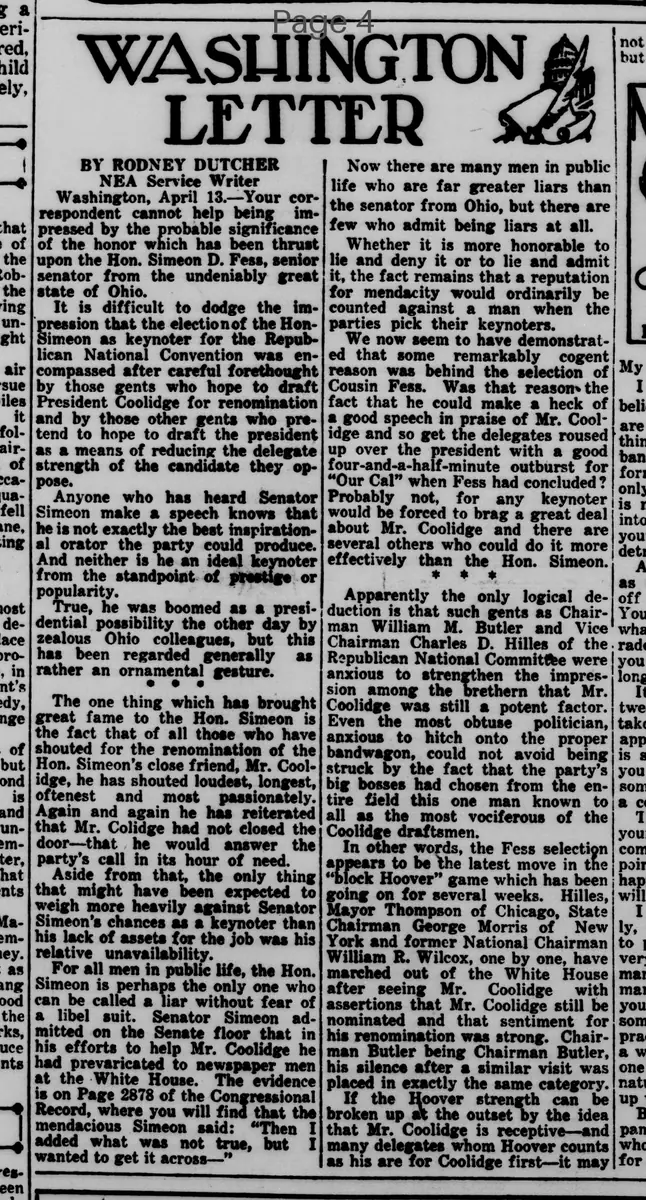
BY RODNEY DUTCHER
NEA Service Writer
Washington, April 13.-Your correspondent cannot help being impressed by the probable significance of the honor which has been thrust upon the Hon. Simeon D. Fess, senior senator from the undeniably great state of Ohio.
It is difficult to dodge the impression that the election of the Hon. Simeon as keynoter for the Republican National Convention was encompassed after careful forethought by those gents who hope to draft President Coolidge for renomination and by those other gents who pretend to hope to draft the president as a means of reducing the delegate strength of the candidate they oppose.
Anyone who has heard Senator Simeon make a speech knows that he is not exactly the best inspirational orator the party could produce. And neither is he an ideal keynoter from the standpoint of prestige or popularity.
True, he was boomed as a presidential possibility the other day by zealous Ohio colleagues, but this has been regarded generally as rather an ornamental gesture.
The one thing which has brought great fame to the Hon. Simeon is the fact that of all those who have shouted for the renomination of the Hon. Simeon's close friend. Mr. Coolidge, he has shouted loudest, longest, oftenest and most passionately.
Again and again he has reiterated that Mr. Coolidge had not closed the door-that he would answer the party's call in its hour of need.
Aside from that, the only thing that might have been expected to weigh more heavily against Senator Simeon's chances as a keynoter than his lack of assets for the job was his relative unavailability.
For all men in public life, the Hon. Simeon is perhaps the only one who can be called a liar without fear of a libel suit. Senator Simeon admitted on the Senate floor that in his efforts to help Mr. Coolidge he had prevaricated to newspaper men at the White House. The evidence is on Page 2878 of the Congressional Record, where you will find that the mendacious Simeon said: "Then added what was not true, but I wanted to get it across-"
Now there are many men in public life who are far greater liars than the senator from Ohio, but there are few who admit being liars at all.
Whether it is more honorable to lie and deny it or to lie and admit it, the fact remains that a reputation for mendacity would ordinarily be counted against a man when the parties pick their keynoters.
We now seem to have demonstrated that some remarkably cogent reason was behind the selection of Cousin Fess. Was that reason the fact that he could make a heck of a good speech in praise of Mr. Coolidge and so get the delegates roused up over the president with a good four-and-a-half-minute outburst for "Our Cal" when Fess had concluded?
Probably not, for any keynoter would be forced to brag a great deal about Mr. Coolidge and there are several others who could do it more effectively than the Hon. Simeon.
Apparently the only logical deduction is that such gents as Chairman William M. Butler and Vice Chairman Charles D. Hilles of the Republican National Committee were anxious to strengthen the impression among the brethren that Mr. Coolidge was still a potent factor.
Even the most obtuse politician, anxious to hitch onto the proper bandwagon, could not avoid being struck by the fact that the party's big bosses had chosen from the entire field this one man known to all as the most vociferous of the Coolidge draftsmen.
In other words, the Fess selection appears to be the latest move in the "block Hoover" game which has been going on for several weeks. Hilles, Mayor Thompson of Chicago, State Chairman George Morris of New York and former National Chairman William R. Wilcox, one by one, have marched out of the White House after seeing Mr. Coolidge with assertions that Mr. Coolidge still be nominated and that sentiment for his renomination was strong. Chairman Butler being Chairman Butler, his silence after a similar visit was placed in exactly the same category.
If the Hoover strength can be broken up at the outset by the idea that Mr. Coolidge is receptive--and many delegates whom Hoover counts on might switch--the Coolidge boom would be off to a running start.
What sub-type of article is it?
What themes does it cover?
What keywords are associated?
What entities or persons were involved?
Where did it happen?
Story Details
Key Persons
Location
Washington
Event Date
April 13
Story Details
Rodney Dutcher analyzes the selection of Senator Simeon D. Fess as keynoter for the Republican National Convention as a strategic move by Coolidge supporters to promote his renomination and undermine Hoover's candidacy, highlighting Fess's vocal support for Coolidge and his admitted prevarication to reporters.